 look news india

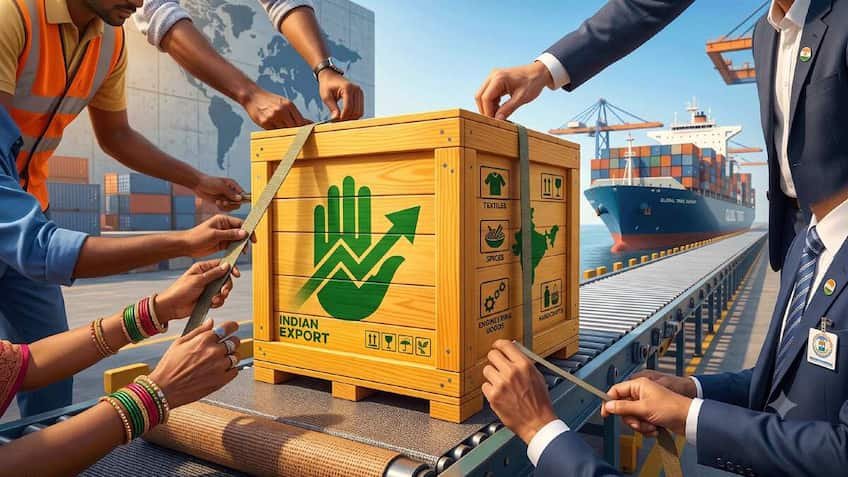
Despite the ongoing geopolitical turmoil across the world, logistics disruptions from the Red Sea to the Strait of Hormuz and expensive ocean freight, the Indian engineering industry has proved its mettle in the global market. According to the latest data released by the Engineering Export Promotion Council of India (EEPC India), the country’s engineering exports have seen a strong jump of 18 percent on an annual basis in the month of July, reaching the level of $ 12.24 billion (about ₹ 1.02 lakh crore). In the same period last year (July 2025), this figure was $ 10.40 billion. This is the fourth consecutive month that the country’s engineering shipments have remained above the $10 billion benchmark, reflecting the global competitiveness of the Indian manufacturing sector.
Crossed the figure of $46.38 billion in four months: 27.7% share in the country’s total exports
According to quick estimates of the Commerce Ministry, the engineering sector continued to dominate the country’s total merchandise exports in July. Of India’s total merchandise exports of $44.24 billion, engineering products alone accounted for 27.7 percent.
Talking about the cumulative period of the first four months of the current financial year (FY27) i.e. April to July, the total engineering exports increased by 18.21 percent to $ 46.38 billion, whereas in the same period of the last financial year it was $ 39.24 billion. In this way, Indian exporters have achieved additional business of $ 7.14 billion from global markets as compared to last year within four months.
America and China became the biggest growth drivers
The United States (US) remains the largest and preferred destination for Indian engineering products. Engineering exports to America registered a 20 percent increase in July and reached $2.18 billion. During April-July, exports to the US totaled $7.78 billion, showing an annual growth of 11.8 percent.
At the same time, there was tremendous demand for Indian engineering goods from the Chinese market also. Engineering exports to China jumped 32 percent to $349 million ($349 million) in July. Apart from this, strong consumption of Indian industrial machinery, auto components and electrical equipment was also recorded in developed and strategic markets like Germany, United Kingdom (UK), United Arab Emirates (UAE) and Singapore.
Great growth recorded in 27 out of 34 major product categories
According to EEPC India’s analysis, this growth in July was not limited to any one particular product but was very wide-ranging. Of the total 34 major product panels of the Engineering Council, 27 panels recorded positive growth. Among these, a sharp jump was seen in the shipment of industrial machinery, auto parts, electrical machinery, non-ferrous metals, copper and aluminum products and medical devices.
However, 7 key categories witnessed decline due to global economic slowdown and subdued local demand. These included iron and steel products, lead and related products, machine tools, aircraft and spacecraft parts, heavy cranes, lifts and office equipment. Additionally, project-based engineering exports to Saudi Arabia recorded some pressure due to ongoing tensions in the Middle East and the logistics crisis at the Strait of Hormuz.
Global challenges and obstacles faced by exporters
While praising this strong performance, EEPC India Chairman Pankaj Chadha also alerted about the emerging challenges at the global level. He underlined that rising international energy costs, high container freight, protectionist trade policies of developed countries and stringent technical and carbon compliance standards (such as CBAM) being imposed by the European Union are increasing logistics costs for Indian exporters.
The organization believes that to sustain this strong export momentum throughout the financial year, Indian manufacturers will have to expand the scale of production, increase investment on modern R&D and technology upgradation and diversify their export basket to non-traditional markets such as African and Latin American. Timely implementation of export promotion schemes (like RoDTEP) and new free trade agreements (FTAs) by the government can prove to be a game-changer in keeping this momentum sustainable.