 look news india

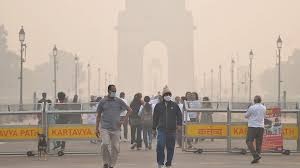
News India Live, Digital Desk: The Supreme Court has once again taken a very strict stance in the case of air pollution which has reached life-threatening levels in Delhi and the National Capital Region (NCR). While hearing the petitions related to this case on Monday, the court expressed deep displeasure over the lax attitude of the officials and the government. The court clearly said that “reports upon reports” are coming regarding pollution, but no concrete action is visible on the ground.
The hearing took place at a time when Delhi’s air remained in the ‘very poor’ category and the city was shrouded in thick smog.
“Many monitor stations are not working.”
During the hearing, the Supreme Court was informed that many air quality monitor stations that check the pollution level in the capital are not working, making it difficult to ascertain the actual status of pollution. A lawyer told the court that on the day of Diwali, only 9 out of 37 monitor stations in Delhi were operational. The court expressed surprise at this and said, “If the stations themselves do not function, how will we know when to implement GRAP (Graded Response Action Plan)? This is a serious situation.”
Court’s strict comment on lax attitude of officers
The Supreme Court also commented strongly on the lax attitude of the Commission for Air Quality Management (CAQM) formed to deal with pollution. The court said that instead of waiting for the pollution to reach ‘severe’ levels, precautionary measures should have been taken before the situation was likely to worsen.
Chief Justice B. R. A bench headed by Gavai said, “This is a completely wrong approach… You cannot wait for the wind to improve. It is the duty of the Commission to be prepared in advance to implement GRAP-III or GRAP-IV.”
Report sought from CAQM and CPCB
In view of these serious lapses, the Supreme Court has ordered CAQM and the Central Pollution Control Board (CPCB) to immediately file a report. The court has asked in its report to explain what concrete and precautionary steps they are taking to prevent the air quality from deteriorating further.
“Restrictions will not be lifted without the court’s permission.”
The Supreme Court also made it clear that the stringent restrictions on pollution (GRAP-IV) will not be removed unless the court allows it, even if there is some improvement in air quality. This strict stance of the court shows that it is in no mood to leave the people of Delhi-NCR to breathe poisonous air this year.