 look news india

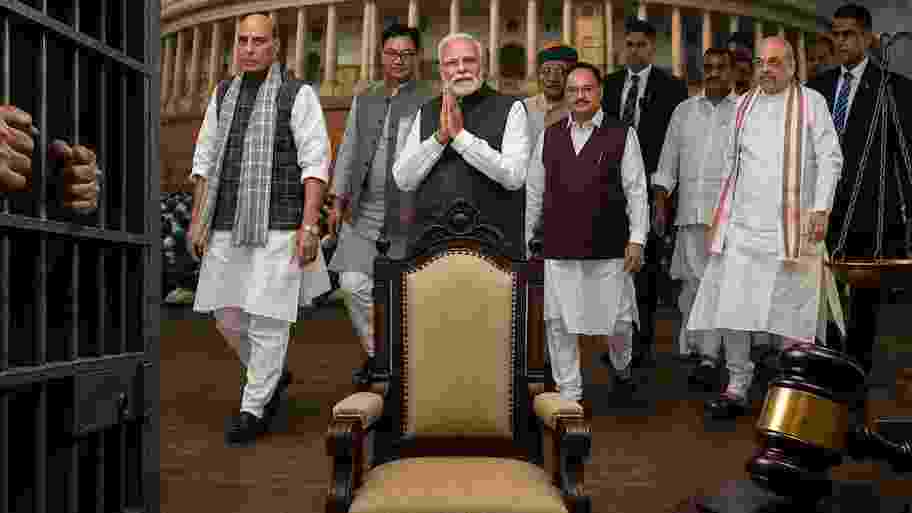
There is going to be a turning point in the history of Indian politics which will change the entire democratic system and political equation of the country forever. The Modi government at the Center is fully prepared to redefine the country’s power system by implementing a very strict and historic law. According to concrete information received from inside sources, the government is going to present the much awaited 130th Constitutional Amendment Bill, 2025 in the monsoon session of Parliament starting from July 20. This law has created a stir in the political circles as soon as it is introduced because it is directly related to the security of the Chief Ministers, Ministers and the chair of the Prime Minister himself.
What is the most surprising provision of this bill?
The most surprising thing about this proposed law is that after its implementation, if any Minister, Chief Minister (CM) or Prime Minister (PM) remains in jail or judicial custody for 30 consecutive days on charges of any serious crime, then his chair will automatically go away. The Joint Parliamentary Committee (JPC), which is closely examining this very stringent law, is going to approve its final report and submit it to the government on July 17, after which it will be tabled in the Parliament.
Home Minister Amit Shah has prepared the outline, know the strict rules
The outline of this historic bill was presented in Parliament by Home Minister Amit Shah in August last year. Mainly three big and strict rules have been set under this law. The first rule is that this law will be applicable to those public representatives who are accused of serious crimes in which there is a provision of jail sentence of 5 years or more. The second rule sets a time limit of 30 days of detention. According to this, if an accused leader remains in police or judicial custody for 30 consecutive days, then on the 31st day of his detention, that leader will automatically be considered expelled from his post. In such a situation, he will have to leave his chair immediately on the instructions of the President or the Governor. The 31-member JPC, headed by BJP MP from Odisha Aparajita Sarangi, is in favor of retaining this stringent provision in the bill completely, although some necessary precautions i.e. safeguards are also being added to prevent its political misuse.
Opposition’s concern and ruling party’s counterattack
In view of the provisions of this law, a huge political conflict has erupted between the ruling party and the opposition. Most of the members of ‘India’ alliance including Congress have completely boycotted the meetings of this JPC. The opposition directly alleges that this committee is only working like a ‘rubber stamp’ of the government. Opposition parties argue that this law is completely undemocratic and a major attack on the federal structure of India. He says that removing any leader from office only on the basis of police or judicial custody, before being proven guilty by the court, is against the principles of natural justice. The biggest fear of the opposition is that this law can be misused to topple opposition governments and harass leaders with the help of central investigative agencies. On the other hand, the ruling alliance (NDA) clearly says that 30 days is a very long time and during this time any accused can apply for bail in the court at least three times. If that leader does not get any relief even from the courts of the country, then only he will lose his chair, hence this law is necessary for correct and corruption-free politics in every sense.
Parliament’s Complete Number Game: Equation of Lok Sabha and Rajya Sabha
Since this is not an ordinary bill but a major Constitution Amendment Bill, to get it passed by the Parliament, the government will have to muster a two-thirds (2/3) majority of the members present and voting in both the Lok Sabha and Rajya Sabha houses. Due to major political defections and upheavals within the country in recent times, the position of NDA has strengthened, but the path still does not look very easy.
The current arithmetic of seats in both the Houses of Parliament is as follows:
| house | Current strength of NDA | Data required for two-thirds majority | How many votes are missing? |
| Lok Sabha | 330 MPs | 362 MPs | 32 votes less |
| Rajya Sabha | 151 MPs (141 + 10 nominated/independent) | 162 MPs | 11 votes less |
Recently, there was a big change in the equations of the Lok Sabha when 20 Lok Sabha MPs of the Trinamool Congress (TMC) switched sides and joined the Nationalist Citizen Party of India (NCPI), which is pro-NDA. Along with this, 6 MPs from Shiv Sena of Uddhav Thackeray faction have also joined Eknath Shinde faction (NDA). Talking about Rajya Sabha, there too 7 MPs of Aam Aadmi Party (AAP) have switched sides and joined BJP, due to which the opposition camp has got a big blow.
Naveen Patnaik and Jagan Mohan Reddy in the role of kingmaker.
Even though in the official figures the government still appears to be a little away from the magical figure of two-thirds, but political experts believe that backdoor channels have become fully active to pass this historic bill. Naveen Patnaik’s Biju Janata Dal (BJD) and Y.S. Jagan Mohan Reddy’s YSR Congress Party (YSRCP) can once again play the role of kingmaker in this great struggle. Both these regional parties have already supported the government in times of crisis on many big and controversial bills (like Delhi Ordinance Bill). If this time too both these parties walk out of the House during voting or vote in favor of the government, then the Modi government will easily create history by making this ‘PM/CM Removal Bill’ a law. This monsoon session starting from July 20 is going to decide the new direction of the country’s politics.