 look news india

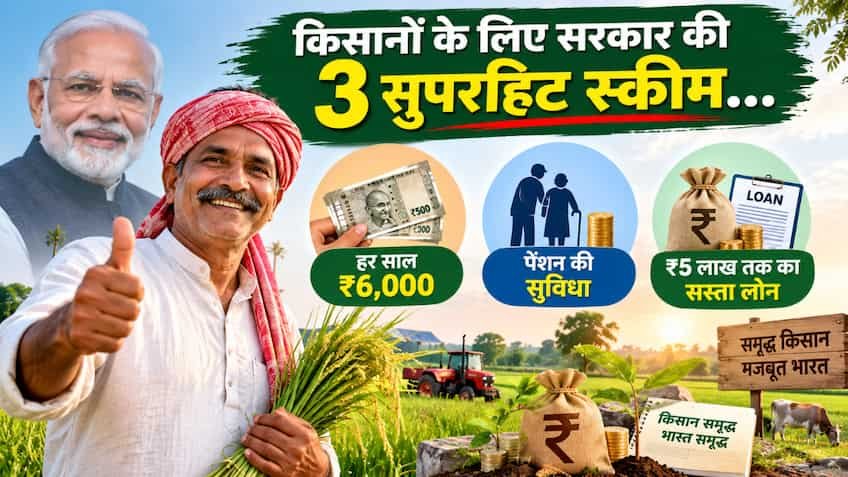
India is an agricultural country and the real backbone of the country’s economy is our farmer brothers. Due to the uncertainty of weather in farming, rising prices of fertilizers and seeds, diesel-irrigation expenses and not getting the right prices for crops in the market, the financial condition of farmers often becomes unstable. Keeping this ground reality in mind, the Central Government has prepared a three-tier safety net of several welfare schemes to economically empower rural India and farmers. From the ravines of Lakhimpur Kheri, Barabanki, Sitapur, Gorakhpur, Varanasi, Prayagraj and Bundelkhand in Uttar Pradesh to Bihar, Madhya Pradesh, Rajasthan, Haryana and Punjab, crores of farmers are improving their lives through these schemes. However, even today, due to lack of correct information and understanding of the process, many small and marginal farmers remain deprived of the full benefits of these schemes. If you also do farming, then three major schemes of the government—Pradhan Mantri Kisan Samman Nidhi (PM-KISAN), Pradhan Mantri Kisan Maandhan Yojana (PM-KMY) and Revised Kisan Credit Card (KCC)—can completely secure your pocket, your farming and your old age.
Among the schemes being run for farmers, ‘Pradhan Mantri Kisan Samman Nidhi’ (PM-KISAN) is the most popular and largest Direct Benefit Transfer (DBT) scheme in the country. The main objective of this scheme is to provide timely cash assistance to small and marginal farmers for purchasing seeds, fertilizers and pesticides at the time of sowing of crops. Under this, direct financial assistance of Rs 6,000 per year is given to eligible landholding farmer families. This amount is transferred directly to the farmer’s Aadhaar-linked bank account in three equal installments a year (₹2,000-₹2,000 every four months). The first installment is released between April-July, the second installment between August-November and the third installment between December-March.
To avail the benefits of this scheme, the government has made three basic formalities mandatory:
-
Active linking of farmer’s bank account with Aadhar card and NPCI mapper.
-
Completing ‘e-KYC’ by visiting PM Kisan Portal (pmkisan.gov.in) or from the nearest Public Service Center (CSC) through Face Authentication or Biometric.
-
Physical and digital verification of the farmer’s land in the revenue records of the state government i.e. ‘Land Seeding’.
If a farmer’s documents are complete, then this ₹ 6,000 reaches his account directly every year without any middleman or commission, thereby eliminating the compulsion of taking loans from moneylenders for small expenses.
Elderly farmers in the unorganized sector engaged in farming do not have any social security or source of monthly income after retirement. To overcome this pain, the Central Government has started ‘Pradhan Mantri Kisan Maandhan Yojana’ (PM-KMY). It is a voluntary and contributory pension scheme, which gives a legal guarantee of an assured pension of Rs 3,000 per month (Rs 36,000 annually) to the farmer throughout his life after he attains the age of 60 years. This scheme can include all those small and marginal farmers in the age group of 18 to 40 years who have cultivable land up to 2 hectares (about 5 acres).
The mathematics of the scheme is extremely simple and practical:
-
Depending on the entry age of the applicant farmer, he has to deposit a nominal premium ranging from Rs 55 to a maximum of Rs 200 every month (only Rs 55 per month at the age of 18 years and Rs 200 per month at the age of 40 years).
-
Whatever amount the farmer deposits from his own pocket, the Central Government deposits the same 50% matching amount in the farmer’s pension account on its own behalf.
-
The most wonderful and convenient rule is that if you are already a beneficiary of PM-Kisan, then you do not need to pay any premium from your pocket. You can get this monthly premium auto-debited from your PM-Kisan’s ₹ 2,000 directly by giving a consent form.
If a pensioner farmer dies after the age of 60, his wife or husband continues to receive 50 percent of the pension i.e. Rs 1,500 per month for life as family pension.
The ‘Kisan Credit Card’ (KCC) scheme is the biggest financial boon to meet the cost of farming and save the farmers from the deadly interest rate of 24% to 36% charged by village moneylenders and moneylenders. In a historic reform in the KCC rules, the Central Government has increased the limit of concessional agricultural loan from ₹ 3 lakh to ₹ 5 lakh directly under the Modified Interest Subvention Scheme (MISS).
The entire mathematics of interest and subsidy under KCC works as follows:
-
Banks generally fix the base rate of 9% on agricultural loans, but the Central Government gives interest subvention of 2% to 3% on it, due to which the initial rate reduces to 7%.
-
Additionally, if a farmer repays his loan principal amount and interest honestly within the due date, the government provides him an additional ‘Prompt Repayment Incentive’ (PRI) of 3%.
-
After this 3% additional discount, the effective interest rate for the farmer falls to only 4 percent per year.
Apart from this, the government has also increased the limit of collateral-free loan from Rs 1.60 lakh to ₹ 2 lakh. Now the scope of KCC is not limited to crop growing only, but farmers can also avail working capital loans at concessional rates for dairy farming, goat rearing, poultry farming, pisciculture and maintenance of agricultural equipment. This card is valid for 5 years and there is also a provision for automatic increase of 10% in its credit limit as per the cost of cultivation every year.
For the convenience of farmers, a comparison of the main parameters, economic benefits and conditions of these three major schemes can be easily understood from the table given below:
| name of the scheme | Main Benefits (Financial Assistance) | Eligibility (age and land limit) | Premium/Cost | major government condition |
| PM-KISAN Samman Nidhi | ₹6,000 annually (3 installments of ₹2,000 each) | All land holding farmers (constitutional posts/income tax payers excluded) | 100% free (government support) | Aadhaar seeded bank account, land seeding and e-KYC mandatory |
| PM-KMY Kisan Maandhan | ₹3,000 per month pension (after age 60) | 18 to 40 years of age, land up to 2 hectares (5 acres) | ₹55 to ₹200 per month (50% matching contribution is given by the government) | Contribution up to 60 years, auto-debit facility from PM Kisan |
| Kisan Credit Card (KCC) | Concessional loan up to ₹5 lakh | 18 to 75 years (including owners, sharecroppers and cattle herders) | Only 4% effective annual interest on timely repayment | Loan without guarantee up to ₹2 lakh, card validity of 5 years |
To avail the benefits of these three schemes, the Central Government has made the application process very transparent and digital. Farmers can apply as per their convenience through the online portal or by visiting the nearest Common Service Center (CSC), Sahaj Jan Seva Kendra or bank branch of their village:
-
For PM Kisan Samman Nidhi: Visit the official portal pmkisan.gov.in, go to ‘Farmers Corner’ and click on ‘New Farmer Registration’. Enter your Aadhaar number, state, district and mobile number. Upload your Khatauni/land documents (Khasra-Khatauni copy).
-
For PM Kisan Maandhan Yojana: Visit Maandhan portal maandhan.in or visit the nearest CSC centre. Carry your Aadhar card, savings bank account details (passbook/canceled cheque) and PM Kisan registration number. CSC VLE will register you and ‘Kisan Pension Card’ will be issued immediately.
-
To make Kisan Credit Card (KCC): If you are already a PM-Kisan beneficiary, download the simple one-page KCC form from the PM-Kisan portal. Along with this form, take the revenue documents of your land (Khasra-Khatauni), Aadhaar card, PAN card, two passport photographs and details of the crops you sow and submit it to the bank branch where you have your PM-Kisan account. As per the clear instructions of RBI, it is mandatory for the bank to approve Kisan Credit Card within 14 working days once all the formalities are completed.
By availing the combined benefits of all three schemes, a farmer can not only be free from the burden of current farming costs, but can also increase his production by adopting modern agricultural equipment and advanced seeds with a cheap loan of 4% and can make his old age completely self-reliant and self-respecting with a pension of ₹ 3,000 every month after the age of 60.