 look news india

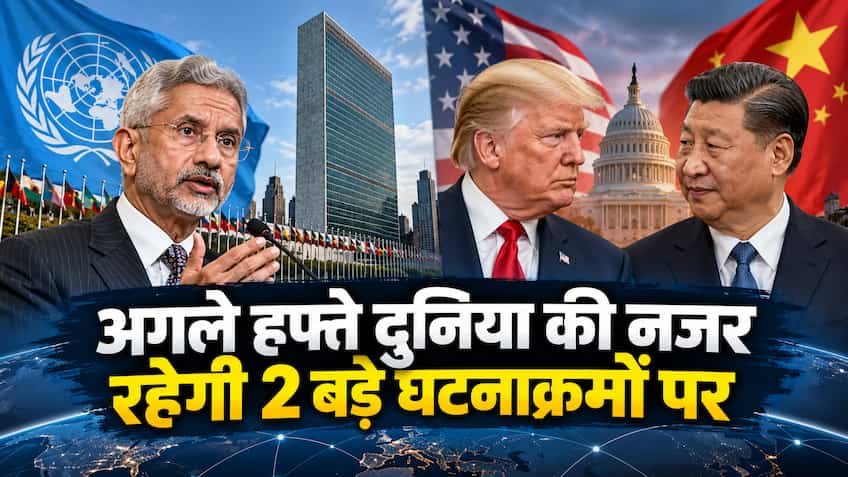
The last week of September 2026 is going to prove to be historic and extremely important for global geopolitics and international diplomacy. The highest level direct talks are going to be held in Washington DC between the world’s two largest superpowers—America and China. The much-awaited bilateral summit (Trump-Xi Summit) is scheduled at the White House between US President Donald Trump and Chinese President Xi Jinping on September 24.
Just two days later, on September 26, in the 81st high-level session of the United Nations General Assembly (UNGA) at the United Nations Headquarters in New York, India’s External Affairs Minister Dr. S. Jaishankar will raise the strong voice of India and the ‘Global South’ in front of 193 countries of the world. The coincidence of these two global events has generated immense curiosity in international defence, trade and diplomatic circles.
The Trump-Xi meeting to be held in Washington on September 24 will be the second direct meeting between the two top leaders in the year 2026, after the two leaders met in Beijing in May. The main objective of this summit is to establish a fragile stability amid the long-standing trade, technological and strategic tensions between the two countries.
According to sources in the White House and the Chinese Foreign Ministry, several burning issues are going to be at the center of these talks:
-
Tariff, Trade and Investment Board: Reviewing progress on implementation of bilateral Board of Trade agreements agreed in May, US agricultural products and Chinese purchases of Boeing aircraft.
-
Critical Minerals and Semiconductors: Discussion regarding the global supply chain of rare earth elements and US export restrictions on advanced Artificial Intelligence (AI) chips.
-
Taiwan and the South China Sea: Both sides took a tough stance on Chinese military pressure in the Taiwan Strait and US arms supplies to Taiwan.
-
Middle East and Iran sanctions: Addressing US concerns over China’s role in the growing conflict in the Middle East and Iran’s nuclear program and oil trade.
The world’s attention will focus on New York immediately after the US-China talks in Washington. According to the official release issued by the Ministry of External Affairs (MEA), External Affairs Minister Dr. S. Jaishankar will lead the Indian delegation at the ‘High-Level Week’ of the 81st UN General Assembly session and will address the General Debate on the afternoon of 26 September.
This global UN forum is expected to highlight several key priorities for India:
-
Reforms in UNSC: Reiterating with full force India’s long-standing demand for permanent membership of the United Nations Security Council and giving proper representation to developing countries.
-
Voice of the Global South: Advocacy for the rights of developing and underdeveloped countries affected by rising food, fertilizer and fuel prices due to the Russia-Ukraine conflict and Middle East tensions.
-
Strong message on cross border terrorism: To expose the countries harboring terrorism and their sponsors on the international stage without any double standards.
-
Bilateral and multilateral diplomacy: During the visit, the External Affairs Minister will also hold dozens of high-level meetings with his counterparts from the Quad, BRICS, IBSA and G20 partner countries.
This diplomatic exercise running from Washington to New York is directly related to India’s national security and economic interests. Defense policy experts sitting in South Block of New Delhi are keeping an eye on every minute aspect of the Trump-Xi talks.
The ongoing military standoff between India and China on the Line of Actual Control (LAC) and any strategic understanding formed between the US and China in the context of border management is sure to have an impact on the balance of power in the Indo-Pacific region. If an agreement is reached on the trade front between the US and China, new supply chain equations may be created for Indian manufacturing and IT exporters.
On the other hand, India’s speech at the UN on September 26 will make it clear that India will remain firm on its strategic autonomy without being a part of any factionalism and will strongly advance its global role towards becoming the world’s third largest economic power.
These two events of 24 and 26 September will decide whether global politics will move towards confrontation in the coming years or new rules will be forged through dialogue. While on one hand the Washington summit is an effort to prevent sudden shocks in the economic cold war between the US and China, on the other hand India’s address from the UN platform will prove that no global order can be stable by ignoring the voice of the developing world.