 look news india

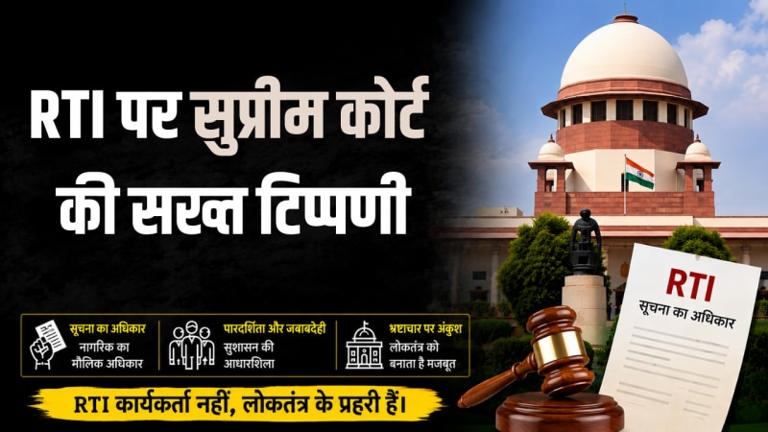
In a vibrant and constitutional democratic system, every institution is expected to perform its duties with complete impartiality, transparency and accountability. But when the government system does not live up to its expectations, then “Citizen Activism” works to show the mirror to the system. Recently, the harsh and harsh comments made by the Supreme Court of India on RTI activists during the hearing of two separate cases have given rise to a new ideological debate between the judiciary versus civil rights.
What is the whole issue of the judiciary’s strict stance on ‘activism’?
Some time ago, during the hearing of a case, Supreme Court Justice Surya Kant had made a very strict comment and said, “Some unemployed youth are like cockroaches, who are unable to make a place in their profession due to not getting a job and start attacking everyone by becoming RTI activists.” This comment created such a huge controversy on social media and civil society that about 25 million supporters even formed a symbolic “cockroach political party” online.
Another similar oral stand was seen when the apex court heard the anticipatory bail plea of another RTI activist Rajeev Kumar alias Mintu and Rakesh Kumar Bahl. During this the court orally said that “Activism has now become a new business.”
Incident in Gurdaspur, Punjab: Where the controversy started
The roots of this entire matter are related to Gurdaspur district of Punjab. RTI activist Rajiv Kumar Bahl had sought information under the Right to Information regarding alleged corruption and use of substandard construction material in a road construction work there. Subsequently, a criminal case was registered against him under sections 351(2), 351(3), 304(2), 221, 132, 121 of the Indian Justice Code (BJS) and section 3(1) of the Scheduled Caste-Tribe (Prevention of Atrocities) Act on charges of obstructing the construction work, threatening the workers, using abusive language and assault.
When the case reached the Supreme Court for anticipatory bail, the court’s oral observations during the hearing raised serious questions. The court asked, “Who are you to monitor?”, “Who gave you this right?” And “The central government has released the funds, it will take care of the road construction.” These comments have forced one to think whether leaving the responsibility of investigation and monitoring completely to the system which has been accused of corruption is not in line with the basic principles of justice – “No man can be a judge in his own case.”—Not against?
How right is it to put an entire class in the dock due to the misconduct of one person?
There is no doubt that if RTI activist Mintu or anyone else has taken law into their own hands, resorted to blackmailing or obstructed government work, then strictest legal action should be taken against them. But the question arises whether it is appropriate to call all the RTI activists and civil activism in the country a ‘business’ on the basis of one pending case?
There is a very subtle difference between ‘use’ and ‘misuse’ of the law. Just as the entire judicial system cannot be questioned if the corrupt conduct or misconduct of one judge in the judiciary comes to light, in the same way, it cannot be justified to look at the Right to Information Act (RTI Act, 2005) and its impartial activists, who are strengthening democracy in the country, with suspicion because of the mistake of one activist.
Different standards in two decisions: Contradictory position of the judiciary
Another contradiction amid this entire incident came to light when the Supreme Court took suo motu cognizance of the inclusion of the topic “Corruption in Judiciary” in the Class 8 Social Science textbook by NCERT. Then the court had imposed a ‘complete ban’ on the entire book, calling it an attempt to defame the judiciary.
Legal analysts believe that on one hand banning a book that questions its institution and on the other hand making a blanket attack on the entire RTI community which plays an important role in keeping democracy alive, reflects two opposite standards of the judiciary. The Right to Information Act was made with the basic idea that the common citizen of the country can ask questions to the government and prevent misuse of public funds.
Is the activism of conscious citizens a threat to the system?
There is a danger of this rebuke from the court sending a message to the society that raising voice against corruption is a crime. If every citizen of the society starts checking, monitoring and keeping an eye on the quality of government construction works happening around him, then it will not only curb corruption but will also strengthen the basic infrastructure of the country.
As a local example, it is often seen that conscious public representatives or local citizens themselves monitor the roads being built in their ward and also clean them with water early in the morning. This behavior is absolutely in line with the Fundamental Duties given in our Constitution. If the administration and local system remain alert in time, then citizens will not need to intervene again and again. It is true that citizen surveillance should not be transformed into some parallel administrative bullying, but it is equally true that the sleeping government machinery often works because of the awakened citizens.
Increasing scope for quasi-judicial and administrative interference
In this entire matter, it was also expected from the Supreme Court that on one hand it would give instructions to investigate the criminal act against the accused worker, on the other hand it would also give orders to the government to conduct an impartial investigation into the quality of the road construction work. Treating only one aspect of a dispute does not fulfill the entire concept of justice.
Similarly, regarding the occupation of about 120 acres of land of the police department in Uttar Pradesh by a notorious mafia, the Chief Minister recently saying in a public forum that ‘eliminating the mafia is my favorite subject’, and then directly directing the Chairman of the Board of Revenue to issue a stay order, also gives rise to a different debate. Such administrative instructions or interference in the autonomous functioning of quasi-judicial bodies like the Revenue Board can be considered an attack on the basic principle of judicial independence.