 look news india

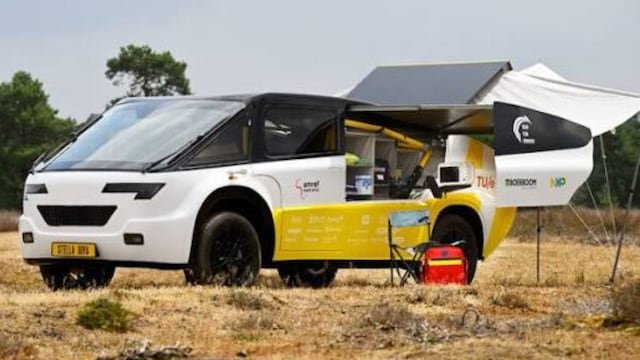
A revolutionary achievement has been registered in the field of healthcare and green energy technology. The world’s first solar powered ambulance ‘Stella Juva’, developed by the student team of Eindhoven University of Technology, Netherlands, has successfully completed its rigorous and challenging 800 km field testing in Kenya, Africa. This trial, conducted in collaboration with Amref Health Africa in remote areas with no roads and no electricity, has proved that the vehicle can not only be driven for long distances with solar energy, but complex medical operations can also be conducted easily inside it.
Conventional ambulances require expensive diesel-petrol or grid-based electric charging infrastructure to run. But ‘Stella Juva’ is a completely off-the-grid and self-sustainable vehicle. State-of-the-art All-Black Contact (ABC) solar panels have been installed on its entire roof. These solar panels keep charging the battery pack continuously even while the vehicle is moving. Additionally, when the ambulance stops in a village or remote location, extendable solar wings come out from both its sides. This system has the ability to generate more electricity than required even in low sunlight and bad weather.
This vehicle is not just an ordinary vehicle to transport patients from one place to another, but a complete ‘mobile healthcare clinic’.
-
Digital
-
Sonography for pregnant women: Ultrasound scanning can be done on-spot for pregnant women in remote rural areas to check the condition of the fetus.
-
Solar Vaccine Refrigerator: A special cold-chain medical refrigerator for vaccines, anti-venom and critical life-saving medicines is housed inside, maintaining a constant temperature of 2 to 8 degrees Celsius even in extreme heat.
-
Emergency ICU and Telemedicine Setup: It is provided with basic life support monitors and satellite connectivity system, allowing rural doctors to consult live with super-specialist doctors from big cities.
The team of engineers and doctors operated all the medical equipment (X-ray, ultrasound, freezer and lights) at full load simultaneously during the test conducted over 800 kilometers of rugged and dusty roads in Kenya. Data analysis revealed that the vehicle’s solar panels and energy management system produced far more solar energy than the total electricity consumed by the devices. This means that this vehicle itself can work like a ‘power station’ in those villages where there is no grid electricity for months.
According to World Health Organization (WHO) data, more than one-third of the rural population in Africa and developing countries lives more than 2 hours away from a basic health centre. In emergency situations, patients lose their lives before reaching the hospital. Apart from such areas, when electric poles and roads are destroyed due to natural disasters like floods, earthquakes or cyclones, this solar ambulance can reach immediately and start treating the injured without any external fuel or grid supply.
After this successful 800 km testing of ‘Stella Juva’, now there is a plan to introduce it on a large scale for commercial and relief operations in different countries. In the hilly areas and desert areas of India’s North-Eastern states, Ladakh and Uttarakhand, where providing primary health facilities is still a big challenge, this kind of solar ambulance can bring a revolutionary change. This technology with zero carbon emissions and zero running cost has become a new global model for environmental protection as well as ensuring better last mile health services.