 look news india

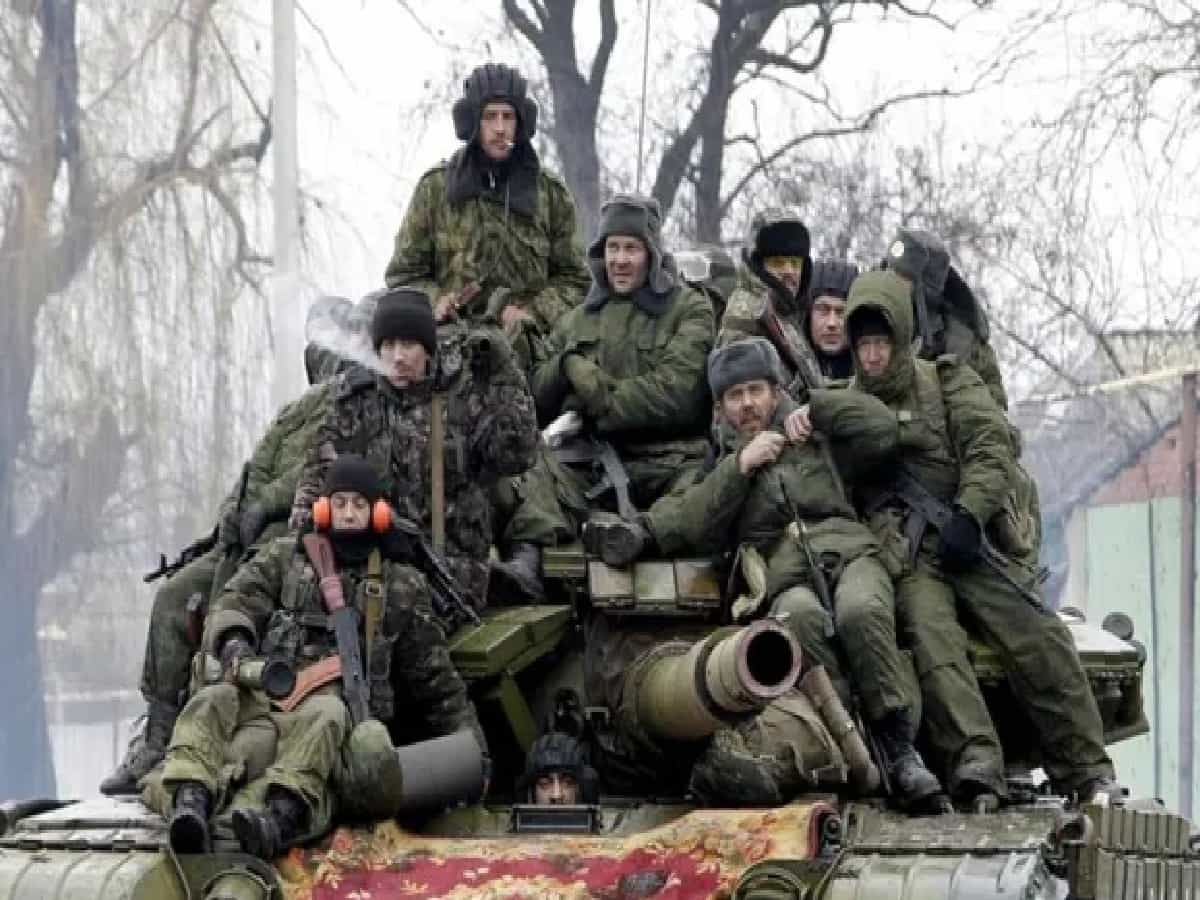
As temperatures drop across the bloody battlefield in eastern Ukraine as the military conflict heads into another brutal winter, Moscow has added a unique and unexpected chapter to its war strategy. State-of-the-art missiles and tanks, as well as centuries-old holy relics of medieval Russian rulers and warrior saints, are now being delivered to war fronts and Russian military bases. Parts of the remains of the right-hand man of Moscow’s 14th-century Grand Duke Dmitry Donskoy are being transported under special security to Russian-controlled Ukrainian territories. The Russian Orthodox Church officially recognizes that Prince Donskoy held his sword with this hand when he defeated the Mongol-Tatar army at the historic Battle of Kulikovo in 1380.
The military department of the Moscow Patriarchate clearly argues that this saint commander invisibly stands shoulder to shoulder with Russian soldiers stationed at forward posts. Strategic analysts are considering it not just a religious ritual but a well-planned psychological and ideological tool, which experts have named ‘Mobilizing Myth’ i.e. a story fabricated for mobilization. As the complexities and casualties of a modern war increase, this fusion of military history and religious symbolism becomes one of the most effective means of mobilizing public sentiment.
The transportation of holy relics among soldiers during times of war has historically been frowned upon in the Orthodox Christian tradition, but Donskoy’s choice is part of a particular geopolitical narrative given the current situation in Ukraine. According to Sergei Chapanin, a well-known religious scholar and communications director of Fordham University’s Center for Orthodox Christian Studies, Donskoy has never been taught as an aggressive aggressor in Russian history. He has always been established as a shield protecting the Russian land from foreign invaders and a ‘defender of the motherland’.
This historical explanation fits very well with the Kremlin’s information system. The Russian government is constantly trying to convey to its domestic citizens and soldiers that Russia has not launched a unilateral attack on Ukraine, but is protecting its sovereignty and civilizational borders from NATO expansion and Western threats. By showing the bones of Donskoy’s hand on the front, an ideological framework is being created that today’s Russian soldier, like Donskoy, is also performing the sacred duty of protecting his motherland, thereby giving the war the status of a ‘holy struggle’.
Relations between the Kremlin, led by President Vladimir Putin, and the Russian Orthodox Church, led by Patriarch Kirill, have deepened unprecedentedly since the 2022 military campaign. The Church has spared no effort in providing moral and spiritual legitimacy to Russian foreign policy and military actions. The situation has become such that the dividing line between religion and the state machinery has become completely blurred. When these holy relics from Donskoy were officially made public in August, it was hailed a divine event in the political and spiritual circles of Moscow.
President Putin described this historic discovery as extraordinary and unique, while Patriarch Kirill declared it a special divine sign that Russia is on the right path and has God’s blessing. When these relics were put on display in Moscow’s historic churches, millions of Russian citizens expressed their faith. This entire process made it clear that mobilizing support for war by linking religious faith with national identity has become a central pillar of the Kremlin’s overall strategy.
Military experts and psychologists believe that religious symbols offer a deep psychological support for soldiers living under constant artillery attacks and drone strikes. This faith becomes the last hope for survival for soldiers facing deadly risks on the battlefield. Describing this ground reality, a former Russian soldier admitted that in times of peace, people may forget God, but when the smell of gunpowder and death looms in front, everyone starts praying.
Bunker churches and field chapels have been built in the ravines and on the front lines of eastern Ukraine. Before sending the troops on any dangerous mission, the military chaplain, or chaplain, blesses them, sprinkles holy water and presents them with protective shield symbols. The regular presence of chaplains at the bedside of the wounded in field hospitals is now an essential part of Russian military routine. The popular saying in the Russian army that ‘just as a field kitchen is necessary on every front, so there should be a chaplain with every battalion’ shows the extent to which religious rituals have become institutionalized on the battlefield.
The ongoing war in Ukraine is not just a battle of modern weapons, electronic warfare and air supremacy, but also a fierce clash of identity, culture and interpretations of history. By moving the remains of centuries-old rulers and warrior saints to modern trenches, Moscow wants to ensure that Russian soldiers’ dedication to war is not limited to pay or orders, but is linked to their inner religious commitment. This strategy, which is being presented by molding history in the mold of modern politics, shows that even in the 21st century era of information and technology, medieval faith and religious nationalism remain the most lethal weapons to win the war.