 look news india

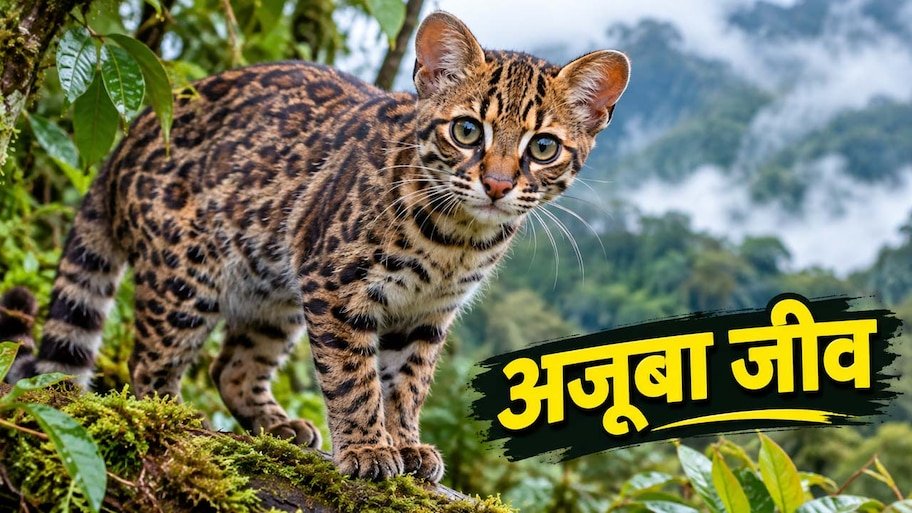
There are still such unsolved mysteries hidden in the womb of nature that astonish even the advanced techniques of modern science. One such incredible and surprising case has come to light from France’s picturesque Corsica Island located in the Mediterranean Sea. Modern genetic analysis (DNA Sequencing) has made such revelations about the creature which local shepherds and villagers had been ignoring for centuries considering it to be an ordinary stray cat or fox-like creature that has stunned biologists all over the world.
In local folklore ‘Ghjattu Volpe’ i.e. ‘Cat-Fox’ This mysterious cat, known as the Cat, turns out to be, in fact, not a domestic or common European wild cat, but a completely unique and distinct species that has preserved its pure genetic identity since prehistoric times. Its DNA strings have been found to be linked to an evolutionary history dating back approximately 1.4 million years.
For generations, local shepherds who herded goats in the dense forests and inaccessible rocky gorges of Corsica have told stories of a predatory animal that would attack the sheep and goat pens in the dark of night. Its tail was thick and ringed, its body was much longer than normal cats and its sharp teeth looked like those of a fox. For decades, mainstream zoologists dismissed these claims as mere herders’ fabrications and myths.
This situation changed when this strange cat was found unexpectedly trapped in a chicken coop in 2008. After this, scientists from the French Office of Biodiversity (OFB – Office Français de la Biodiversity) launched a special mission to formally track this elusive creature. Scientists set up non-invasive traps in the forest, equipped with scent lures and brushes that would trap cat hair as they passed through them. Samples from these hairs gave researchers direct access to its high-quality DNA for the first time.
When the DNA profile of this ‘cat-fox’ was matched with known domestic cats (Felis catus), European wild cats (Felis silvestris silvestris) and African wild cats (Felis lybica) at top genetic laboratories in Paris and Lyon, the researchers were stunned by the results.
Genetic data clearly indicated that this cat is completely different from the common wild cats found on the European mainland. Its mitochondrial and nuclear genomes reflect a distinct genetic lineage that diverged from the main cat family about 10 to 14 million years ago and evolved in an unknown part of the Mediterranean basin. Scientists estimate that this species may have reached the island through natural means or early human migration from the coastal areas of the Middle East or North Africa in prehistoric times and remained safe without any adulteration in the isolated environment of the island for millions of years.
Although it may look like a large brown-striped cat externally, its physical structure puts it in a completely different category from ordinary cats:
-
Huge Size and Length: Its length from head to the tip of tail is approximately 90 centimeters (about 3 feet), which is much longer than an ordinary domestic cat.
-
Unique fox tail: Its tail is very dense, with clear black rings on it and the tip of the tail is completely dark black.
-
Special ears and mustache: Its ears are wider and more downward sloping, while its whiskers are shorter and more sensitive which helps it detect prey in dense forests.
-
Color and silky texture: The lower part of its stomach is light red-ochre and the soles of its feet are completely black, which gives it the amazing ability to move stealthily on rocky paths.
-
Canine Teeth: Its canine teeth are highly developed and sharp, which act like the jaws of a fox to capture the prey in a single blow.
The impact of this discovery in Corsica is not limited to Europe only, but it has also brought very important lessons for a country with huge biodiversity like India. The Western Ghats of India, the rainforests of the North-East and the high Himalayan regions of Uttarakhand, Himachal and Ladakh are home to many mysterious and shy cat species—such as the ‘Rusty-spotted cat’ (the world’s smallest cat), the ‘Fishing Cat’, the ‘Clouded Leopard’ and the ‘Pallas’s cat’.
Scientists at the Wildlife Institute of India (WII, Dehradun) also consistently emphasize that the genetic mapping of many local wild cats found in the Terai areas of Uttar Pradesh (Pilibhit, Dudhwa) and the Himalayan foothills is still incomplete. Just as modern genomics proved the folklore cat of Corsica to be a unique creature 1.4 million years old, in the same way there may be many such rare creatures present in the dense forests of India which we are ignoring as ordinary stray creatures, whereas they may be the last surviving representatives of some extinct ancient species.
This cat of Corsica is no longer just a subject of curiosity, but saving its existence has become a big mission for international conservationists. French researchers have recommended its official scientific naming and its inclusion in the IUCN Red List as a specially protected species.
The biggest threats facing this species are habitat destruction and possible hybridization with domestic cats. If this wild species comes into contact with common domesticated or stray cats and reproduces, its 14 million year old pure gene pool will be destroyed forever. This is why the local administration has planned to declare the forest areas inhabited by these cats and foxes as protected biological corridors and to monitor their movements 24 hours through GPS collars.