 look news india

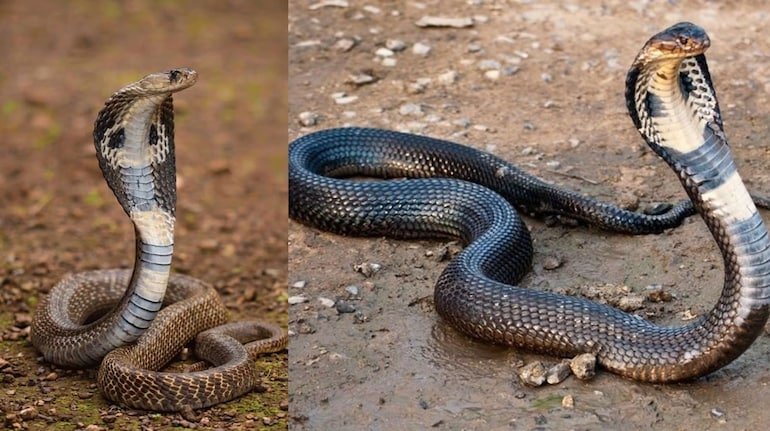
From rural areas to cities, people always have both curiosity and fear about snakes. Often people consider common snake and cobra to be the same or use both the words interchangeably. Even in religious and mythological stories, snakes have been given a special status, due to which this confusion becomes deeper. From the point of view of biology and herpetology, every snake is a snake, but not every snake is a snake. On the basis of scientific classification, physical structure, hood and effect of poison, there is a clear difference between the two.
Biological Classification: Common Viper vs Cobra (Cobra)
-
Snake: In biology, snakes come under the suborder ‘Serpentes’ under the Reptilia class. More than 3,500 species of snakes are found around the world. These range from non-poisonous snakes (such as pythons, pythons, sand boas) to highly venomous snakes (such as Russell’s viper, krait).
-
Cobra/Naja: Cobras are part of a special family of snakes, ‘Elapidae’ and the ‘Naja’ genus. That is, cobra is a special and distinct class of the entire community of snakes, which has its own distinct physical and behavioral characteristics.
The biggest difference between body structure and hood
-
Spread the hood: The biggest identity of a snake is its ‘fun’. In case of danger, snakes spread the cervical ribs and loose skin of their neck to form a hood shape and can raise the front one-third of the body vertically in the air. Spectacle mark or monocle mark is often visible behind its hood.
-
Common snake: Most common snakes do not have such flexible ribs, so they cannot form a hood. When they sense danger, they either run away, curl up and hide, or give a warning by wagging their tail.
Type of poison: neurotoxic vs hemotoxic
-
Neurotoxic Venom: Cobra venom mainly attacks the nervous system. Its bite causes difficulty in breathing, muscle paralysis and blurred vision. If anti-venom is not received on time, death can occur due to respiratory failure.
-
Venom of other poisonous snakes: Viper species of snakes (such as Russell’s Viper) mainly have hemotoxic venom, which affects blood clotting, causes internal bleeding and destroys tissues. At the same time, snakes like krait also have extremely deadly neurotoxin.
behavior and hunting style
Snakes are alert and defensive by nature. Instead of attacking directly without provocation, they first give warning by hissing and raising their hood. If someone still goes too close to them, they bite. On the contrary, common non-poisonous snakes like Dhaman (Rat Snake) are very agile and as soon as they hear the sound of a human, they quickly run away into the hole or bushes. Large non-poisonous snakes, such as pythons, kill their prey by constriction instead of killing them with poison.
The ‘Big Four’ found in India and the role of snakes
More than 90% of serious snakebite cases in India are caused by four major venomous snakes, known as ‘The Big Four’:
-
Spectacled Cobra (Naag/Indian Cobra)
-
Common Krait (Krait)
-
Russell’s Viper (Daboia)
-
Saw-scaled viper (Afai)
Among these, cobra is the most easily identified snake due to its identity, huge hood and hissing.