 look news india

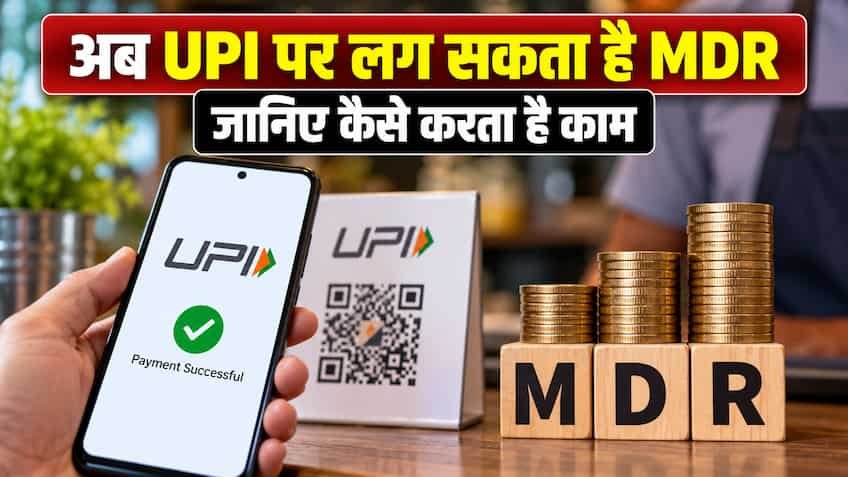
In today’s digital India, whenever we shop at a supermarket, petrol pump, mall or online website, we swipe our debit card, tap a credit card or scan a QR code from a smartphone to make a UPI payment. Within a few seconds, money is deducted from our bank account and payment confirmation reaches the shopkeeper. As magical and free as this process appears to an ordinary customer, there is a very complex and expensive structure of financial and technology companies working behind it. The fee charged for running this financial structure is called ‘Merchant Discount Rate’ i.e. MDR (Merchant Discount Rate) in the technical language of banking and fintech. In simple words, MDR is the service fee or commission that a merchant or shopkeeper pays to his bank and digital payment service providers in exchange for the facility of accepting money from customers through digital means. It is called ‘discount rate’ because this percentage is already ‘discounted’ (deducted) from the original sale amount received by the merchant and the remaining net amount is deposited in his bank account.
To understand the working of MDR, one has to look at the digital payment process that happens within just 2 to 3 seconds of you entering the UPI PIN or swiping the card. There are mainly four key players (Four Pillars) involved in any digital transaction: First, the paying customer (Payer); Second, the merchant or merchant accepting payment (Payee); Third, the customer’s bank called the ‘issuing bank’; And fourth, the merchant’s bank or payment service provider called the ‘Acquiring Bank / Payment Aggregator’. Apart from this, there is a ‘payment network switch’ like National Payments Corporation of India (NPCI), Visa or MasterCard which connects the two banks. When a customer makes a payment of Rs 1,000, the acquirer bank deducts Rs 10 from the merchant as per the fixed MDR (say 1%). After this only Rs 990 is credited to the merchant’s bank account. This deducted amount of Rs 10 is called MDR, which is considered as ‘toll tax’ for using the digital highway.
Often this question arises in the minds of common people and small traders that when no paper notes are printed in digital payment, then why is this charge levied? The reason for this is the heavy operational cost of digital infrastructure. More than 15 to 16 billion UPI transactions and crores of cards are swiped every month in India. To operate this huge network around the clock without any interruptions, server crashes or hangs, banks need ultra-fast supercomputers, cloud servers and high-speed data centers. The second biggest expenditure is on cyber security and fraud detection. Billions of rupees are spent on end-to-end 256-bit encryption and artificial intelligence based fraud monitoring systems to keep transactions safe from hackers and online fraudsters. Additionally, payment gateway companies have to set up QR code stands, soundboxes and POS swipe machines for merchants, run customer care support and make payments for telecom bandwidth to network operators. If there is no MDR, banks and fintech companies will have no economic capital left to keep the system alive.
The MDR deducted from the merchant does not go into the pocket of any single company, but is distributed among different stakeholders of the entire payments ecosystem in a fixed ratio:
-
Interchange Fee: The largest part of MDR (about 60 to 70 percent) goes to the customer’s bank i.e. ‘Issuing Bank’. This is done because the customer’s bank debits the money from its servers, authenticates the customer, sends SMS alerts and also bears the financial risk of default in case of credit cards.
-
Acquirer Bank and Payment Gateway Fee: About 20 to 25 percent of the MDR remains with the merchant’s bank or payment aggregator (like Razorpay, Paytm, PhonePe, Pine Labs). These institutions do KYC of the merchant, install soundbox or swipe machine at their place and ensure timely settlement.
-
Network Switch Fee: The smallest but significant portion of MDR (about 5 to 10 percent) goes to payment network switches—like NPCI for India’s UPI and RuPay or Visa and MasterCard for cards. These institutions provide a national and global corridor of secure digital communications between the two banks.
In India, in 2020, to take digital transactions to every home, the government had completely reduced the MDR on UPI and Rupay debit cards to zero (Zero MDR). But for a long time banks and fintech companies were complaining that due to zero MDR they were incurring losses and were not able to upgrade servers. To balance this problem, NPCI has notified a new and targeted MDR framework with effect from 15 October 2026:
-
100% free for general public: Common consumers will not have to pay any charges for making payments through their phones. Whether it is Rs 100 or Rs 1 lakh, the charge on sending money to friends and relatives (P2P) will always be zero.
-
0.4% MDR on merchant payments above ₹2,000: If a customer makes a UPI payment of more than ₹2,000 to a large merchant (P2M), an MDR of 0.40% will be charged from that merchant. The maximum limit for large transactions has been fixed at ₹300. For example, the merchant will have to pay ₹12 for a ₹3,000 bill and a maximum of ₹300 for a ₹1,00,000 bill.
-
Full discount to small shopkeepers (P2PM): All those small street shopkeepers, tea-samosa stalls and street vendors who take digital payments up to ₹ 1 lakh per month will be under the protection of ‘Mandatory Zero MDR’.
-
Flat ₹5 on utilities and essential services: On payments above ₹2,000 on railways, electricity, water, LPG gas, education, telecom and petrol pumps, a one-time token MDR of ₹5 will be levied instead of percentage.
-
0.02% on Capital Market: A highly concessional rate of 0.02% (maximum ₹300) has been kept for the stock market, mutual funds and stock brokers.
MDR rates are not the same for different modes of digital payment. This rate is decided based on the risk and features of the payment instrument. most expensive mdr credit card (Credit Card). On credit card purchases, the merchant has to pay a hefty MDR ranging from 1.5% to 3.0%. The reason for this is that in credit cards, the bank gives 45 to 50 days free loan to the customer and the reward points and cashback are also compensated from this merchant MDR. comes second debit card (Debit Card), on which MDR ranges from 0.40% to 0.90% as per the rules of Reserve Bank of India. At the third and cheapest place is India’s indigenous UPI where the minimum rate has been fixed at zero up to ₹2,000 and only 0.40% above. This is the reason why India’s digital payment model is considered to be the most economical and sustainable compared to other countries of the world.
A concern is often raised that when MDR of 0.4% is imposed on big merchants, will they start charging more money from customers? As per NPCI and Finance Ministry rules, the merchant discount rate is purely the merchant’s cost of doing business. By law, no merchant can ask for additional surcharge or convenience fee from the customer for making payment through UPI. The customer does not have to pay even a single penny more than the MRP or the fixed price of the product. If any big mall or electronics showroom tries to add a separate 0.4% charge on payments through UPI, it will be a direct violation of the Consumer Protection Act and NPCI’s merchant agreement. Overall, MDR is not a new tax or crime, but the fuel to keep on track the huge and secure bullet train of digital payments that is racing towards making India an economic superpower.