 look news india

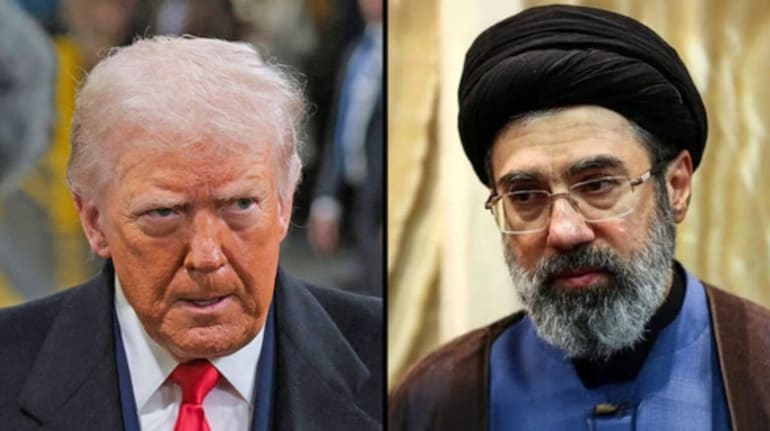
US President Donald Trump has created a sensation across the world by announcing a historic ‘peace deal’ with Iran (US-Iran Peace Deal). This sudden development has shaken the entire geopolitics and equations of the Middle East. Trump’s strong claim is that the US-Iran war is now completely over, the strategically sensitive sea route ‘Strait of Hormuz’ will reopen and the US military will lift its strict naval blockade.
But wait! This is only half the truth of this whole story. The truth is that this agreement (MoU), prepared with the mediation of Pakistan, is only to be officially signed on the soil of Switzerland on coming Friday, while its most sensitive and real terms are still in the locked safe. Iran has made it clear that it will not consider it fully implemented until it is officially signed. At the same time, American defense officials have clarified that the blockade will be lifted only after Friday. So what is the real game behind this great deal? Let us decode this entire inside story in simple language.
1. Has the war really stopped? Know the 3 main points of the initial deal
The biggest and immediate objective of this initial agreement is to stop the ongoing fierce military conflict in the Middle East and end its side-effects on the global economy:
-
Full stop on military operations: According to Pakistan Prime Minister Shehbaz Sharif and Iran’s Supreme National Security Council, who are playing the role of mediator, both sides have announced an immediate and permanent halt to military operations on all active fronts, including Lebanon.
-
Crude oil will be cheaper: Iran has agreed to reopen the Strait of Hormuz, which has been closed for months, to commercial ships, which will restore the supply chain of oil, gas and fertilizer in the global market. As soon as this news arrived, the prices of Brent crude and American West Texas Intermediate (WTI) in the international commodity market. fell by more than 4%.
-
American blockade will be removed: In exchange for these concessions, the US will completely lift its strict naval blockade imposed by the US Navy on Iran’s strategic ports.
2. 60 days time bomb: Deep suspense of nuclear program
This agreement is only a temporary diplomatic ‘bridge’, not a permanent solution. To resolve real and controversial issues 60 days ‘ceasefire period’ It has been decided, of which the biggest obstacle is Iran’s nuclear program:
Dangerous Stock of Uranium: International Atomic Energy Agency (IAEA)IAEA) According to the latest report, Iran currently has 440.9 kg Uranium exists that has been enriched to 60% purity. It will only take a few weeks to get it to weapons-grade (90% weapon grade).
-
America vs Iran’s insistence: The US and its European allies want Iran’s nuclear program to be completely destroyed and the enriched uranium to be sent out of the country. On the other hand, Iran is adamant on only ‘diluting’ it within the country. Britain, Germany and France have made it clear that relief from the stringent economic sanctions imposed on Iran will be available only if it takes concrete steps.
3. ‘Tu-Tu Main-Main’ on $25 billion freeze fund
There are stark differences between the two countries’ claims regarding Iranian financial assets seized and frozen in foreign banks, which could spoil the talks:
-
Iran’s strict conditions: Iranian Foreign Ministry officials say the US must first seize them in order to move on to the next phase of the deal. 25 billion dollars (about ₹2 lakh crore) Will have to be released.
-
America’s befitting reply: On the other hand, American officials while talking to the media (CNN) said that this claim is a complete lie. This is completely a ‘pay for performance’ deal; Unless Iran fulfills the written oaths and promises on the ground, not even a single penny will be given to it.
4. Iran’s deadly missiles and the future of Hezbollah
The most mysterious and shocking thing in this entire peace framework is that there is no direct mention of Iran’s dangerous Ballistic Missile Program or its armed allies (Proxy Groups) operating in the Middle East region. Even after months of war and bombing, Iran’s missile network and regional influence remain strong, which is expected to be a major tussle in future diplomatic talks.
5. Israel’s ‘Villain’ Avatar: Will Netanyahu spoil the game?
America’s closest ally Israel was not included anywhere in this entire secret deal, due to which it is extremely angry. The Israeli Defense Forces (IDF) clearly says that it will not give up its ‘freedom of action’ in Lebanon for any agreement, which is against the basic terms of this ceasefire.
US President Donald Trump has called Israeli PM Benjamin Netanyahu, calling him ‘a very difficult man’ and taunting that Netanyahu should thank him for saving Israel from the direct threat of a nuclear-armed Iran. Seeing this aggressive stance of Israel, geopolitical experts believe that this peace agreement is at a very delicate point and can break at any time.