 look news india

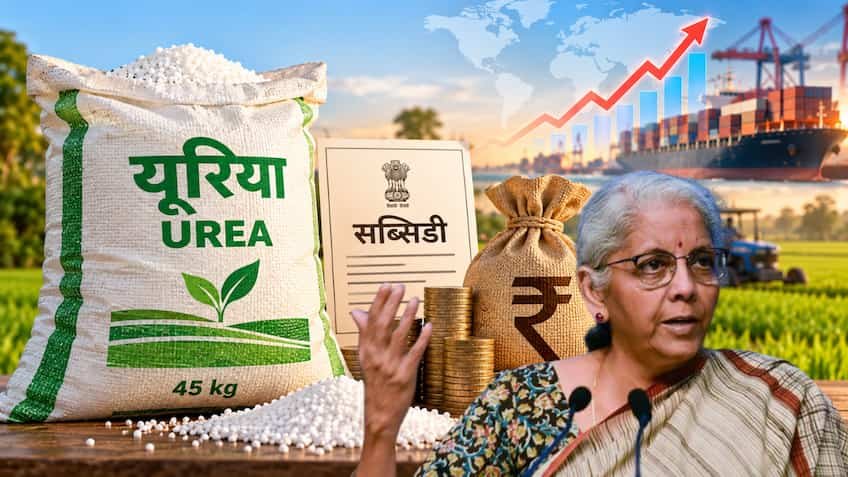
For crores of farmers in the country, urea fertilizer plays the most important role in controlling the cost of farming and increasing the yield of crops. Often, farmers buy a 45 kg bag of urea from cooperative societies or fertilizer shops for around ₹ 266 to ₹ 300 and consider this as its normal price. But the actual international and production value of this bag of fertilizer is enough to shock any common citizen. Union Finance Minister Nirmala Sitharaman has made a big revelation by lifting the curtain on this huge difference.
The Finance Minister has clarified that the real cost of a bag of urea, which has reached ₹ 3,000 in the global market, is being made available to the farmers at only around ₹ 300 by the Government of India by giving huge subsidy from its treasury. This means that the Central Government itself is bearing a financial loss of about ₹ 2,700 on each bag, so that the farmers of the country do not suffer the slightest impact of inflation.
There has been a record jump in the production cost of chemical fertilizers due to fluctuations in the international market of raw materials, natural gas and the global supply chain. If the government leaves the market open, farmers may have to shell out up to ₹3,000 for a bag, sending farming costs out of control.
-
Total global cost of urea bag: Around ₹3,000 per bag
-
Retail price paid by farmers: Around ₹266 to ₹300 per bag
-
Per bag subsidy being borne by the government: Around ₹2,700 (about 90% of the cost)
-
Annual Fertilizer Subsidy Budget: Rs 1.7 lakh crore to more than Rs 2 lakh crore
From this mathematics it becomes clear that what farmers pay is only 10 percent of the total cost of urea. The remaining 90 percent of the expenditure is borne by the country’s exchequer.
Addressing a special program related to agriculture and horticulture in Madanapalle, Andhra Pradesh, Finance Minister Nirmala Sitharaman shared the intention behind this huge subsidy and the priorities of the government. He underlined that the global fertilizer supply chain has been severely affected due to global geopolitical tensions, the Russia-Ukraine crisis and the situation in the Middle East. Despite this, the government under the leadership of Prime Minister Narendra Modi has been determined that the burden of the international crisis will not be placed on the shoulders of Indian farmers.
The Finance Minister said that the Central and State Governments together are continuously investing to strengthen the infrastructure of the agriculture sector and connect farmers to the global value chain. If the prices of chemical fertilizers were increased, it would have a direct impact on food grain production, food inflation and the rural economy. Therefore, despite the pressure on the government treasury, providing fertilizers to farmers at concessional rates remains the top priority of the government.
With such a large portion of the government exchequer being spent on chemical urea, the government is now increasingly promoting sustainable alternatives to reduce the excessive and unbalanced use of urea in the country. The use of liquid ‘Nano Urea’ and ‘Nano DAP’ developed by IFFCO is being encouraged as an alternative to the conventional 45 kg granular bag.
-
Transportation and storage savings: One 500 ml Nano Urea bottle works the same as a conventional 45 kg sack, drastically cutting down on heavy freight and warehousing expenses.
-
Improves Nutrient Efficiency: While plants can absorb only 30 to 40 percent of granular urea, the absorption capacity of nano urea is more than 80 percent.
-
Conservation of soil and ground water: Excessive use of chemical urea poses a risk of reducing soil fertility and causing nitrate pollution in groundwater, which can be prevented by balanced fertilizers and organic alternatives.
Rabi season (sowing of wheat, mustard, potatoes) is going to start for the farmers of Uttar Pradesh capital Lucknow, Kanpur, Varanasi, Gorakhpur, Prayagraj and farmers of Bihar, Punjab, Haryana and Madhya Pradesh. The demand for urea and DAP reaches its peak during Rabi crops.
The administration has clarified that there is adequate buffer stock of fertilizer available across the country for the upcoming Rabi crops and there will be no shortage in any district. Farmers have been advised to immediately register their complaints against black marketing or fertilizer sellers charging more than the prescribed MRP to the District Agriculture Officer or toll-free helpline, as urea prices are statutorily controlled across the country.