 look news india

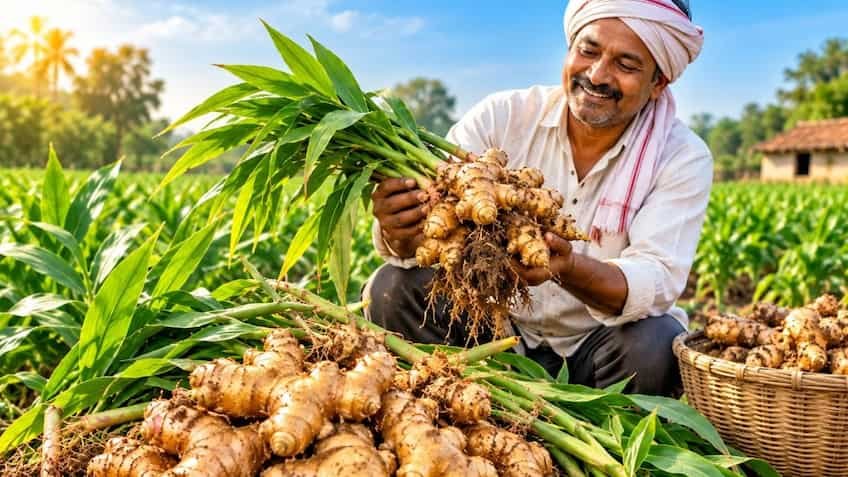
Amid rising costs and declining profits in the cultivation of traditional grains, the country’s farmers are increasingly turning to high-value cash and horticultural crops. Ginger, considered the queen of spices, is one such crop, which is in demand 365 days a year, from home kitchens to Ayurvedic medicine industries, tea shops and food processing units.
Wholesale and retail prices of quality fresh ginger in the mandis touch as high as ₹100 to ₹250 per kg during the winter season and festive season and ₹300 to ₹400 per kg in the off-season. Farmers cultivating ginger using modern farming techniques, drip irrigation and bed method are easily earning a net profit of Rs 6 to 8 lakh from one acre in a period of just 8 to 9 months.
Ginger is a rhizome crop, hence soil selection is the most important step for the proper development of its roots:
-
Suitable soil and drainage: Sandy loam or clay loam soil which has abundant amount of organic matter is considered best for ginger. There should be absolutely no waterlogging in the field, because stagnant water can cause rhizome rot. The pH value of soil is ideal between 6.0 to 7.0.
-
Deep plowing and fertilization of the field: Do the first plowing with a soil turning plow and make the soil crumbly by running the cultivator 2 to 3 times. At the time of ploughing, apply 8 to 10 tonnes of well decomposed cowdung manure (FYM) or 2 tonnes of vermicompost per acre, mixing it well with the soil.
-
Construction of raised beds: Ginger should always be sown on raised beds. The width of the beds should be 1 to 1.2 meters, height 15 to 20 centimeters and keep a drain of 30 to 40 centimeters between the beds for drainage and irrigation.
Quality seeds and disease-free rhizomes are the first guarantee of good yield:
-
Major improved varieties: Varieties like Suprabha, Suruchi, Surabhi, Wardha, Mahima, Himgiri and Rio de Janeiro are known for high yield and high Dry Ginger percentage.
-
Seed quantity: About 8 to 10 quintals of healthy rhizome bits are required for sowing in one acre of field. Each tuber piece should weigh 25 to 30 grams and have at least 2 to 3 live sprouts.
-
Mandatory Seed Treatment: To protect against tuber rot and fungal diseases, before sowing, dip the seeds in a solution of carbendazim or mancozeb (2 grams per liter of water) for 30 minutes and dry them, only then sow.
The initial investment in ginger cultivation is slightly higher, but its return ratio is three times higher than any other common crop:
-
Total estimated cost (per acre):
-
Cost of seeds/rhizome (8-10 quintals @ ₹80-₹100/kg): Approx ₹80,000 – ₹1,00,000
-
Field preparation, manure and fertilizers: approximately ₹25,000 – ₹30,000
-
Drip system, bed making and mulching: around ₹25,000
-
Weeding, irrigation and labor: approximately ₹30,000
-
Total Average Cost: Around ₹1,60,000 to ₹1,80,000 per acre
-
-
Yield Estimates: If cultivated scientifically, an average of one acre 80 to 100 quintals (8,000 to 10,000 kg) Green ginger is easily grown.
-
Gross Income: Even if the average wholesale price in the market is only ₹ 80 to ₹ 100 per kg (whereas the retail price ranges from ₹ 150 to ₹ 300), then the total income from 9,000 kg ginger ₹7,20,000 to ₹9,00,000 it occurs.
-
Net Profit: After deducting the total cost (about ₹ 1.8 lakh), the farmer will get the profit in just 8 to 9 months. Net profit of ₹5.5 lakh to ₹7.2 lakh It takes place directly.
The initial growth of ginger crop is slow and it needs to be protected from strong sunlight. Therefore, farmers must do mulching on the beds with green leaves, straw or dry sugarcane leaves. Due to this, moisture is maintained in the field, weeds do not grow and the temperature of the soil remains controlled.
Apart from this, ginger also thrives in shady places. Farmers can earn double income from the same land by planting ginger as an inter-crop in papaya, banana or maize orchards.
Farmers from Awadh region of Uttar Pradesh (Lucknow, Barabanki, Sitapur, Unnao) to Madhya Pradesh, Kerala and North-East India can directly grade and package ginger after harvesting and sell it in the nearest big wholesale markets.
Even if market prices soften a bit at any time, there is no pressure to sell ginger immediately. farmers dry it Dry Ginger Or you can make ginger powder, paste and candy and sell it as packaged food. By doing value addition, the value of the product is doubled and huge profits can be earned from the international market through export.