 look news india

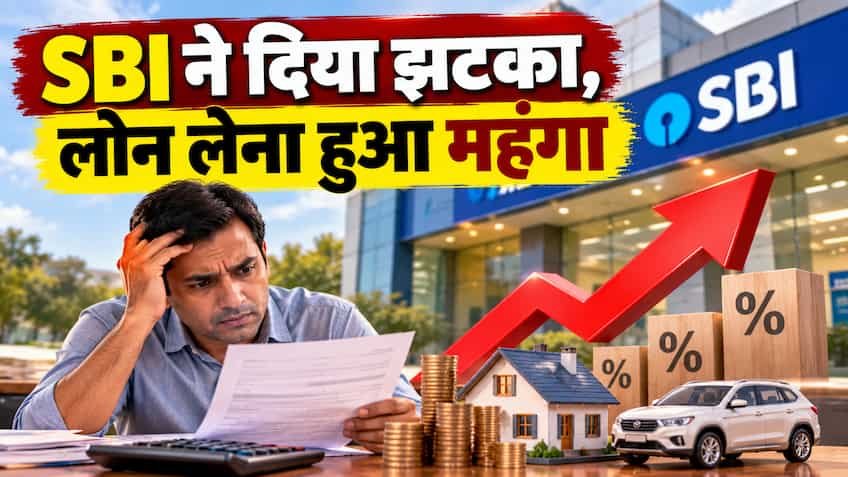
State Bank of India (SBI), the country’s largest public sector bank, has announced an increase in its key lending rates, giving a shock to crores of retail and corporate borrowers. The bank has increased the Marginal Cost of Funds Based Lending Rate (MCLR) by up to 15 basis points (0.15%) for select tenors, while the External Benchmark Lending Rate (EBLR) and Repo Linked Lending Rate (RLLR) have also increased by 25 basis points (0.25%). The new revised rates have come into effect. After this step of State Bank of India, it is considered certain to increase the monthly installment (EMI) or loan tenure (tenure) of all types of home loans, car loans and personal loans taken at floating interest rates. Its direct impact will be seen on the budget of existing and new loan customers connected to SBI branches from Lucknow, Kanpur, Delhi-NCR to Mumbai.
According to the official data released by the bank, MCLR of various tenures has been increased by up to 15 basis points. However, overnight and one month MCLR have been kept unchanged at 7.85%. At the same time, the three month rate has increased from 8.25% to 8.40%, the six month rate has increased from 8.60% to 8.75% and most importantly the one year MCLR has been increased from 8.70% to 8.85%. The two-year MCLR has increased from 8.75% to 8.90% and the three-year rate has increased from 8.80% to 8.95%. Most auto loans, personal loans and corporate working capital loans are linked to 1 year MCLR. With this, the EBLR impacting retail home loans has increased to 8.15% plus spread and RLLR to 7.75% plus spread.
This decision of the bank will have a direct financial impact on the pockets of all floating rate borrowers. If a customer had taken a home loan of Rs 30 lakh at an interest rate of 8.50% for 20 years, then his current EMI works out to be approximately Rs 26,035 per month. If the interest rate increases by 25 basis points (0.25%) to 8.75%, the same EMI will increase to Rs 26,511. That means there will be an additional burden of approximately Rs 476 every month and Rs 5,712 on an annual basis. This difference will work out to a total additional interest of approximately Rs 1.14 lakh over the entire 20 year period. If the loan amount is Rs 50 lakh, the monthly EMI will increase by around Rs 794 per month, which will add additional expenses of around Rs 9,528 on an annual basis.
After October 2019, almost all new home loans and most personal loans issued by banks under RBI regulations are directly linked to an external benchmark i.e. EBLR or RLLR. The interest rate automatically increases on the next billing cycle or quarterly reset as these benchmarks change. On the contrary, for old borrowers who are still availing loans under the MCLR regime, its impact will be applicable from their respective reset date. For example, if a customer’s one-year MCLR reset falls in January every year, the new 8.85% rate will be added to their EMIs from January onwards.
When interest rates increase, banks usually increase the repayment tenure of the loan instead of increasing the EMI of the customers immediately, so that the monthly budget does not get spoiled immediately. But as the tenure increases, the total interest paid becomes much higher. In such a situation, financial advisors believe that borrowers should plan to repay 5 to 10 percent of the principal amount of the loan every year through part-payment, so that the effect of increased interest rates can be offset. Additionally, customers stuck in the old MCLR regime can get their loans switched to the current transparent EBLR/RLLR regime by paying a nominal processing fee.