 look news india

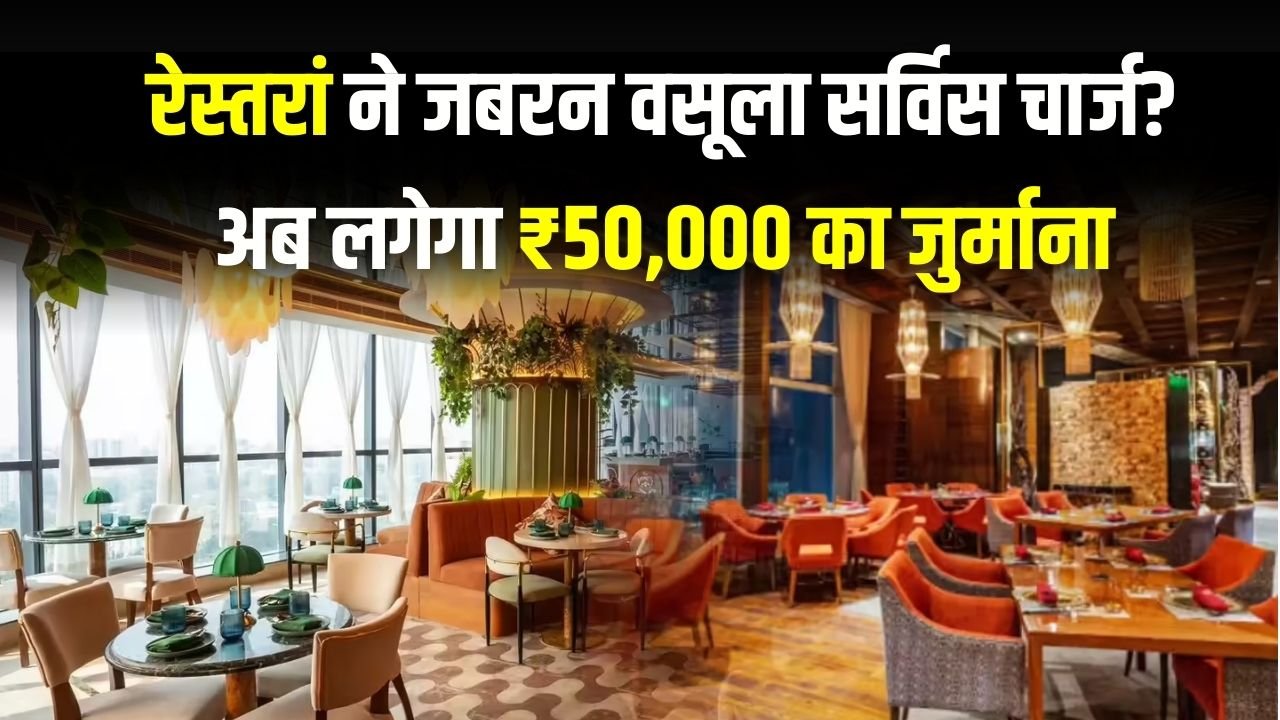
When the bill arrives after enjoying a delicious meal at a hotel or restaurant, there is often a ‘Service Charge’ of 5% to 10% already attached, in addition to the food price and GST. Many times waiters or managers call it mandatory and insist on extorting money from customers. As per the clear guidelines of Central Consumer Protection Authority (CCPA) and Ministry of Consumer Affairs, forcibly charging service charges from any customer is completely illegal, arbitrary and unfair trade practice. If a restaurant refuses to remove service charge from the bill even after you refuse, it can face a fine of up to ₹50,000 and its license can also be in jeopardy.
Under the Consumer Protection Act, 2019, CCPA has set strict rules regarding service charges:
-
Completely Voluntary: Whether to pay service charge or not depends entirely on the choice of the customer. This is a kind of ‘tip’. If the customer is satisfied with the service, he can leave a tip of his own free will; The restaurant cannot ask for it by adding it to the bill in advance.
-
Prohibited from adding by default: No food outlet can automatically add service charge to the bill nor force it by writing on the menu card that “service charge is mandatory.”
-
No entry restrictions: No restaurant shall refuse admission or service to any customer on condition of non-payment of service charge.
-
No double whammy of GST: Increasing the bill by adding separate GST on service charge is also a violation of rules.
Instead of panicking or disputing when you see a service charge on your bill, follow these three steps:
-
1. Make a verbal request for deletion: First of all, ask the billing counter or manager to immediately remove the service charge amount from the bill as per consumer protection rules. In most cases, managers immediately remove it and print a new bill.
-
2. Keep the original copy of the bill with you: If the restaurant management clearly refuses to waive the service charge, instead of wasting time in arguing, pay the bill with the service charge attached and keep the original copy (or a clear photo) of that bill safely. This bill will become the most solid legal evidence of your complaint.
-
3. Give warning about filing complaint: Make it clear to the restaurant management that a complaint about this extortion is being lodged with the National Consumer Helpline (NCH) and CCPA.
The Government has provided several digital and instant means for the convenience of consumers:
-
National Consumer Helpline (NCH Portal):
-
official portal consumerhelpline.gov.in Go to.
-
Register or login by entering your mobile number.
-
Click on ‘Register Grievance’, select ‘Restaurant/ Hotels’ in the sector.
-
Enter restaurant name, address, bill number and upload the photo of the bill.
-
-
Umang App: By downloading the Umang app on your smartphone, you can register a complaint directly through the National Consumer Helpline Service within a few minutes.
-
Toll-free numbers and SMS:
-
toll free number 1915 Register your complaint directly with the customer care executive by calling .
-
Other than this 8800001915 Help can also be obtained by sending SMS.
-
-
WhatsApp Helpline: Official WhatsApp Number of Ministry of Consumer Affairs 8800001915 Complaint details can be lodged directly through the chatbot by typing ‘Hi’.
-
e-Daakhil Portal: If you wish to seek damages and compensation, edaakhil.nic.in You can directly file a case online in the District Consumer Disputes Redressal Commission without any lawyer.
Strict action is taken against the restaurant if the complaint is found true in Consumer Commission and CCPA:
-
Refund of illegal recovery: The restaurant will have to return the entire amount of service charge along with interest to the customer.
-
Damages for mental torture: The customer may be ordered to pay legal expenses and damages ranging from ₹5,000 to ₹25,000 for causing unnecessary trouble.
-
Heavy penalty: The CCPA imposes an administrative fine of up to ₹50,000 in the Consumer Welfare Fund on establishments that repeatedly ignore the rules.
Be aware of your rights as a consumer. The job of the restaurant is to charge a clear price for the food and service; Charging any kind of hidden service charges without your consent is punishable by law.