 look news india

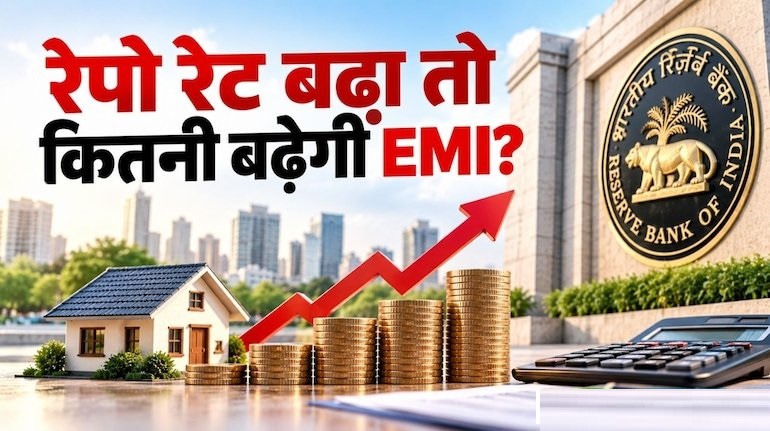
Discussions about a possible increase in repo rate by 25 basis points (0.25%) in the Monetary Policy Committee (MPC) meeting of the Reserve Bank of India (RBI) has increased the concern of borrowers across the country. Whenever the central bank increases the repo rate, it becomes expensive for commercial banks to borrow funds from the Reserve Bank. As a result, banks immediately pass on these increased costs to their retail borrowers. Today, most banks in the country link floating-rate home loans to the External Benchmark Lending Rate (EBLR/RLLR). This simply means that as soon as the repo rate increases by 0.25%, home loan interest rates also increase by 0.25% within 24 to 48 hours. Home loan and personal loan EMIs are the biggest expense in the monthly budget of middle-class families in cities like Lucknow, Delhi, Mumbai or Bengaluru, and this increase adds to the monthly installment as well as the total interest burden by lakhs of rupees.
Home loan is a long term loan (15 to 25 years), so even a small change in interest rate of just 0.25% (25 bps) has a huge impact on the total payment. Let us understand the exact calculation through two popular loan options of 20 and 25 years:
Instead of immediately increasing the monthly EMI of customers when the interest rate increases, most banks quietly extend the loan tenure by 1 to 2 years. Many times borrowers do not even realize that their 20 year loan has turned into 22 years. For example, on a loan of ₹50 lakh, if you do not increase your monthly EMI, a rate increase of 0.25% may add approximately 12 to 18 months of additional installments to your loan tenure, thereby increasing your interest expense unexpectedly. However, as per the recent rules of the Reserve Bank, it is now mandatory for banks to give the customer the option at the time of reset whether they want to increase their monthly EMI or extend the tenure.
Personal loans are usually given for a short tenure of 3 to 5 years and without any guarantee (Unsecured Loan). The impact of repo rate on personal loan depends on whether your loan is on fixed rate or floating rate:
-
Fixed Rate Personal Loan: More than 80% of personal loans in the country are approved at fixed interest rates. If your personal loan is already running at a fixed rate, the increase in repo rate will be reflected in your existing EMI or interest rate. Zero (0%) effect Will have to.
-
Floating Rate Personal Loan: If your loan is on floating rate, banks can increase its interest by 0.25%. For example, on a personal loan of ₹5 lakh for a tenure of 3 years at 12.25% instead of 12.0%, the EMI will be approximately Rs. ₹58 to ₹60 per month This means the total additional burden over 3 years is around ₹2,100 to ₹2,200. However, new personal loan interest rates may be expensive for new customers.
If your EMI increases after the repo rate hike, you can completely eliminate the burden of additional interest by adopting these practical financial strategies:
-
Annual Partial Prepayment: Repay just 5% extra of the loan principal from the bonus or savings you receive every year. This reduces the principal amount of the loan and lakhs are saved in interest.
-
Increase EMI yourself by 5% every year: If there is an annual increase in your income, then contact the bank and get a voluntary increase of 5% to 10% in your EMI. With this, the 20 year loan will be repaid in just 13-14 years.
-
Home Loan Balance Transfer (Refinancing): If your current bank is charging exorbitant interest rates (like 9.25%+) while other government or private banks are offering loans at lower spreads, consider transferring your loan to a bank with a lower interest rate.