 look news india

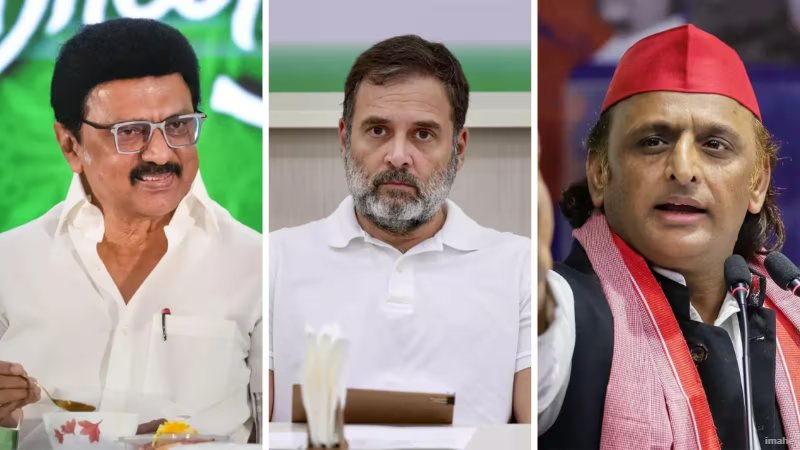
In the Indian political scenario, whenever opposition parties put aside their ideological differences and stand together on a big platform, the excitement intensifies from the country’s capital to the political corridors of the states. In the current political environment, the echo of opposition unity against the ruling party is continuously being heard. On many occasions, political analysts and opposition leaders present it as a huge success that he has united the scattered opposition.
But the history of electoral politics testifies that leaders joining hands and sharing the stage does not in itself guarantee electoral victory or votes. The mathematics of public mood, ground equations and voter behavior is more complex than paper alliances. In today’s political scenario, the biggest question remains whether opposition unity can really prove to be a game-changer in the electoral arena or it will remain limited to mere statements.
When political parties form alliances among themselves or come together on a common platform, they often keep the mathematics of seat sharing and electoral coordination at the forefront. They feel that if the vote share of all opposition parties is added, they will be far ahead of the vote share of the ruling party. But politics is not a simple mathematical formula that two plus two always equals four. On the ground, every party has its own core voter base, with its own local priorities, ambitions and resentments.
It has been seen many times that a voter who stands loyally in favor of one party hesitates in transferring his vote to the other alliance partner. Ideological differences, old rivalry among workers at the local level and leadership tussle are all such reasons which weaken the alliance which looks strong on paper on the ground. This is the reason why mere opposition leaders coming together on the stage cannot be considered a guarantee of conversion into votes.
To achieve success in any election, merely counting the shortcomings of the government or joining hands is not enough. The public is always looking for a strong, clear and trustworthy alternative. The biggest challenge before the opposition parties is to prove that they have not gathered just to protest, but they have a better vision and concrete policies for the development of the country or state.
Apart from this, it is also necessary for the opposition to have a universally recognized and charismatic face who can give confidence to the public in the form of Prime Minister or Chief Minister. As long as there is confusion regarding leadership in the opposition camp and the leader of every party is in a race to prove itself supreme, there remains doubt in the mind of the common voter about providing a stable government. Rising above emotional slogans, the public now gives priority to good governance and stability.
It is often believed in politics that if there is an anti-incumbency wave going on against the government, then the unity of the opposition can work as icing on the cake. This may also be true to some extent if the opposition parties come together completely and aggressively raise the issues of the people on the ground. But if the opposition is awake only during the election season and remains engaged in mutual rhetoric the rest of the time, the public immediately senses such opportunistic alliances.
People should have faith that the parties which are contesting elections together in opposition today will not disintegrate due to infighting if the government is formed tomorrow. Lack of stability and trust is the biggest reason due to which even a united opposition sometimes proves unsuccessful in winning the hearts of the people.
Today’s Indian voter has become more aware, intelligent and development-oriented than ever before. He does not vote for any party just because they all stand together in one camp, but he assesses which party can do the best work for his local development, employment, security and future. Opposition unity may be a necessary political strategy, but it is not the lifeblood of victory in any election.
Unless the opposition parties overcome their strategic shortcomings and make their place in the hearts of the people by maintaining coordination among the workers at the grassroots level, mere joining hands of the leaders cannot be a guarantee of votes. Amidst the upcoming election results and political turmoil, it will be very interesting to see whether the opposition is able to make any concrete changes in its strategy or not.