 look news india

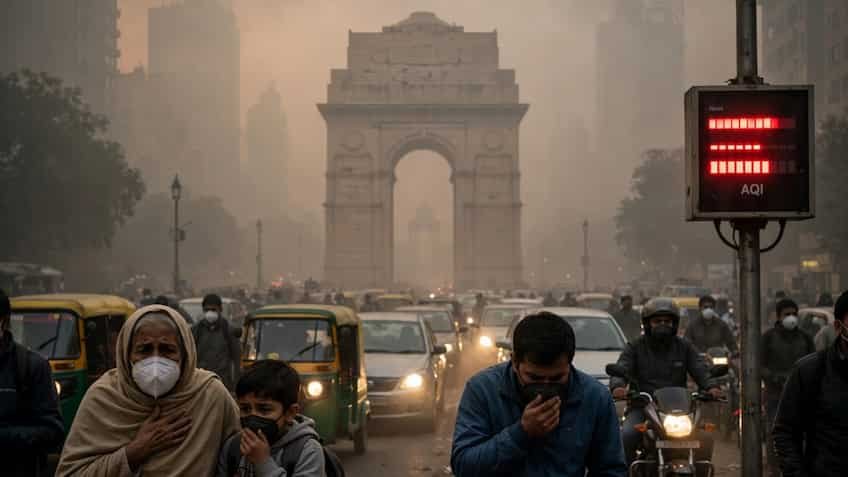
New Delhi: At present, the people of the country’s capital Delhi and NCR do not seem to be getting any respite from the poisonous air. On Wednesday, November 25, 2026, the average air quality of Delhi was recorded in the ‘Poor’ category for the 11th consecutive day. According to the latest data from the Central Pollution Control Board (CPCB) and Delhi Pollution Control Committee (DPCC), Delhi’s average air quality index (AQI) was recorded between 220 and 228. Although the overall average of the capital is in the ‘poor’ category, the pollution level in many major residential and commercial areas of Delhi has crossed the ‘Very Poor’ category i.e. 300. Along with this, the Meteorological Department (IMD) has issued a warning of dense fog and further drop in temperature in Delhi-NCR for the next two days, due to which the smog problem is likely to become more serious.
If we look at the data of 56 active stations out of 59 monitoring centers in the capital, the air is in poor condition at more than 36 places, while pollution has reached extremely dangerous levels in five major hotspot areas. The worst air quality was recorded in Anand Vihar, where the AQI rose from 336 to 357. Apart from this, AQI 329 to 331 was recorded in Delhi Technological University (DTU), 313 in North Campus of Delhi University, 305 in IGNOU-Maidan Garhi and 303 in Burari Crossing. Talking about other areas, AQI was recorded at 296 at CRRI Mathura Road, 282 at Commonwealth Sports Complex, 272 at Chandni Chowk and 263 at Bawana. The only saving grace was that the air in Sri Aurobindo Marg (140), Lodhi Road (147) and Patparganj (148) remained in ‘moderate’ category.
Along with Delhi, the level of pollution in the adjacent NCR cities also remains worrying. AQI was recorded at 297 in Haryana’s Panchgaon and 280 in Gurugram, which is very close to the very poor category. In Uttar Pradesh, AQI has been recorded at 248 in Meerut, 240 in Ghaziabad, 215 in Noida and 209 in Greater Noida. At the same time, with AQI being recorded at 236 in Bhiwadi of Rajasthan and 231 in Bahadurgarh of Haryana, a thick layer of dust and smoke has covered the entire NCR region. The levels of PM 2.5 and PM 10 particles due to vehicular smoke and local dust are not reducing despite restrictions in the second phase of the Graded Response Action Plan (GRAP) implemented by the Commission for Air Quality Management (CAQM).
Along with pollution, severe cold and fog have also increased the problems of Delhiites. The minimum temperature in Delhi dropped to 10 degrees Celsius on Wednesday morning, which was the coldest morning recorded this season. The minimum temperature was recorded at 10.1 degrees Celsius at Lodhi Road and 10.4 degrees Celsius at Ayanagar. According to the forecast of the Indian Meteorological Department (IMD), the night temperature may further fall to 9 degrees Celsius by Friday, November 27. Along with this, the Meteorological Department has issued an alert of dense fog in Delhi-NCR, Haryana and Punjab for the next two days. Experts say that due to slow wind speed (about 5.6 kilometers per hour) and falling temperature, Delhi’s air may worsen by November 28.
In view of this double attack of smog and falling temperature, the Environment and Health Department of Delhi Government has issued a special advisory for the citizens. Doctors have strictly advised the elderly, small children, pregnant women and people suffering from respiratory or heart disease to avoid walking or exercising in the open in the morning and evening. An appeal has been made to use N95 mask while leaving the house, cover the body with warm clothes and drink lukewarm water. Additionally, if any citizen notices garbage burning or pollution spreading activity in his area, he can lodge a complaint on Delhi Pollution Control Helpline number 1800-202-5051 or 10741.