 look news india

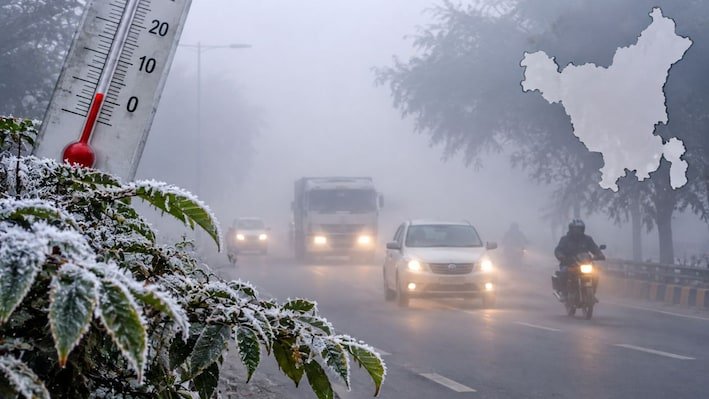
Chandigarh: The weather in Haryana is once again going to change rapidly in the last days of November. After the fresh snowfall in the hilly states of Himachal Pradesh, Jammu and Kashmir and Uttarakhand, the direct north-westerly icy winds blowing from there have increased the chill in the plains of the state. According to the latest bulletin of Indian Meteorological Department (IMD) Chandigarh Centre, dense to very dense fog will prevail over most parts of Haryana on 26 and 27 November 2026. Meteorologists say that due to increase in humidity and slowing down of wind speed, visibility in many districts may drop to near zero in the morning, which will have a direct impact on life and traffic.
The Meteorological Department has issued a special warning for the northern, central and south-eastern districts of the state. According to the forecast, the maximum impact of fog will be seen in the GT Road belt and districts adjacent to NCR. These mainly include Ambala, Yamunanagar, Kurukshetra, Kaithal, Karnal, Panipat, Sonipat, Jhajjar, Gurugram, Faridabad, Palwal and Nuh (Mewat). Apart from this, there will be dense mist and fog in the morning in Hisar, Sirsa, Fatehabad, Jind, Rohtak, Bhiwani and Charkhi Dadri of Western Haryana. Drivers may face a lot of trouble due to very low visibility on national highways (NH-44, NH-9 and KMP Expressway) during early morning and late night hours.
Along with fog, the minimum night temperature is also continuously falling in the state. According to the weather center data, the minimum temperature in Hisar, Balsamand and Mahendragarh (Narnaul) has dropped to the level of 7 to 8.5 degrees Celsius, due to which cold wave-like melting is being felt in these areas. Apart from this, the night temperature in Karnal, Ambala, Sirsa and Rohtak also remains around 9 to 10 degrees Celsius. Due to light sunshine during the day, the maximum temperature is being recorded between 24 to 26 degrees Celsius, but as the evening approaches, the cold winds are giving shivers. The Meteorological Department estimates that the temperature may drop further by 2 to 3 degrees Celsius by November 30.
The increasing cold and dense fog in Haryana has also made the problem of air pollution serious. Due to slowing down of wind speed and increasing humidity, pollutant particles are accumulating near the ground surface and forming ‘smog’. According to Central Pollution Control Board (CPCB) data, the air quality index (AQI) in Gurugram has crossed 280, while the air quality in Bahadurgarh, Faridabad, Sonipat, Panipat and Dharuhera also remains close to ‘poor’ to ‘very poor’ category. Due to this mixture of smog and fog, people are experiencing burning sensation in the eyes and difficulty in breathing.
In view of the warning of zero visibility, Haryana Traffic Police and Administration has issued a safety advisory for the drivers. Police have appealed to people to avoid unnecessary travel during dense fog, use low-beam headlights and fog lights while driving and maintain adequate distance from the vehicle ahead. It has also been made mandatory to install reflector tape behind vehicles. On the other hand, agricultural experts have said that this cold and fog is very beneficial for the growth of wheat crop, but to protect mustard and vegetable crops from frost, farmers should keep doing light irrigation in the fields as per need.