 look news india

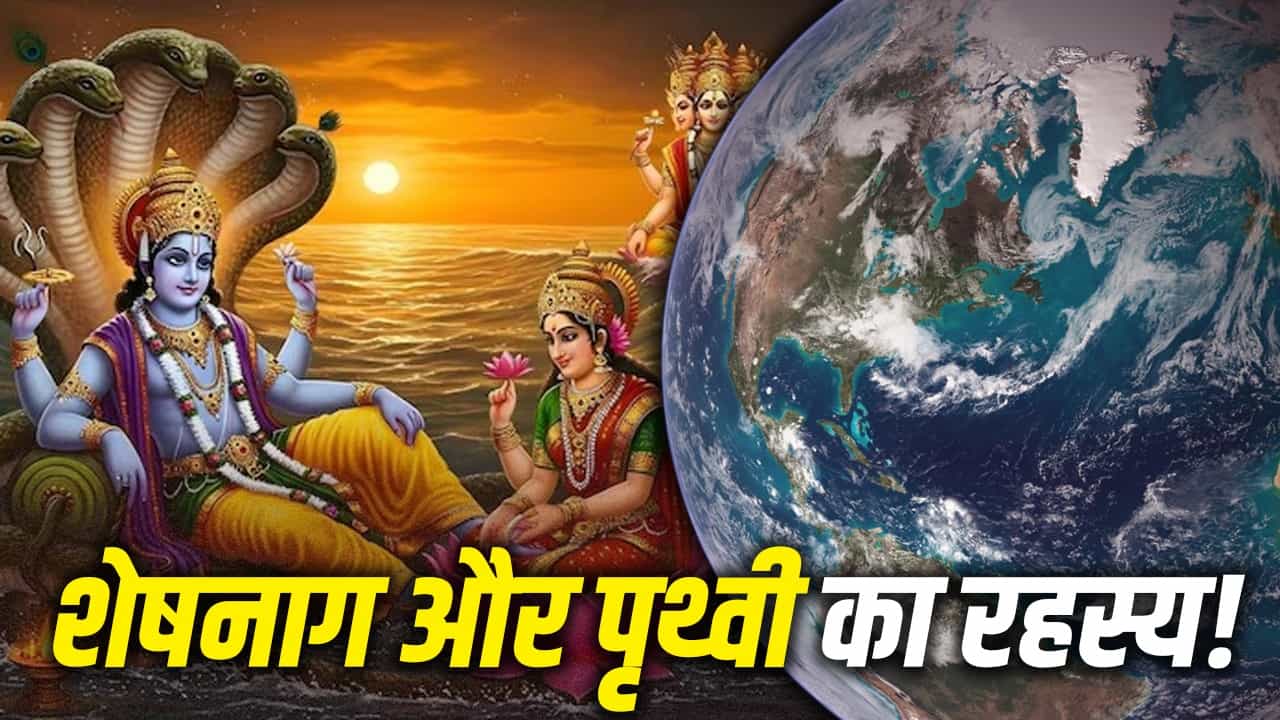
In Sanatan Dharma, the holy festival of Nag Panchami, celebrated on the fifth day of Shukla Paksha of Shravan month, is a special festival to express gratitude towards nature, living beings and cosmic energy. In every corner of India—from Uttar Pradesh, Madhya Pradesh, Bihar, Rajasthan, Maharashtra to South India—special worship of the Nag Devta is done on the day of Nag Panchami. With the arrival of this festival, an age-old belief and story in the public mind creates curiosity in everyone’s mind: “Is our entire earth really resting on the thousand hoods of Sheshnag?” Since childhood, we all have heard this folktale that when Sheshnag changes its hood or turns its head, an earthquake occurs on the earth. But when this is seen from the perspective of the modern generation and science, the question arises whether this is just a mythological imagination, or is there some deep scientific and astronomical truth hidden behind it coined by our ancient sages? Let us investigate this mystery in depth in the light of scriptures, Vedas, Puranas and modern science.
Mythological narrative: What is the description of Sheshnag in Shrimad Bhagwat and Vishnu Purana?
In the Vedic scriptures, Sheshnag is not an ordinary snake or a poisonous reptile, but is described as the divine form of Lord Shri Hari Vishnu and the basis of his infinite power. A very grand and detailed description of Sheshnag is found in the twenty-fifth chapter of the fifth canto of Shrimad Bhagwat Mahapuran and in Vishnu Purana.
According to the Puranas, under the lowest part of the underworld i.e. Talatal and Rasatal, Lord Sankarshan (Sheshnag) with the demonic power named ‘Anant’ resides. He has a thousand heads, on whose crowns the shining divine gems dispel the darkness of the entire universe. It is written in Shrimad Bhagwat that the entire globe i.e. this round earth rests on the hood of Sheshnag as if a small mustard seed is placed on the peak of a huge mountain. When the time of doomsday comes, a cataclysmic fire called ‘Samvarak’ emerges from the mouth of Sheshnag, which again dissolves the entire universe into nothingness.
According to the story described in Aadi Parva of Mahabharata, Sheshnag was the eldest and most pious among the sons of Maharishi Kashyap and his wife Kadru. Seeing the wickedness of his brothers, he chose the path of penance. Pleased with his rigorous penance, Lord Brahma gave him a boon and ordered him to provide stability to this fickle and wavering earth from below. After receiving the permission of Lord Brahma, Sheshnag held the earth on its hood.
Real meaning of the word ‘remnant’: Those who remained even after the cataclysm
According to Sanskrit grammar and Vedic philosophy, the literal meaning of the word ‘shesh’ is ‘that which remains’. Even when the entire water, land, air, fire, sky, planets, stars and the entire visible universe is destroyed in the great cataclysm, the element that remains as a residue, which never gets destroyed, is the ‘residue’. For this reason he is also called ‘Anant’ (which has no end).
From the spiritual point of view, Sheshnag is not a real snake made of flesh and blood, rather he is the living personification of Eternal Time, Infinite Space and Latent Cosmic Energy. Lord Vishnu as the ‘controller of creation’ is depicted resting on the bed of Sheshnag in Kshirsagar. Its symbolic meaning is that consciousness (Vishnu) always operates the creation on the basis of infinite time and energy (Sheshnag).
What is the scientific and astronomical perspective? Metaphor of space-time and gravity
When this mythological belief is seen through the lens of modern Astrophysics and the laws of physics, the amazing scientific vision of the ancient sages comes to the fore.
According to modern science, the Earth is hanging at zero in space and is not resting on any physical object. According to Albert Einstein’s General Theory of Relativity, the entire universe is located on ‘Space-Time Fabric’. Just as placing a heavy ball on a stretched sheet causes rotation or curvature in it, in the same way celestial bodies rotate in space-time. The ancient sages gave the beautiful metaphor of the ‘coiled serpent’ (Sheshnag) to make the common people understand that instead of falling on some baseless place, the Earth rests on the balance of an invisible, infinite and continuously flowing cosmic pull (Gravitational Pull & Magnetic Field).
Like the coil of a snake, the path of our Galaxy (Milky Way) and the Solar System is curved. The Earth’s magnetic field, which keeps the Earth balanced on its axis, also creates an energy ring between the North and South Poles, which exactly matches the shape of a serpent with its hood extended. Therefore, “The Earth rests on the hood of Sheshnag” is actually a very rich scientific and philosophical expression to explain the balance of the invisible gravitational force and the infinite cosmic space.
Sheshnag, Vasuki and Takshak: Know what is the difference between these main forms of snakes?
Often people get confused about mythological snakes and consider Sheshnag, Vasuki and Takshak to be the same. The place and function of these three in Hindu scriptures are completely different:
-
Sheshnag (Infinite): He is the exclusive servant and bed of Lord Vishnu. Lakshman in Treta Yuga and Balram in Dwapara Yuga are considered to be the incarnation of Sheshnag. Maharishi Patanjali, the author of Yoga Sutra, is also considered to be an incarnation of Sheshnag.
-
Nagraj Vasuki: Vasuki is a great devotee of Lord Shiva and remains as a necklace around his neck. At the time of churning of the ocean, the gods and demons used Vasuki serpent as a neti (rope) to churn the Mandarachal mountain.
-
Takshak Naga: Takshak is the son of Nagaraj of Patala Loka and Kashyap-Kadru, who is mentioned mainly in the Mahabharata in the context of biting King Parikshit and the subsequent ‘Naagdaha Yajna’ of Janmejaya.
Kundalini Shakti and the secret of snake energy in the human body
In Indian Yoga Shastra, the structure of the subtle body and the universe is considered to be the same – “Yatha Pinde Tath Brahmande” (What is in the universe is same in the human body). According to Yoga science, the basic life energy remains in a sleeping state by making ‘three and a half rounds’ on the Muladhar Chakra located at the lowest part of the human body i.e. the root of the spine. This ‘Kundalini Energy’ It is said.
Just as Sheshnag provides support to the earth, similarly Kundalini in serpentine form provides life force to the human consciousness and body. When a seeker awakens this Kundalini through Pranayama and meditation, this energy travels through the spine and reaches the Sahasrara Chakra (brain), where the soul unites with the Supreme Soul. Worship of snakes on Nag Panchami actually symbolizes the awakening of this spiritual and spiritual energy sleeping within us.
Ecological and environmental importance of snake worship on Nag Panchami
Apart from mythological and spiritual significance, Nag Panchami is deeply related to our food security and environmental balance (Ecology).
Ancient India was an agricultural civilization. During the rainy season i.e. in the months of Sawan-Bhado, when crops flourish in the fields, there is a huge increase in the number of rats, insects and harmful creatures. Rats cause huge financial loss to farmers by destroying standing crops and granaries. At such times, snakes naturally protect the fields by eating rats and poisonous insects. That is why the snake is considered sacred in Indian culture. ‘Teacher’ That is, he is considered the protector of fields and grains and has been called a ‘friend of farmers’. Worshiping snakes on the day of Nag Panchami gives the message of man’s gratitude towards nature and conservation of biodiversity.
Instead of getting entangled in mere superstition or fabricated stories, this holy festival of Nag Panchami leads us towards the scientific and spiritual contemplation of Sanatan Dharma, where every living being, every planet and the entire universe is bound in unbreakable harmony with each other.