 look news india

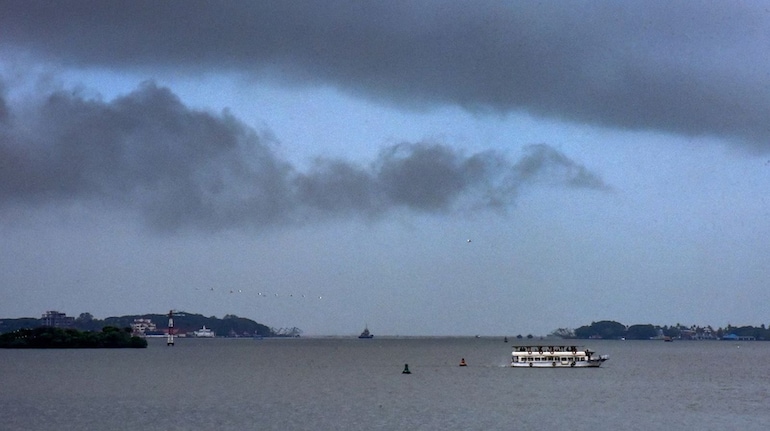
There seems to be a sudden big break in the speed of the south-west monsoon, which was moving at a record breaking pace in the beginning of June. Till a few days ago, the monsoon which was progressing much ahead of its normal dates, has now come to a complete standstill in the central and western parts of the country. The biggest concern for meteorologists at this time is the latest satellite images from the Indian Space Research Organization (ISRO) and global weather agencies, which have exposed the bitter truth of the monsoon stopping.
Why did satellite photos increase the concern of meteorologists?
The latest pictures received from European weather satellite Meteosat, American weather agency NOAA and ISRO’s INSAT-3DS satellite have presented a very scary and worrying picture. Normally, by mid-June, the parts of India where there should have been thick bands of dense and dark monsoon clouds, are looking completely clear when seen from space. This drastic reduction of monsoon clouds over large areas of central, western and peninsular India is the biggest and strongest evidence that there has been a major ‘pause’ in the progress of the monsoon.
Dangerous effect visible on ground, 65% lack of rain in Central India
The direct and harmful effect of this sudden slowdown of monsoon is now clearly visible on the land of the country. According to the latest data of the Indian Meteorological Department (IMD), between June 4 and June 16, central India has recorded 65 percent less rainfall than normal. Due to this huge decline, Central India has currently become the most affected weather region of the entire country. This time is very important for sowing of Kharif crops in Maharashtra, Madhya Pradesh, Chhattisgarh and many major agricultural districts around them, but during this period there has not been even minimal monsoon rain, due to which lines of worry have been drawn on the forehead of the farmers.
Why did monsoon get stuck in Solapur after a promising start?
This year the entry of monsoon was very wonderful and full of expectations. The South-West Monsoon reached the Kerala coast on June 4, 2026, three days later than its normal date (June 1), but soon after that it gained a very aggressive pace. By the second week of June, the monsoon had covered Kerala, Tamil Nadu, Karnataka, Goa, Andhra Pradesh, Telangana, Odisha, West Bengal, Bihar and the entire Northeast India. Even in some parts of Maharashtra, its entry was made before time.
But after this stormy pace the monsoon suddenly stopped. Monsoon has reached Solapur region of Maharashtra and is stuck at one place for more than a week. Monsoon usually arrives in Vidarbha by June 15, but the farmers there are still gazing at the sky. Due to this slowness, there is a possibility of monsoon arriving in many parts of Uttar Pradesh with a delay of 5 to 10 days from its normal date. For example, in Lucknow, the city of Nawabs, where monsoon used to arrive by June 23 every year, it is now expected to arrive in the end of June or the first week of July.
Why did the speed of monsoon suddenly stop? These are 3 big reasons
Meteorologists have mainly attributed three major reasons behind the sudden stoppage of monsoon and disappearance of clouds:
-
Disappearance of low-pressure systems: In the month of June, strong low pressure zones are formed in the Bay of Bengal to push the monsoon forward. These systems act like a powerful engine drawing marine moisture into the interior of the country. In June this year, such systems are completely missing from the Bay of Bengal.
-
Weak Monsoon Trough: The ‘Monsoon Trough’ (low pressure belt), which causes widespread rain in North and Central India, is currently in a very weak state, due to which the wind pressure is not able to build up.
-
Interference of Western Disturbance: The suddenly active Western Disturbance in North India has also severely disrupted the normal flow and cycle of monsoon winds in the plains.
The shadow and looming danger of El Nino
‘El Nino’ is considered to be the biggest global and scientific reason behind this indifference of weather. IMD had already warned that moderate to strong El Nino conditions may persist in the Pacific Ocean during the entire monsoon season from June to September. In years when El Nino is active, the entire cycle of monsoon winds weakens, resulting in less rainfall than normal in India. The remaining gap has been filled by the Indian Ocean Dipole (IOD), which currently remains completely neutral, that is, it is not able to help India in reducing the ill effects of El Nino.
Monsoon has stopped, so why is it raining in some areas?
Despite the disappearance of clouds in satellite images, there is confusion among the common people regarding the rains occurring in some parts of the country. On this, scientists have clarified that not every rain that occurs in June is monsoon. For example, the recent rainfall over Nagpur and parts of Vidarbha was not due to fully established monsoon winds, but to local thunderstorms created by extreme heat and regional moisture. At the same time, due to the proximity of the Bay of Bengal branch in Northeast India and eastern parts of the country, locally heavy rains are continuing, while the rest of the main part of the country is facing drought.
Should we worry about this now?
Meteorologists say that the nature of monsoon never moves uniformly. In its journey of four months, there are always active and weak (break) phases. History is witness to the fact that many times in the past also the deficiency of June has been easily compensated by the heavy rains of July and August. However, this time weak cloud cover, 65% less rainfall in Central India and simultaneous activation of El Nino definitely raises concerns.
The next two weeks are going to be very critical for the agricultural sector of the country for the cultivation of paddy, soybean, cotton and pulses. If a new weather system forms in the Bay of Bengal by the end of June and the monsoon becomes active again, then huge losses to farmers can be avoided. Otherwise, if this dry spell continues even in July, there could be a major crisis on the water level of the reservoirs and the economy of the country.