 look news india

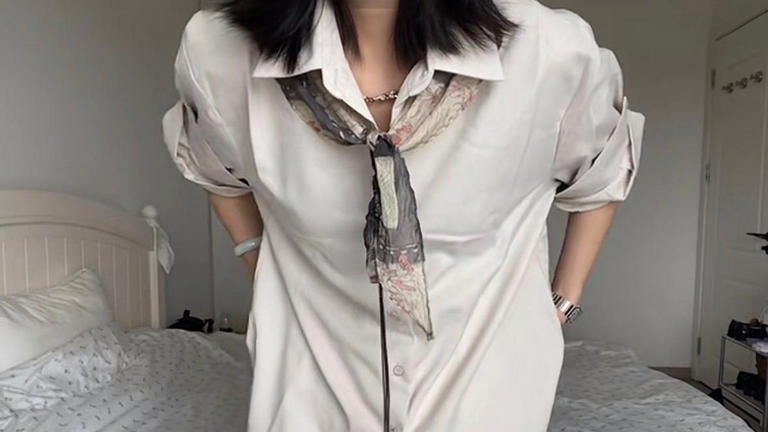
With changing times, the meaning of fashion is changing rapidly all over the world. Often men were seen adopting women’s clothes or unisex style, but currently a completely opposite and very unique fashion trend is spreading like wildfire in China. Young women here are now leaving aside traditional and trendy women’s clothes and making men’s wear like shirts, loose T-shirts, trousers and shorts a part of their wardrobe.
Millions of Chinese girls like Shanghai-based Kexin are now shopping extensively for menswear, not for their boyfriends or fathers, but to wear themselves. This trend, which has spread from social media to markets, has forced fashion pundits and the textile industry to think. Let us understand deeply why this ‘secret’ craze of wearing men’s clothes has started among Chinese women.
Big explosion of ‘gender-neutral’ and ‘menswear’ on social media
China’s most popular lifestyle and social media app Xiaohongshu, also known as ‘Rednote’ globally, has been flooded with videos and posts of women wearing men’s clothes. According to statistics, the tag ‘Women wearing men’s clothes’ has been viewed more than 8 crore (80 million) times on the app so far.
Along with this, the tag ‘Gender-Neutral Dressing’ has also crossed the magical figure of 9 crores. In these posts, girls are enumerating the innumerable benefits of men’s clothing – like the use of better cotton and linen, clean and simple cuts, soft stitching that gives comfort to the body, strong finishing and most importantly, extremely low prices.
That one line from the livestream, which changed Kexin’s thinking
Kexin, who works in Shanghai, says that this revolutionary change in her wardrobe started in the year 2023. During that time, livestream videos of men selling T-shirts started appearing repeatedly on his Chinese social media feed. Initially she thought that due to an algorithm glitch she was being shown men’s clothes, because she was not shopping for a man.
But one day he listened carefully to the livestream, in which the host was repeatedly shouting— “Girls can buy it in small size and wear it themselves… it is completely unisex!” In typical livestreams targeting women, there is often pressure to look ‘slim’ and wear tight clothing, but in this livestream the focus was on the quality, thickness and material of the clothing.
Considering the risk was low, Kexin ordered a men’s T-shirt for less than 100 yuan (about ₹ 1325). When the parcel arrived, she was surprised. That T-shirt was much more comfortable, thick, airy and durable than the expensive women’s T-shirts, while its price was only one-third of women’s clothes. After this, Kexin never looked back and today her wardrobe is filled with men’s clothes.
Reason 1: ‘996’ working culture and economic recession (reverse consumption)
China’s current weak consumer economy and the changed environment after Covid-19 are also a major reason behind this trend. Youth in China’s big cities ‘996’ schedule (Working 6 days a week, 9 am to 9 pm). In this highly tiring work culture, women want clothes that are comfortable and not constricting.
In this era of economic alertness, consumers have abandoned fast fashion. ‘Reverse Consumption’ Adopted the trend, i.e. buying more durable things at less expense. Kexin says, “Now I don’t see any point in spending unnecessarily on expensive women’s clothes. Men’s clothes are cheaper and last for many seasons without getting torn.”
Reason 2: ‘Child-size’ and body shaming in women’s clothes
The second most practical and biggest reason for this change is the ‘sizing system’ of women’s clothes in China. Chinese social media like Douyin But influencers often show that even the tops written ‘XL’ (Extra Large) in women’s clothes are so small that they hardly fit a thin girl. In a viral video, a blogger wore a women’s ‘L’ size top to her poodle (pet dog) and it fit her perfectly.
Because of this misleading sizing system, women with average and broad shoulders are forcibly pushed into the ‘plus size’ category, which is a form of mental body shaming. ‘Li’, a 170 cm tall lawyer from Shanghai, says that women’s clothes in China are not made for normal and strong bodies like hers. When he started wearing men’s ‘M’ (Medium) size, for the first time he felt the right fit and comfort in clothes.
Reason 3: Those big pockets of ‘men’s pants’ which women do not have
Lawyer Lee makes a very interesting and important point towards the practicality of men’s clothing. She says, “The pockets of men’s ‘M’ sized pants are so big and deep that I can comfortably fit my 11-inch tablet and an entire book in them, without affecting the fit of the pants. Can women’s pants or jeans do the same? Even carrying a lipstick or a smartphone in the pocket of our clothes makes them feel heavy and awkward.” This pocket-equality is also attracting women towards menswear.
Reason 4: Pressure on textile industry and decreasing quality
According to ‘Wang’, designer of a medium-sized Chinese fashion brand, the reason behind the declining quality of women’s clothing is the economic crisis of the textile industry. While the growth of China’s retail clothing sector was 15% in the year 2023, in the year 2024 it will fall to just 0.1% is left.
To save costs, many Chinese brands are now buying cheap, ready-made patterns from Southeast Asia, which do not fit the body shapes of Chinese women, instead of doing their own research. Moreover, making thin and small sized clothes is cheaper for the manufacturers because it requires less fabric and the stitching is not complicated. Wang warns that women’s clothing may become even thinner and more uncomfortable in the future due to rising costs. This is the reason why sensible Chinese girls are now completely shifting towards men’s strong and comfortable wardrobe.