 look news india
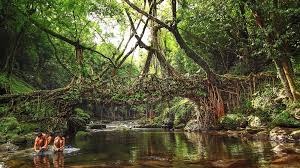
News India Live, Digital Desk: India’s north-eastern state Meghalaya has once again attracted the world’s attention. Prepared from the roots of rubber trees by the Khasi and Jaintia tribes here. ‘Living Root Bridges’ It has been officially nominated for permanent status as a UNESCO World Heritage Site. These bridges are not only a center of tourism, but are also the biggest example of sustainable architecture in the era of climate change.
What are living root bridges? (The Living Engineering)
These bridges are not made of any cement, iron or wooden logs, but ‘Ficus elastica’ The species are made by twisting and braiding the roots of rubber trees.
Manufacturing Process: Local people use bamboo structures to ‘guide’ the roots to grow from one end of the river to the other.
Time: A strong bridge is in the making 10 to 15 years It takes time.
Why are these bridges so special? (Key Features)
| Speciality | Description |
|---|---|
| strength | As the tree grows older, the roots become stronger. get it together 50 people Can lift the weight of. |
| lifespan | an average root bridge 500 years Can survive longer than. |
| eco-friendly | These bridges do not break despite floods and torrential rains, rather their grip becomes stronger after coming in contact with water. |
| double decker bridge | ‘Umshiang Double Decker Bridge’ located at Cherrapunji (Sohra) is the only one of its kind in the world. |
What will be the benefit of UNESCO nomination?
around Meghalaya 72 villages If these bridges spread across India get UNESCO status, then:
Global Conservation: International funds and technology will be available for the maintenance and conservation of these bridges.
Promotion of tourism: Eco-tourism will increase in rural areas of Meghalaya, which will increase local employment.
Scientific Research: Scientists will be able to study how natural resources can be used as an alternative to modern infrastructure.
‘Living’ wonders of Cherrapunji
of Meghalaya ‘Nongriat’ The village is the biggest center of these bridges. To reach here tourists have to descend about 3,000 stairs. For the people of the local Khasi tribe, these bridges are not just a way, but a part of their culture and ancestral heritage. They call them ‘Jingkieng Jri’.