 look news india

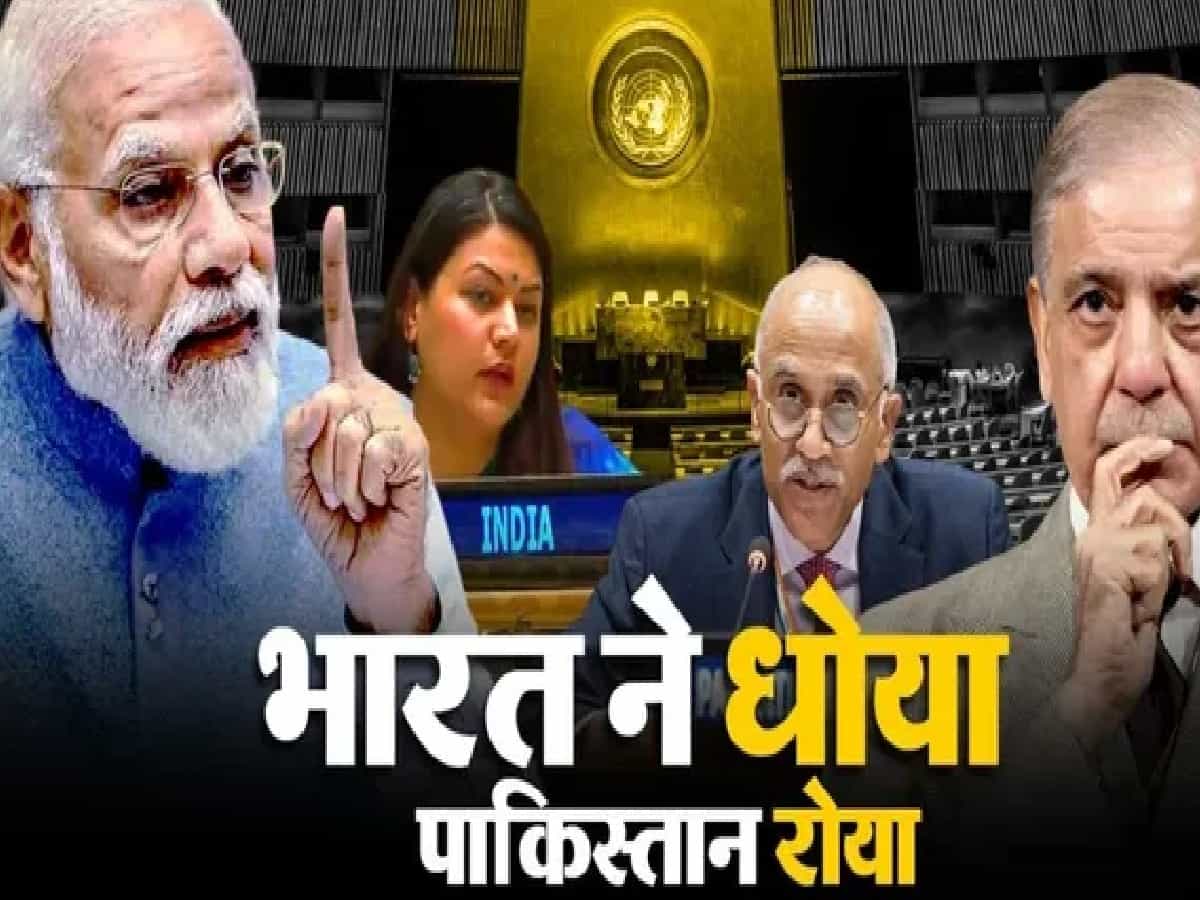
In the 81st annual high-level session of the United Nations General Assembly (UNGA), the largest forum of global diplomacy, Pakistan once again repeated its old tradition of causing international embarrassment. Pakistani Prime Minister Shehbaz Sharif, in his address before the heads of state around the world, played the old and worn out tune of Kashmir under domestic political compulsions. Shehbaz Sharif claimed that his country will continue to provide political, diplomatic and moral support to the people of Kashmir until they get the right to so-called self-determination. When the world was discussing serious issues like climate change, war crisis and economic stability, this irrelevant speech of the Pakistani Prime Minister became a laughing stock on the global stage.
India did not delay even an iota in responding to this false propaganda. Petal Gehlot, the first secretary of India’s Permanent Mission to the United Nations, blasted each and every lie of Pakistan under ‘Right to Reply’. The Indian diplomat said in a very calm and sharp tone that today this prestigious General Assembly has heard the bizarre and baseless claims of the Pakistani representative. This statement has come at a time when New York and the entire world is celebrating the 25th anniversary of 9/11, humanity’s worst terrorist attack. Petal Gehlot reminded the whole world that the mastermind of this gruesome attack and the world’s biggest terrorist, Osama Bin Laden, was finding safe haven for years in Abbottabad, right next to the Kakul Military Academy, the main Pakistani Army. He bluntly said that the Pakistani Army and its institutions before which today’s rulers bow down, has actually been the main nursery of global terrorism.
The issue of Kashmir between India and Pakistan has a long and historical record in the pages of the United Nations. Ever since the issue was first taken to the United Nations Security Council (UNSC) in January 1948, India has proved every time that the entire Jammu, Kashmir and Ladakh was, is and will always be an integral, indivisible and sovereign part of India. The part which Pakistan had illegally occupied by attacking in the name of tribals in 1947-48, is still a direct witness of its illegal infiltration in the form of Pakistan Occupied Kashmir (PoK). India has always explained to the international community that this is a purely bilateral matter under the Shimla Agreement and the Lahore Declaration and there is no scope for interference by any third party or institution.
On the contrary, Pakistan has been trying to divert the world’s attention from its internal failures by invoking decades-old and irrelevant resolutions in international forums. But since the abrogation of Article 370 of the Constitution on 5 August 2019, the rapid restoration of democracy, historic voting and unprecedented infrastructure development in Jammu and Kashmir has shaken every false narrative of Pakistan to its roots. Now whenever Pakistan mentions Kashmir in the corridors of the UN, the international community sees it as a political stunt by a desperate and bankrupt country.
Whenever Pakistan takes over the temporary arrangement or presidency of any forum, it does not shy away from misusing it for its vested interests. Last year in July 2025, when Pakistan got the opportunity of monthly presidency of the Security Council, instead of fulfilling its responsibility, it tried unsuccessfully to misuse the Indus Water Treaty and Kashmir to spread propaganda against India. At that time, India’s Permanent Representative to the United Nations, Ambassador Parvathaneni Harish, had strongly and officially condemned these actions of Pakistan in the open session of the Security Council.
Ambassador Harish informed the Security Council on the basis of facts and legal documents that India will never compromise with its sovereignty. He clarified that India’s stand regarding the Indus Water Treaty is completely legal and transparent, whereas Pakistan has been accustomed to give political color to every water agreement instead of cooperating on technical changes. This tough and rational resistance by India had completely isolated Pakistan in the Security Council and forced its supporting countries also to go on the backfoot.
India has time and again exposed before the world the irrefutable fact of how Pakistan has been using terrorism as a tool of its state policy. In the UNSC meeting of February 2025, India had termed Pakistan as the ‘Global Epicenter of Terrorism’ in the world. The leaders of dreaded terrorist organizations like Jaish-e-Mohammed, Lashkar-e-Taiba and Hizbul Mujahideen are still living a safe life in the shadow of Rawalpindi and Islamabad. More than 20 UN-designated international terrorists openly hold rallies and collect funds on Pakistani soil.
India has handed over digital and forensic evidence of the 2001 Parliament attack, 26/11 Mumbai massacre and dastardly attacks on innocent tourists in Pahalgam to the UN Counter-Terrorism Committee. In May 2025, when Indian security forces had killed terrorists infiltrating from across the border in ‘Operation Sindoor’, pictures were revealed of senior Pakistani Army officers draping their army flag on the dead bodies of those terrorists and giving them state honours. By presenting these photographs in the United Nations, India had exposed the hypocrisy of Pakistan in which it calls itself a victim of terrorism.
Pakistan’s duplicitous character on UN platforms becomes more exposed when it starts preaching on internal human rights. In June 2025, when an open discussion was going on in the United Nations Security Council on children and armed conflict, Pakistan had made fabricated allegations regarding the rights of children in Kashmir. India immediately hit back and said that the country which forcibly disappears innocent children in its Khyber Pakhtunkhwa and Balochistan provinces and throws them into the furnace of fundamentalism in madrassas, has no moral right to speak on human rights.
On the historic occasion of the 80th anniversary of the United Nations in July 2025, India showed a mirror to the global community that on one hand India, as the world’s fifth largest and fastest growing economic and democratic superpower, is leading humanity from space to digital technology, while on the other hand Pakistan is standing on the verge of bankruptcy. Pakistan is dependent on International Monetary Fund (IMF) loans and financial bailouts from friendly countries to provide oxygen to its daily economy. India gave a clear message that a country running on the crutches of debt and steeped in fanaticism is in no position to question India’s democratic maturity.
India has, over the years, developed an extremely aggressive, fact-based and infallible diplomatic strategy to dismantle every bit of Pakistan’s propaganda at the UN. The backbone of this strategy is the young diplomats of India, who without any hesitation expose Pakistan to the world. Whenever any leader or representative of Pakistan makes false allegations against India, India immediately uses the ‘Right to Reply’ and within minutes demolishes their claims through statistics, international reports and historical references.
India does not rely on empty statements but places cross-border infiltration, serial numbers of recovered Chinese and Turkish weapons, GPS trackers and confessions of captured terrorists on the table of the UN counter-terrorism committees. India also puts on record Pakistan’s internal plight—human rights abuses in Sindh and Balochistan, forced conversion of daughters of Hindu, Sikh and Christian minorities and repression of political opponents. As a result, the situation today is such that whenever Pakistan turns on the mic to speak against India in the United Nations, the world already understands that this is just a new drama of a failed country.