 look news india

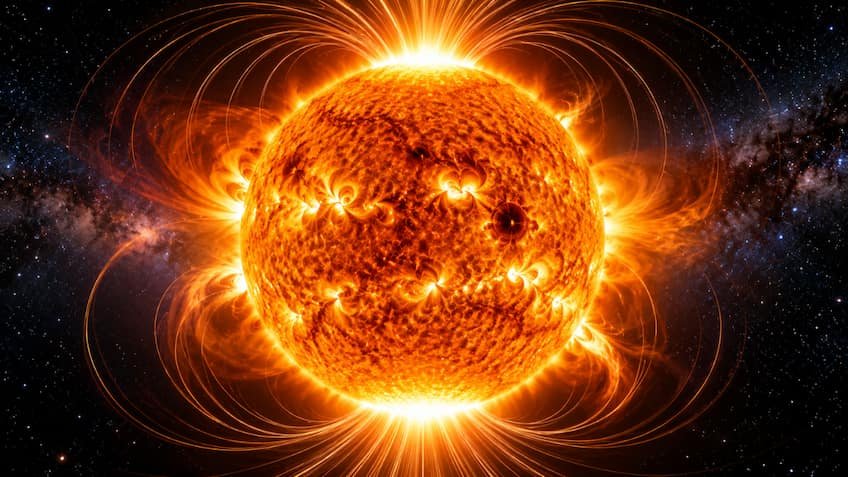
Indian Astrophysicists have achieved a historic scientific breakthrough in the field of space science. A joint research team of Indian scientists has made public a ground-breaking research on the internal magnetic dynamics of the Sun’s remote and till now considered mysterious solar poles. For decades, a puzzle in global solar physics has been how magnetic fields at the sun’s poles are created, weakened, and reversed in each 11-year solar cycle. Sophisticated theoretical models developed by Indian scientists and satellite data analysis have proved that the microscopic plasma movements occurring in both the poles of the Sun are the real mother of the severe solar storms that occur throughout the solar system. This discovery is also extremely sensitive because at present the Sun is passing through the peak of its 25th solar cycle i.e. ‘Solar Maximum’.
The Sun is not a solid body but a huge blazing ball of extremely hot, charged gas i.e. plasma.
-
Differential Rotation and Meridional Flow: The Equator of the Sun rotates faster than the poles. Additionally, beneath the Sun’s surface, giant rivers of plasma flow from the equator to the poles, which is called ‘meridional circulation’.
-
Accumulation of magnetic energy at the poles: Indian researchers found that this flow of plasma near the poles acts like a giant magnetic sink, where billions of tons of magnetic energy remains buried for decades.
-
Reversal of poles: When this stored energy reaches its peak, the north and south magnetic poles of the Sun change their positions. During this process, huge magnetic explosions occur in the Sun’s atmosphere, which spread in space at the speed of billions of kilometers per hour in the form of solar flares and coronal mass ejections (CME).
This upheaval in the sun’s poles has a direct and serious impact on the modern technological lifeline of the Earth:
-
Disruption in mobile towers and cellular connectivity: When intense solar storms originating from the Sun’s poles approach Earth, they highly ionize and disturb Earth’s upper atmosphere (ionosphere). Disruption of the ionosphere scatters high-frequency (HF) radio waves, which can cause severe interference or dropped calls in cellular backhaul links, satellite-based mobile connectivity, and ground communications.
-
Wandering of GPS and navigation systems: GPS systems used by aviation, ships, and civilians rely on microscopic signals from satellites. The effects of solar plasma cause delays in GPS signals by thousandths of a second, resulting in inaccurate location readings on navigation maps by several meters to kilometers.
-
Destruction of satellites floating in space: Charged particles released from polar eruptions can burn out sensitive electronic circuits of communications and weather satellites orbiting in low-Earth orbit (LEO). Also, due to increased atmospheric drag, satellites may deviate from their orbit and get destroyed prematurely.
-
Risk of blackout in power grid: Geomagnetic storms generate powerful ‘geomagnetically induced currents’ (GIC) on the Earth’s surface. This excess current can overheat and burn large power transformers of power companies, causing power outages for hours or days in many cities.
This research has made effective use of data obtained from India’s first Sun mission ‘Aditya-L1’, Kodaikanal Solar Observatory’s more than 100-year-old historical database and state-of-the-art supercomputing simulations. Scientists from the Indian Space Research Organization (ISRO) and leading astrophysical institutions have clarified that by understanding the precise behavior of the solar poles, scientists will now be able to issue Space Weather Warning 24 to 48 hours in advance of solar storms hitting the Earth.
The modern world is completely dependent on digital networks, digital banking, satellite communications and electricity. At such a time, uncovering the secrets of the sun’s poles by Indian scientists is not just an astronomical achievement, but it is also like creating a strong protective shield to keep the global digital infrastructure and telecommunication networks safe from any space catastrophe in the future.