 look news india
News India Live, Digital Desk: Different religions of the world have their own beliefs regarding marriage. While in Sanatan Dharma it is considered a bond and ‘sanskaar’ of seven births, in Islam it is a ‘contract’ (Nikah). But have you ever wondered how marriages take place in Buddhism, which shows the path of peace and compassion? Buddhist marriages are known for their simplicity, absence of extravagance and unwavering devotion towards the thoughts of Gautam Buddha. Let us know the process of Buddhist marriage which makes it completely different and special from other religions.
‘Marriage’ is not a ritual, it is a social system.
According to experts in Buddhism, marriage here is not considered a supernatural or religious sacrament. Lord Buddha saw marriage as a ‘social system’ and a responsibility for household life. This is the reason why traditions like horoscope matching, auspicious time, vermilion or seven rounds of fire are not mandatory in a Buddhist marriage. The basis of marriage here is love, mutual respect and loyalty.
How does the process of rituals begin?
Engagement is not mandatory in Buddhist weddings, but in modern times families decide the date with mutual consent. No astrological moment is observed for this. During engagements the bride and groom often wear white and exchange rings. The Buddhist monks present at the event give their blessings to the couple.
Decoration of the pavilion and ‘Buddha Vandana’
The marriage ceremony is held at home, Vihar (Monastery) or any hall. At the venue of the ceremony, a white cloth is spread on a table and an idol or picture of Lord Buddha is installed. Candles, incense sticks, fresh flowers, peepal leaves, water pot and fruit-kheer are kept in front of the idol.
At the beginning of the wedding the bride and groom and everyone present sit facing the Buddha and chant the sacred mantras:
Trisharan: ‘Buddha Saranam Gachchami, Dhamma Saranam Gachchami, Sangham Saranam Gachchami’.
Panchsheel: Five moral vows are recited.
Pooja Gatha: Buddha is worshiped by offering lamps, incense and flowers.
Father’s pledge and bride and groom’s oath
There is a special ritual in a Buddhist marriage in which the father of the bride pours water from the pot with his right hand on the joined hands of the bride and groom. It is a symbol of dedication. After this the bride and groom take an oath of their duties towards each other:
Husband’s Oath: He will respect his wife, be loyal, cooperate in household chores and keep her happy by giving him gifts.
Wife’s Oath: She will manage the household efficiently, welcome guests, be loyal to her husband, and protect the family property.
Water Abhishek and recitation of Mangal Sutta
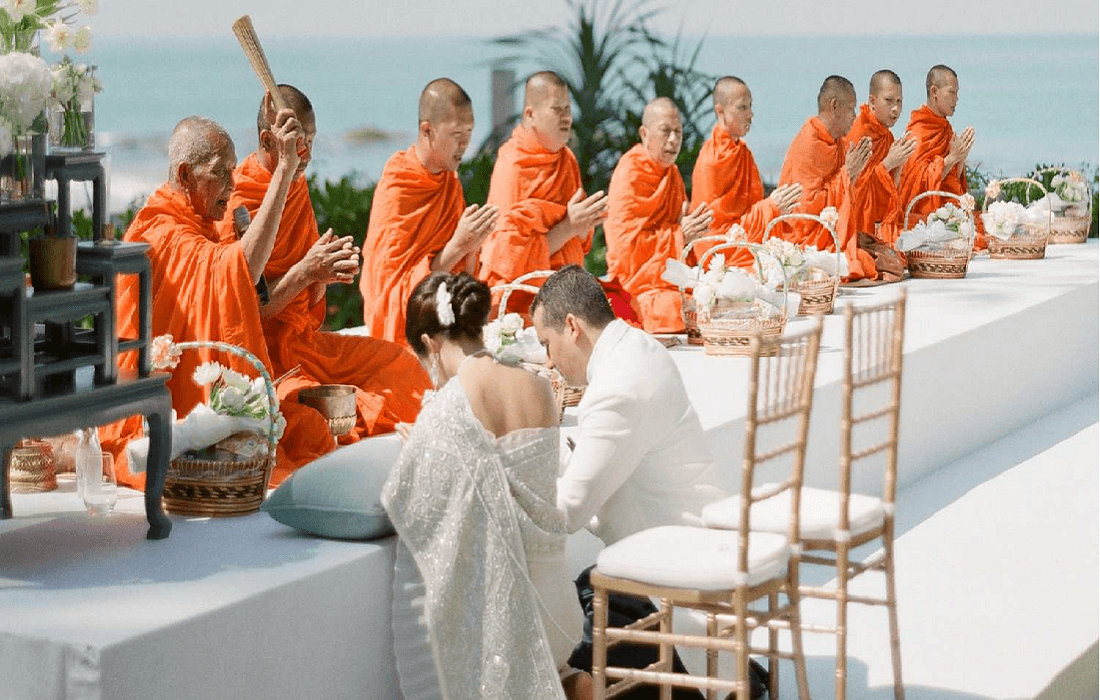
After taking the oath, Buddhist monks recite ‘Mangal Sutta’ or ‘Jayamangal Gatha’. During this, water is sprinkled on the hands of the bride and groom or a ‘white thread’ is tied on their hands as a symbol of protection. At the end, the bride and groom garland each other and the monks solemnize the marriage by garlanding them with Buddha’s garland (prasad form).
Simplicity and dowry free farewell
The entire process of Buddhist marriage is completed in just 30 minutes to an hour. At the end of the ceremony, food (donation) is first offered to the monks, followed by the guests. Taking dowry or spending unnecessarily for show is prohibited in Buddhism. Only items given voluntarily are accepted as gifts.