 look news india

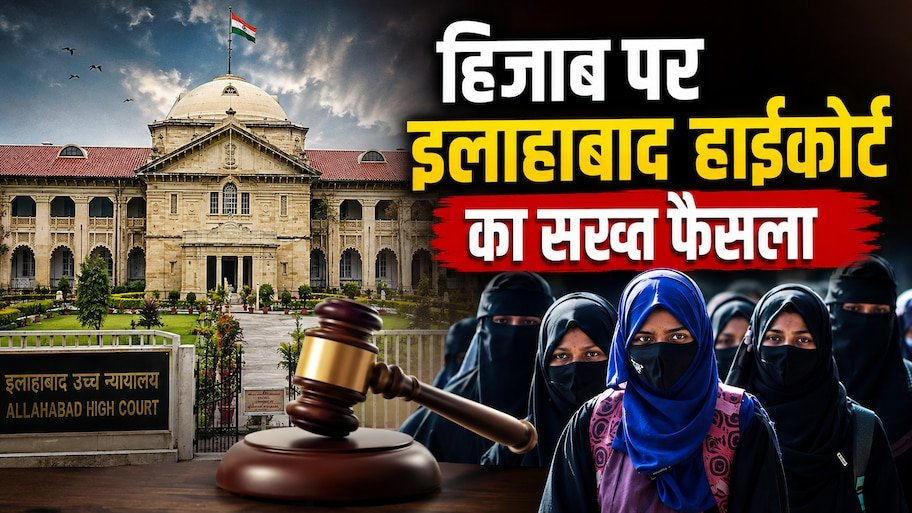
Allahabad High Court has given a big and example-setting decision regarding dress code, discipline and religious symbols in schools. The High Court has outrightly rejected the plea filed by a Class 11 Muslim student seeking permission to wear hijab (headscarf) along with the prescribed school uniform. Justice J.J. A division bench of Justice Munir and Justice Inderjit Shukla made it clear that as long as the dress code of a school is fair, non-discriminatory and in force for the purpose of maintaining discipline in the institution, no student can insist on a change in it on the basis of personal or religious preference.
What was the whole matter and the student’s argument?
This case pertains to a private unaided CBSE school (Tagore Public School) located at Atarasuiya, Prayagraj.
-
The petitioner student (Sukaina Rizvi) had passed her 10th examination from the same school and was taking admission in 11th.
-
The student filed the petition through her mother saying that she had been coming to school wearing a headscarf since Class 6 and no objection was ever raised then.
-
At the time of admission in class 11, the school management refused to wear scarf citing dress code.
-
The student’s argument was that wearing hijab is her fundamental right and an essential part of her faith under Article 19(1)(a) (freedom of expression) and Article 25 (religious freedom) of the Constitution.
4 big and important comments of Allahabad High Court
The Division Bench, while dismissing the petition, made important observations from a legal and constitutional point of view:
-
1. Hijab not a mandatory religious practice: The court said that the petitioner could not produce any concrete religious texts or evidence to prove that wearing a headscarf inside the classroom is an essential religious practice of Islam and without it her religion would be in danger. Quoting the Karnataka High Court’s landmark 2022 decision, the court said that other high courts have also been of unanimous opinion on this.
-
2. Prior exemption does not create legal right: The court rejected the student’s argument that she had been wearing the scarf for years. The court said that if the school had earlier given the relaxation due to hesitation, laxity or not strictly enforcing the rules, it does not give the student any vested or legal right to bypass the rules forever.
-
3. Uniform promotes secular environment and equality: The court said that the school dress code erases social, economic or religious differences among children and creates a ‘religion-neutral’ environment inside the classroom.
-
4. Individual exemption will break the structure of discipline: If students are given the freedom to change the uniform based on individual preferences, it will destroy the very concept of ‘uniform’ and the administrative control of the school will be lost and depend on the individual wishes of the students.
The High Court found that other Muslim girl students are also studying in the school who wear normal uniform without any objection. This clear decision of the court has once again made it clear that equality and institutional discipline in educational institutions will be kept above individual preferences.