 look news india

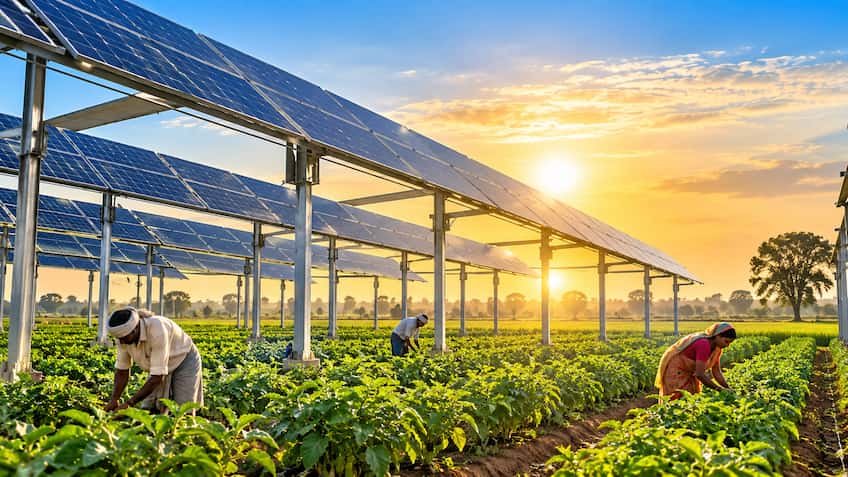
The Central Government has started working on a revolutionary strategy to strike a balance between energy security and food security in India. According to the Ministry of New and Renewable Energy (MNRE), India can add additional solar power capacity of more than 5 gigawatts (GW) through ‘Agrivoltaics’ (AgriPV) technology in the next three to four years. The biggest miracle of this technology is that green electricity is generated through solar panels on the same land above and cultivation of traditional crops, vegetables and horticulture continues below.
This initiative is considered a game-changer to address the concerns associated with the acquisition of large amounts of fertile land for large utility-scale solar parks in the country. Just ahead of the high-level conference to be held in New Delhi from 21 to 23 October, the Ministry has made it clear that a roadmap has now been prepared to take Agrivoltaics from experimental (pilot) projects to large-scale commercial rollout.
In traditional solar plants, solar panels are installed very close to the ground surface, making the entire land unfit for farming. In contrast, in an agrivoltaic system, solar panels are installed on structures 2.5 to 3.5 meters high.
Sufficient distance and angle is kept between these panels in such a way that the movement of sunlight and air on the ground remains normal. Farmers can easily run tractors and other modern agricultural equipment under these panels. Due to the light shade of the panels, moisture is retained in the soil for a long time, which reduces evaporation and saves 20 to 30 percent of irrigation water. At the same time, due to greenery under the solar panels, the local temperature remains cool, which also increases the power generation efficiency of the solar panels.
According to Santosh Kumar Sarangi, Secretary, Ministry of New and Renewable Energy, agrivoltaic projects require tall iron structures and special foundations. Due to this, these projects are cheaper than normal ground-mounted solar plants. 25 to 30 percent more expensive Are there.
The Ministry is preparing a special ‘AgriPV Support Scheme’ and comprehensive policy document to bridge this additional cost gap. The central government aims to motivate states and private developers by providing financial incentives so that large-scale production can reduce manufacturing costs over time and make tariffs commercially competitive.
The pace of rapid deployment of agrivoltaic systems will depend on what kind of procurement rules the state governments and their power distribution companies (Discoms) implement. The Ministry is holding detailed meetings with various state DISCOMs to create a transparent tariff structure that will enable DISCOMs to procure agri-solar power directly from farmers and rural developers.
Under the PM-KUSUM scheme, farmers are already being encouraged to set up small solar plants of 500 kW to 2 MW in their barren or fertile fields. Integrating the Agri-PV policy with PM KUSUM, farmers will get a stable and guaranteed monthly income every month by selling their crop income as well as excess power to the grid.
India is a country of diversity, where the soil, intensity of sunlight and climate are different in every state. The ministry is collaborating with various agricultural universities and the Indian Council of Agricultural Research (ICAR) to identify crops suitable for different agro-climatic zones.
Studies so far have proven that leafy vegetables (like spinach, fenugreek, coriander), tomatoes, chillies, turmeric, ginger and medicinal plants produce higher yields than normal under solar panels, as they do not require extremely hot sunlight. Successful pilot projects of agrivoltaic farming in states like Rajasthan, Gujarat, Madhya Pradesh, Maharashtra and Uttar Pradesh have shown that farmers can become energy producers (prosumers) without losing their main livelihood.
India has taken an ambitious global pledge to achieve 500 GW of non-fossil fuel based energy capacity by 2030. To achieve this goal the country will need millions of hectares of land. In a densely populated country it is not possible to give up fertile agricultural land just for energy.
In such a situation, agrivoltaic technology has the potential to change the rural landscape of India forever by ensuring ‘Dual Use of Land’. This target of 5 GW capacity in the next 3-4 years will not only give a new impetus to India’s clean energy revolution, but will also take the rural economy to new heights of economic self-reliance by making the country’s Annadata a true ‘Urjadata’.