 look news india

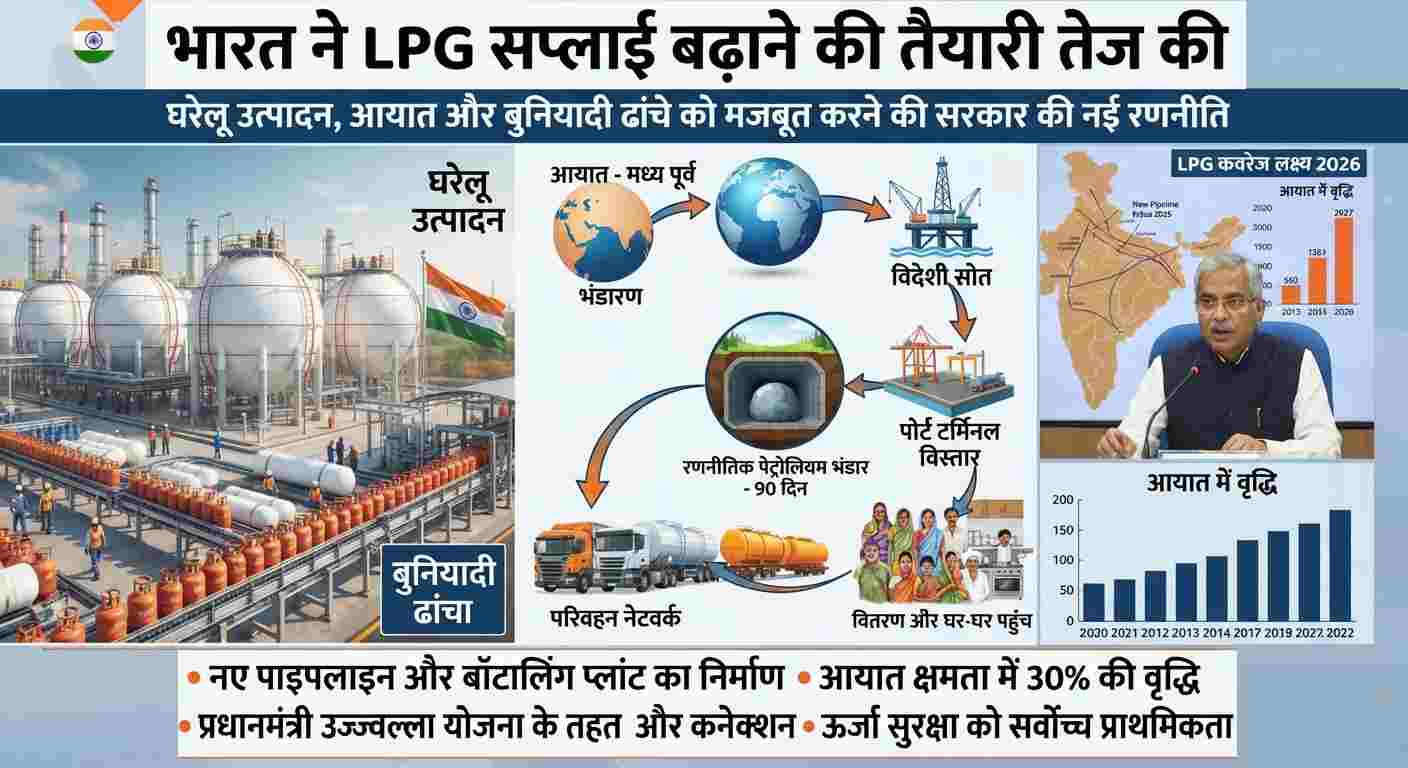
Amidst the ongoing geopolitical turmoil in West Asia and risks to the movement of ships in the Strait of Hormuz, the Government of India has created a permanent and historic security loop to protect the kitchens of crores of families in the country from any possible fuel crisis. For the first time in the country, the Ministry of Petroleum and Natural Gas has issued an official order to set maximum LPG production targets for all 21 major refineries and upstream producing companies in the public and private sector.
As per the guidelines issued by the Ministry, the total combined LPG production capacity of the country is to be 63,810 tonnes per day has been fixed. This capacity is more than double the domestic daily production (about 35,900 tonnes per day) for the financial year ending March 31, 2026 and is capable of meeting 70 per cent of India’s total daily consumption (about 91,000 tonnes per day) through domestic refineries alone. This new structure of the government will act as a permanent standing mechanism, which will be activated with immediate effect in case of supply disruption in the international market or obstruction in the passage of ships.
Reliance got the biggest responsibility: Know which company got how much daily quota
Against the total target of 63,810 tonnes per day set by the government, all major energy companies in the public and private sector have been assigned specific production quotas as per their refining capacity:
-
Reliance Industries Limited (RIL): Reliance’s 33 million tonne per annum capacity Domestic Tariff Area (DTA) refinery at Jamnagar in Gujarat is facing a crisis. 18,000 tons LPG which is the largest individual share of the total target. Reliance’s 35.2 million tonne SEZ refinery, dedicated only to exports, has been kept out of this mandatory target.
-
18 Public Sector Refineries (PSU Refineries): 18 government refineries jointly operated by Indian Oil Corporation (IOCL), Bharat Petroleum (BPCL) and Hindustan Petroleum (HPCL) 31,470 tonnes per day Production target has been assigned.
-
Nayara Energy: For Russia’s Rosneft-backed Nayara Energy’s 20 million tonne capacity refinery at Vadinar (Gujarat). 4,480 tonnes per day The production level has been fixed.
-
Upstream Gas Producers (ONGC and GAIL): Companies extracting LPG from natural gas like ONGC and GAIL have to pay Rs. 6,460 tons Quota for LPG production has been given.
Why was there a need for standing framework? 64% import dependence and the lessons of the West Asia crisis
A total of 33.2 million tonnes (about 3.32 crore tonnes) of LPG was consumed in India during the financial year 2025-26. Of this, only 13.1 million tonnes was produced domestically, while the remaining 21.3 million tonnes of LPG had to be imported from abroad. This simply means that India depends on imports for more than 64 percent of its total LPG requirement.
About 90 percent of this import comes from the Gulf countries (Saudi Arabia, Qatar, UAE and Kuwait), whose ships reach Indian ports through the narrow Strait of Hormuz in the Persian Gulf. In recent months, the military conflict in West Asia and attacks on ships have caused severe disruption to this sea route. At that time the government had to take ad-hoc steps like issuing emergency orders, increasing production from refineries and limiting the sale of commercial cylinders. Taking a lesson from those circumstances, the government has now created a legal and institutional framework so that in case of any future foreign disruption, domestic consumers do not have to face problems like rationing, gas shortage or delay in refill.
Diversion of petrochemical streams and naphtha-to-LPG: How will production be increased?
Refineries have been directed to implement several advanced technological and operational changes to take their LPG production capacity above the current minimum level:
-
Diversion of Propane and Butane: Refineries and petrochemical complexes have been directed to divert the flow of propane, butane, propylene and butylene used in plastics and polymer manufacturing from petrochemical production directly to the LPG pool.
-
Naphtha-to-LPG Conversion: Companies have been asked to activate Naphtha-to-LPG Conversion processes in their units.
-
Upgradation of Catalytic Cracking Units (FCCU): Gasoline-based fluid catalytic cracking units have been ordered to be upgraded to petro-fluid catalytic cracking units to maximize cooking gas production from heavy gases released during refining of crude oil.
As per the Ministry’s order, this production schedule will be comprehensively reviewed every six months (on January 1 and July 1 of every year). Under this, the quota will be updated on the basis of commissioning of new refineries, addition of new gas fields or capacity expansion in existing units.
Geographic diversification of supply: LPG and crude deals increased from non-Gulf countries
Along with doubling domestic production, India has also made a major change in its international procurement strategy:
-
Reduction in dependence on the Hormuz route: According to a recent official briefing by the Petroleum Ministry, more than 70 per cent of India’s crude oil imports now come through safe sea routes outside the Strait of Hormuz.
-
New contracts from the US, Latin America and Africa: India has secured long-term cargoes of LPG and LNG from countries such as the United States, Argentina, Algeria and Brazil, thereby spreading the supply risk across multiple geographies.
-
Indian Naval Escort: Indian flagged LPG carriers and crude tankers transiting through sensitive waters are being provided round the clock security surveillance under ‘Operation Sankalp’ of the Indian Navy.
PNG expansion and subsidy management: preparing for a sustainable energy future
To reduce the pressure on imported LPG in the long term, the government is rapidly expanding domestic connections of Piped Natural Gas (PNG) under the City Gas Distribution (CGD) network. Consumers in urban and suburban areas where the pipeline reaches are being shifted to PNG, so that a safe buffer of leftover LPG cylinders can be reserved for rural and remote areas where pipeline network is not feasible.
Apart from this, continuous supply to more than 10 crore beneficiary families of Pradhan Mantri Ujjwala Yojana and relief through Direct Benefit Transfer (DBT) has been kept on top priority.
Perfect energy security shield for 140 crore citizens
This new LPG production framework implemented by the Central Government for 21 refineries is a landmark step towards India’s energy diplomacy and self-reliance. Whether there are war clouds looming globally, sea routes blocked or huge fluctuations in international prices – this strong structure of domestic production of 63,810 tonnes per day will ensure that the stove of the common citizen does not go out in any corner of the country. This policy step taken in time is proving to be a strong shield towards making India self-reliant and free from external pressures in the field of energy.