 look news india

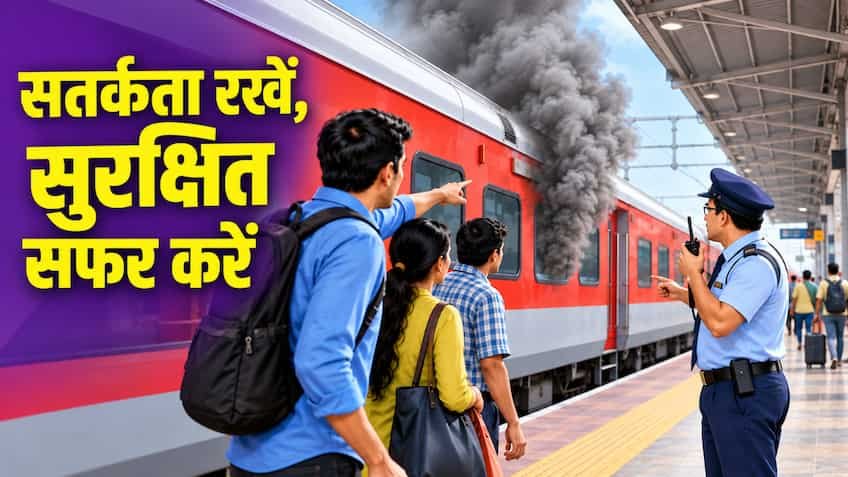
Indian Railways is the lifeline of the country, in which more than 2 crore passengers travel every day. Safety during journey is the first priority of both Railways and passengers, but sometimes unexpected emergencies arise like technical fault, short circuit, stove burning in the pantry car, spark of cigarette or inflammable substances carried by the passengers causing fire or filling of train coach with poisonous smoke. At the time of any such sudden accident, the biggest enemy is not the fire, but the ‘panic’ and stampede that spreads inside the bogie. When suddenly siren sounds or smoke fills in the closed environment of the bogie, people lose their direction and fall on each other and lose their lives. Indian Railways and disaster management experts say that the first 3 to 5 minutes of a fire are ‘golden minutes’. If passengers maintain their composure and follow correct and scientific safety procedures, they can not only save their lives but can also rescue hundreds of co-passengers.
As soon as flames or thick smoke is seen in the coach, the first and most basic step is to try to stop the train immediately. Every bogie has a red colored emergency alarm chain near the windows and at both ends of the coach. Pull it downwards with full force. As soon as the alarm chain is pulled, the pressure of the brake pipe of the train is released and the loco pilot (train driver) and train manager (guard) get an audio-visual alert in the cabin, due to which the train starts stopping automatically.
However, an extremely important technical precaution must be taken when pulling chains. If the train is passing through a long river bridge (Railway Bridge), narrow viaduct or deep tunnel, avoid pulling the chain there. If a train stops inside a bridge or tunnel, there is no exit on either side and rescue operations become almost impossible. In such a situation, let the train first exit the bridge or tunnel and immediately pull the chain as soon as it comes near an open field or a station. If the fire is serious, immediately convey the message through walkie-talkie to the coach attendant or TTE to the guard.
All air conditioned (AC) coaches, pantry cars, brake vans and guard coaches of Indian Railways are mandatorily fitted with dry chemical powder (DCP) or modern ABC type fire extinguishers. In sleeper and general coaches also, these are installed at both ends near the toilet or above the coach attendant’s seat. If the fire is in its initial stages—such as a small spark under a charger socket, curtain, or seat—then remove the red cylinder without wasting time by breaking the glass or opening the bracket.
Internationally recognized for operating fire extinguishers ‘PASS’ Follow the formula:
-
P(Pull): Remove the safety pin and seal on the cylinder handle by pulling firmly.
-
A (Aim): Point the mouth of the nozzle or pipe not over the flames, but towards the base of the fire.
-
S (Squeeze): Press the upper lever or handle of the cylinder with full force so that the chemical powder comes out.
-
S(Sweep): Spray the nozzle at the root of the fire by moving it from side to side like a broom. Remember to never pour water on a fire involving electrical equipment or wires, always use chemical powder or a bucket of sand.
Scientific statistics of train accidents show that 80 percent of deaths in fire incidents are not due to burning, but due to toxic smoke and suffocation. Rexin, foam, plastic panels and insulation materials used in train seats release deadly gases like carbon monoxide and hydrogen cyanide when they burn.
To save life in this situation, remember two surefire rules:
-
Always stay close to the ground (Crawl Low): According to the laws of physics, hot air and poisonous smoke rapidly rise upward and accumulate on the roof of the coach. The layer of fresh oxygen at a height of 1 to 2 feet from the floor lasts the longest. Therefore, instead of running straight, walk in a crouch or crawl on your knees and elbows.
-
Make a wet cloth mask: Completely moisten a part of a handkerchief, towel, scarf or T-shirt with your water bottle and press it firmly over your nose and mouth. The wet cloth acts as a natural air filter, trapping hot soot, toxic smoke particles and lung-scorching hot gases.
When both the main doors of the coach are blocked due to smoke or fire, the only safe life-saving route of exit is through the ‘Emergency Exit Window’. Every coach of Indian Railways has 4 emergency windows, which are marked with red fluorescent paint and red stickers.
Correct way to exit through emergency window:
-
Go to the window marked with red. There is a red handle or lever below the window, which is tied with a wire seal.
-
Break this safety seal with a jerk and pull the handle upward.
-
As soon as the handle is pulled, the window mesh or iron grill opens outwards or upwards.
-
If it is an AC coach and the window is sealed with heavy glass, then break it by hitting all four corners of the glass with an emergency hammer installed in the corner of the bogie.
-
Make sure the train has come to a complete stop before jumping out of the window. Never jump from a moving train.
-
While getting down from the window, first take out the children, elderly and women and keep an eye on the other trains coming and going on both sides of the tracks so that they do not get hit by the train coming on the other track.
The most effective step to prevent fire from spreading throughout the train is ‘compartmentalization’. If the fire is getting out of control in any one bogie, immediately close and latch the heavy metallic door of the vestibule (corridor) connecting the two coaches. This door acts like a fire-barrier, preventing flames and smoke from entering the next coach. Along with this, the On-board Housekeeping Staff (OBHS), Ticket Examiner (TWhat to do if you see fire or smoke during train travel? Know important life-saving safety tips and emergency protocols of Indian Railways
Meta Description: Do not panic if you see fire or smoke while traveling in the train. Complete guide on important railway safety rules, correct way to pull alarm chain, use of helpline 139 and emergency window. (Indian Railways Fire Safety Tips)
Sudden smoke or fire in a coach while traveling in Indian Railways is a very sensitive emergency. In such a situation, instead of panicking or creating panic, only taking quick and correct steps can save the lives of passengers. As per Railway Protection Force (RPF) and disaster management guidelines, these safety measures should be adopted immediately when an emergency arises.
Take these 5 important steps immediately as soon as you see smoke or fire
-
Stop train by pulling alarm chain (ACP): Pull the alarm chain without delay if you see smoke or spark in the compartment. However, if possible, take care that the train does not stop at a long tunnel or high bridge, as rescue and evacuation can be done more safely on open tracks.
-
Use the fire extinguisher present in the coach: All AC and new LHB coaches are fitted with dry chemical powder (DCP) fire extinguishers near the doors or in the attendant cabin. Break its seal, remove the pin and place the nozzle towards the base of the flames and press the lever.
-
Open the Emergency Window: If it is not possible to reach the main door of the coach due to fire or smoke, use the red marked emergency window located in the middle of the coach. It can be safely taken out by pulling its handle or by breaking the glass with a safety hammer placed nearby.
-
Crawl Low: Toxic smoke and carbon monoxide gas are more dangerous than flames. Smoke always rises upward, so crouch close to the floor or crawl forward to breathe. Cover the mouth and nose thoroughly with a wet handkerchief or cloth soaked in water.
-
Cut off power supply: To prevent the rapid spread of fire caused by short circuit, ask the on-board staff or TTE to trip the main circuit breaker (MCB) of the coach immediately.
Give immediate information on helpline 139 and Railmadad
Immediately inform the ticket checker, coach attendant or guard present in the train about the incident. Along with this, use these means for technical and medical assistance:
-
Dial 139: Share your train number, bogie number and current location by calling Railways’ 24×7 all-in-one helpline 139.
-
RailMadad: Send ‘Security/Medical Emergency’ alert immediately through RailMadad app or web portal, so that the fire brigade and medical team at the next station is ready in advance.
What to do and what not to do while traveling (Dos and Don’ts)
-
Don’t be attracted to stuff: Don’t waste precious time trying to get out suitcases or heavy bags in case of an emergency; Saving lives is the top priority.
-
Avoid Stampede: Shouting or pushing in the narrow corridor of the coach causes the exit door to get blocked. Let children, elderly and women leave first.
-
Do not carry flammable items: Under Section 164 of the Railways Act, carrying gas cylinder, petrol, kerosene, acid or firecrackers in a train is a punishable offense punishable with imprisonment up to 3 years.
-
Do not smoke in coach or toilet: Smoking beedis, cigarettes or throwing burning matches/match sticks in the garbage is strictly prohibited in the train. If found doing so, heavy fines and legal action are taken.
Vigilance of passengers is the biggest protection during train travel. Major accidents can be avoided by taking appropriate action as soon as any untoward incident occurs.