 look news india

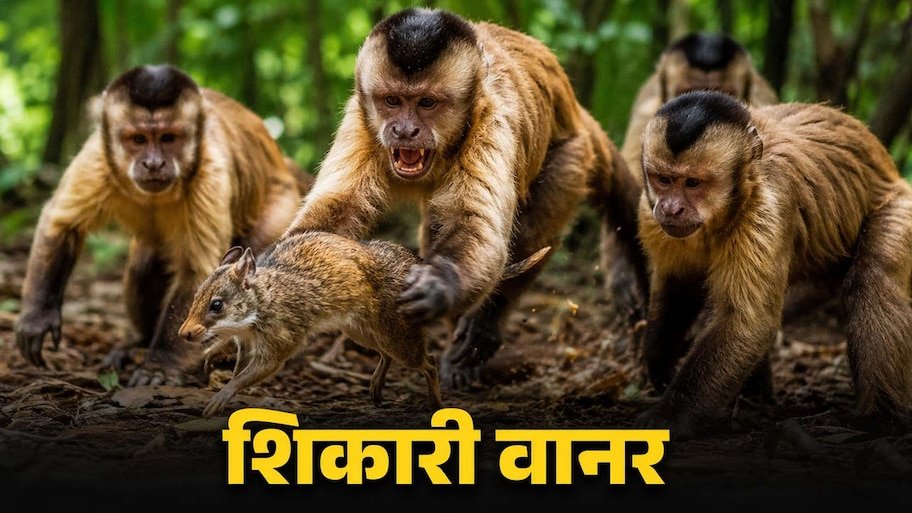
Generally, in human thinking, the image of monkeys is made up of a playful and innocent creature that lives on trees and satisfies its hunger by eating bananas, fruits, flowers, fresh leaves and nuts. Due to religious and cultural beliefs, monkeys are considered completely vegetarian animals in many societies including India. But scientists studying wildlife science and animal behavior (Primatology) have revealed a very scary and shocking truth behind this image. The reality is that many primates like monkeys, chimpanzees, langurs and baboons are not completely vegetarian, but opportunistic omnivores.
When favorable conditions change within the forests or the body is in dire need of a particular nutrient, these simple-looking monkeys transform into ferocious hunters like a ferocious wolf or leopard. They not only prey on small birds, squirrels, rabbits and deer, but also capture and eat the flesh of their own species or other small monkeys (such as the red colobus). This is not an accidental occurrence, but a regular and highly planned strategy for their life cycle and survival in the wild.
When monkeys or chimpanzees hunt any creature, their way of eating is quite different and hair-raising from other carnivorous animals. A tiger or lion usually likes to eat the back, thighs or muscles of its prey, but monkeys first break the skull of the prey, rip open its brain and stomach, take out its intestines and chew them with great gusto. International scientists like primatologists Jane Goodall and Craig Stanford have explained the deep biochemical reasons behind this in their decades of research.
Organisms that survive by eating leaves and fruits in the forest suffer from severe deficiencies in high-quality fats, lipids and essential fatty acids. The brain is the densest store of fat and calories in mammals. It is soft, easy to chew and eating it provides instant energy.
On the other hand, there are two big scientific reasons behind eating intestines. Firstly, the intestines contain semi-digested green food already digested by herbivorous prey, which is rich in vitamins and minerals. The second and most important reason is the supply of salt i.e. sodium and micronutrients. Salt is a rare commodity for primates in the wild, and they obtain this essential mineral in abundance from the intestines and blood vessels of their prey. The prey’s brain and intestines act as the most nutritious ‘superfood’ for them.
The behavior of monkeys while hunting is no less than that of a guerrilla army. Especially when chimpanzees and baboons living in the forests of Western and Central Africa go out hunting, they communicate like an organized gang. They give instructions to each other with eyes and body signals without making any sound. Their task is divided as they surround a herd of red colobus monkeys in the highest branches of the trees.
Some agile young male monkeys of the herd chase the prey from below, some surround the adjacent branches and block their escape route, which is called ‘blocker’. Finally, the most powerful and experienced alpha male of the herd leaps and catches the prey in the air. A captured creature is not killed immediately; Often they start disassembling his body parts while he is still alive. During this time, the screams of hunting echo throughout the forest, but only aggression and bloodlust are visible on the faces of the hunter monkeys. This organized strategy proves that they have the ability to plan at a high level and use collective intelligence.
Scientists have observed a very interesting and shocking social aspect that hunting among monkeys is not just a means to fill their stomach, but it is their biggest weapon to establish social politics and dominance. When a powerful male monkey succeeds in hunting, the entire group sits around him in a begging posture with outstretched hands.
With whom the meat of the hunt will be divided depends entirely on the power of the clan. The alpha male gives each piece of meat as a reward to his loyal companions so that no one can challenge his power in the future. Apart from this, male monkeys also use pieces of meat as ‘bribes’ or gifts to attract female monkeys and get their permission for mating (mating rights). Studies have shown that male monkeys who hunt more and share meat have the highest status in the herd and their offspring are also more likely to survive.
Apart from forests, now scary changes are also being recorded in the nature of rhesus macaques (red-faced monkeys) and langurs living around cities, towns and religious places. Due to deforestation and destruction of natural habitat, when monkeys move to human areas, their food habits become completely unnatural.
Eating junk food, fried foods, processed foods, and sometimes even meat scraps from garbage bins causes profound imbalances in their gut microbiome and hormonal balance. Excess of sugar and fat increases the levels of testosterone and cortisol (stress hormone) in their body, making them overly aggressive and irritable. This is the reason why today in many cities, incidents of monkeys attacking and eating pigeons, rats-squirrels, chickens and even the newborn babies of pet dogs and cats are continuously coming to light. Human interference has disturbed their natural balance and activated their predatory hunting instincts uncontrollably.
Anthropologists believe that this predatory form of monkeys is actually a window into our own evolutionary history. Millions of years ago, human ancestors were also herbivorous primates living on trees. But when due to climate change, dense forests started shrinking and open grasslands were formed, our ancestors also started eating insects, marrow and meat to survive.
The high fat and protein intake from meat played the most important role in making the human brain larger in size and highly intelligent. Today, when we see a monkey breaking the head of its prey and eating its remains, this scene may seem cruel and unnatural to us, but in the strict laws of nature it is only a naked form of ‘survival of the fittest’. When the challenge of survival in nature arises, the boundaries of vegetarianism and non-vegetarianism disappear and only the law of hunger and nutrition applies.