 look news india

The biggest news of this time is coming out from the global energy market. After a long period of tension, America and Iran are now moving towards a peace agreement. America has accepted Iran’s main conditions, after which the movement of ships and oil tankers through the strategically important Strait of Hormuz has once again started normally.
The biggest and direct impact of this geopolitical change has been on the prices of crude oil. A huge decline is being recorded in the prices of crude oil in the global market. Meanwhile, there seems to be a big opportunity for India after the temporary exemption from sanctions on Iranian oil. The country is hopeful of getting another big and cheap supplier of oil after Russia, which can end India’s oil crisis forever. Iran’s fleet of oil-laden ships is parked near Indian shores, just waiting to be given the go-ahead. But will it be so easy for India to buy this oil? Let us understand this entire equation.
America gave temporary extension of 60 days to Iran
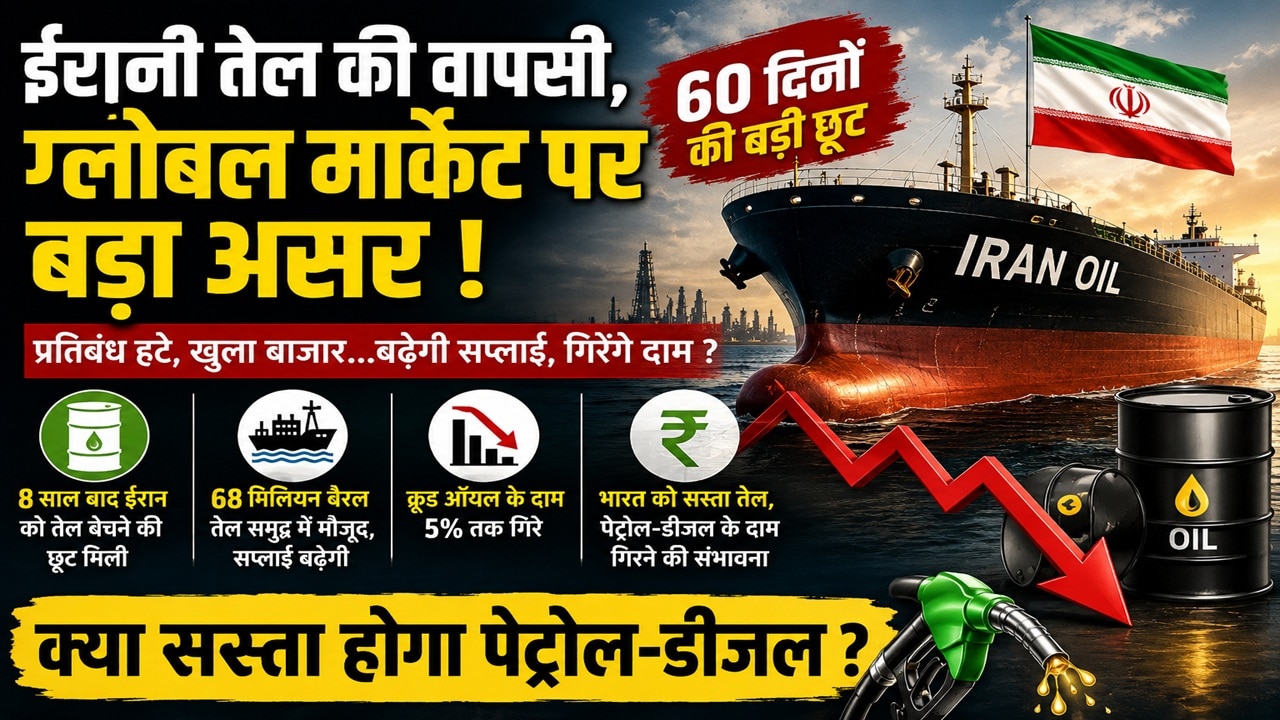
Under this peace agreement, America has temporarily lifted the stringent restrictions imposed on the export of crude oil and petroleum products to Iran, giving great relief. This exemption has been given by America to Iran for 60 days, which will remain effective till August 21, 2026. This is the first time in the last 8 years that such a major relaxation has been given on the export of Iranian oil. As soon as the official announcement of lifting the sanctions came from Washington, Tehran officials, oil traders, middlemen and senior officials of the National Iranian Oil Company (NIOC) started contacting refiners in Asian countries like India, Japan and South Korea.
World’s third largest oil reserves desperate to enter the market
According to Bloomberg’s recent report and Vortex data, as soon as the American exemption is received, Iran is trying to increase the scope of its oil supply to a war footing. Iran has the world’s third largest crude oil reserves (about 209 billion barrels). Due to stringent American sanctions, Iran was not able to sell oil in the open market till now and was forced to sell most of its oil secretly to China at very low prices. But now it wants to expand its reach and for this Iranian oil suppliers are constantly coordinating with India’s government and private oil refineries.
68 million barrels of crude oil floating in the sea
According to the data, as of June 22, 2026, approximately 68 million barrels of Iranian crude oil and condensate are floating in the sea. The surprising thing is that about 85 percent of these oil tankers are such that there is no fixed destination i.e. buyer. Iran wants an immediate new buyer for these floating oil reserves and these cargoes are located very close to the Indian maritime border, from where it is very easy and less expensive to supply to India. However, as much as Iran is in a hurry, other Asian countries including India are not showing the same eagerness. In fact, during the closure of the Hormuz Route, Indian refineries had already made alternative arrangements for oil supply from other countries.
These 3 big difficulties are coming in the way of purchasing Iranian oil
Buying oil from Iran is not so easy for India technically and diplomatically. There are mainly three big challenges behind this:
-
Fear of temporary relaxation: This exemption of America is only for 60 days. Refineries fear that this exemption may end at any time, which will affect their entire planning.
-
EU and UK sanctions: Even though the US has eased up, the European Union (EU) and Britain still maintain sanctions on Iranian oil. Due to this, there are huge difficulties in getting international financing, payment gateway and insurance of ships for oil business.
-
The problem of ‘dark fleet’ ships: Many major ports of the world are not ready to allow entry of Iran’s ‘dark fleet’ i.e. suspicious ships without identification due to fear of security and sanctions.
According to energy experts and Kpler’s refining lead analyst Sumit Ritolia, it is extremely unlikely that any country other than China will make a big increase in the purchase of Iranian oil. The planning cycle for oil refineries usually runs 2 to 3 months in advance, while Iran has only a 60-day leeway. Most of India’s refineries have already completed import deals till August.
Will Indian refineries leave Russia and move to Iran?
Generally, Indian refineries prefer to stay away from purchasing any type of restricted or disputed crude oil to avoid getting hit by global sanctions. At present, India is getting uninterrupted supply of crude oil from Russia in record quantities and at very affordable prices. Apart from this, India is also increasing the import of oil from countries like America and Venezuela. Since the exemption from Iran is for a very short period, India would not want to spoil relations with its old and reliable oil supplier countries or reduce imports from them. Experts believe that India will buy oil from Iran only when Iran is ready to give more attractive and huge discounts on oil prices than Russia.