 look news india

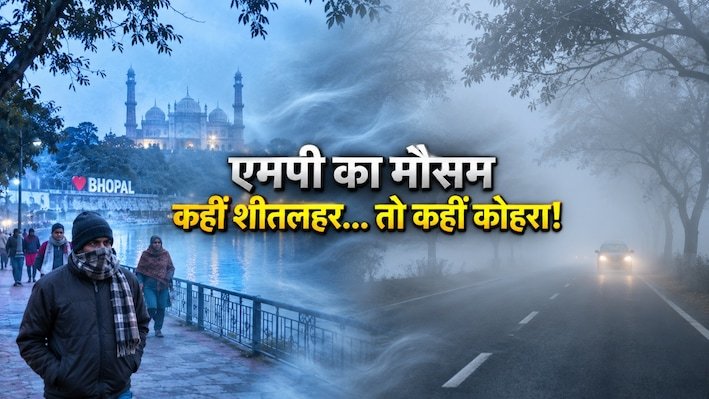
Northern icy winds have started a period of severe cold in Madhya Pradesh. According to the latest report of Meteorological Center Bhopal, the minimum temperature in the state has been recorded below 10 degrees Celsius for the third consecutive day, due to which normal life has been completely affected. Cold wave conditions persist in the capital Bhopal for the third consecutive day and the minimum night temperature was recorded at 8.8 degrees Celsius. The cold winds blowing in the morning and late at night have forced people to resort to bonfires and heavy woolen clothes. Despite the sun shining during the day, the humidity in the air is forcing people to shiver.
The severe effects of cold are clearly visible in the plains and hilly areas of the state. According to the latest data, Karaundi in Katni district was the coldest place in the entire Madhya Pradesh with a minimum temperature of 6.8 degrees Celsius. After this, the mercury was recorded at 7.0 degrees Celsius in Damoh and 7.4 degrees Celsius in Kalyanpur of Shahdol. The minimum temperature in Girwar of Shajapur has dropped to 7.7 degrees Celsius. Apart from this, the severity of cold has also increased in Vindhya and Mahakaushal region, where 9.0 degree Celsius was recorded in Rewa, 9.6 degree in Khajuraho and Raisen and 9.8 degree Celsius was recorded in Jabalpur and Umaria. In more than nine major cities of the state, the night temperature remains below double figures.
The Bhopal center of the Indian Meteorological Department (IMD) has issued a special weather bulletin for the next 48 hours. According to the department, there is a strong possibility of cold wave in Bhopal, Shajapur, Damoh and Katni districts on Friday and Saturday. Along with this, an alert has been issued regarding moderate to dense fog in the morning in at least three districts of Gwalior, Chambal and Vindhya region of Northern Madhya Pradesh. There is a possibility of visibility being affected in the morning due to fog, due to which drivers have been advised to take special caution on national highways and major roads.
According to the analysis of meteorologists, after the fresh snowfall in the hilly states of North India, Jammu-Kashmir, Himachal Pradesh and Uttarakhand, the dry and snowy north-eastern winds coming from there are moving directly towards Madhya Pradesh. At present there is no active western disturbance or major weather system over Central India, due to which the sky remains completely clear. Due to the clear sky, the process of radiation cooling from the earth’s surface at night has increased, due to which the night temperature is falling rapidly. Meteorologists predict that the same weather pattern will continue for the next three to four days.
This severe cold in the last week of November is considered very beneficial for the germination and initial growth of main Rabi crops, especially wheat, gram and mustard. Due to low temperature, germination of crops is good and production is expected to increase. However, the Agriculture Department has warned farmers that if the cold wave continues like this, the risk of frost on early vegetables, potatoes and pulses crops may increase. Farmers have been advised to irrigate the fields lightly in the evening and smoke the north-western ridges of the field so that the temperature around the crop remains balanced.
The risk of seasonal diseases has increased due to the continuous drop in temperature and huge difference in mercury between day and night. There has been an increase in the number of patients suffering from cold, viral fever, joint pain and respiratory problems in major district hospitals of the state including Hamidia Hospital of Bhopal. Doctors have especially advised heart patients, asthma patients, small children and the elderly to avoid cold air in the morning and evening. While leaving the house, cover ears, throat and chest properly with warm clothes, drink lukewarm water and use fog lights of vehicles during fog.