 look news india

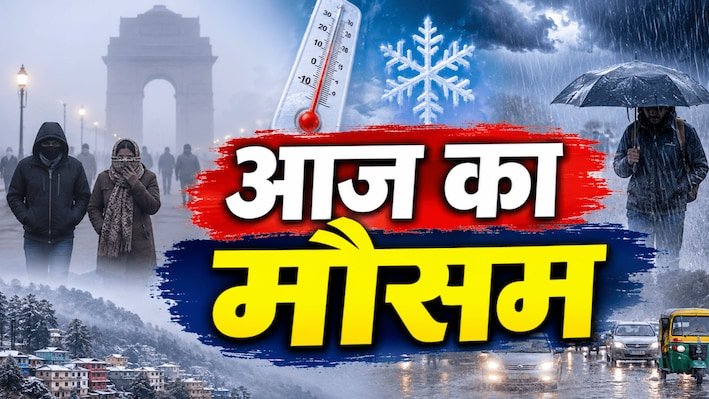
With the last week of November, the weather has started changing rapidly across the country. On one hand, winter has suddenly gained its pace in the plains of North and Central India, on the other hand, the dense fog that has spread in the morning has increased the chill and melting manifold. According to the latest bulletin of the Indian Meteorological Department (IMD), in the last days of November and the beginning of December, two completely opposite colors of weather will be seen in different parts of the country. Due to fresh snowfall in the hilly states, north-westerly snow winds are directly entering the plains, due to which the minimum temperatures are falling rapidly in Delhi-NCR, Uttar Pradesh, Rajasthan, Punjab and Haryana.
The Meteorological Department has issued a special alert of dense fog in many states of North and Northeast India for the next 48 to 72 hours. There is a strong possibility of dense fog in the morning in many areas of Delhi, Chandigarh, Haryana, Punjab, Eastern and Western Uttar Pradesh and Himachal Pradesh on 27 and 28 November. The minimum temperature in the capital Delhi has fallen below double digits for the first time this season and has reached around 8 to 9 degrees Celsius, due to which people going to office and school in the morning are facing severe cold. Apart from this, in the northeastern states of Assam, Meghalaya, Nagaland, Manipur, Mizoram and Tripura, a warning has been given of reduced visibility due to dense fog, which may affect the speed of road and rail traffic.
Among the plain states of North India, Rajasthan appears to be the most vulnerable to cold. The Meteorological Department has issued an alert of cold wave in many parts of eastern Rajasthan on 27 and 28 November. In areas like Sikar and Fatehpur, the minimum temperature has dropped to 5 to 6 degrees Celsius, which is about 5 degrees below normal. On the other hand, severe cold has brought life to a standstill in the valleys of Jammu and Kashmir, where the mercury has been recorded at minus 3.2 degrees Celsius in Pahalgam in South Kashmir and minus 2 degrees Celsius in Qazigund. In the high altitude areas of Himachal Pradesh also, extremely cold and foggy conditions are expected to persist in the morning and night till 30th November.
While on one hand North India is struggling with cold and fog, on the other hand due to active easterly winds, rains are continuing in the states of South India. According to the Meteorological Centre, there is a possibility of heavy rain with thunderstorms and strong winds of 30 to 40 kilometers per hour over many parts of Kerala, Mahe, Tamil Nadu, Puducherry and Karaikal on November 27 and 28. Along with this, strong surface winds and light to moderate rain have also been predicted in coastal Andhra Pradesh, Rayalaseema and Lakshadweep. At the same time, due to the effect of an upper air cyclonic circulation forming over the South Andaman Sea, a warning has been given of heavy rain and storm in the Andaman and Nicobar Islands between November 29 and December 2.
In view of this rapid change in weather, the administration and agricultural experts have issued important guidelines for common citizens, drivers and farmers. Drivers traveling on national highways and expressways during dense fog have been advised to use fog lights, control vehicle speed and maintain safe distance. At the same time, farmers of Rajasthan and North India have been advised to do light irrigation in the fields in the evening to save the standing crops and vegetables from the cold wave attack so that the soil temperature remains maintained. Health experts have also advised children, elderly and respiratory patients to avoid cold morning and evening air, wear warm clothes and consume lukewarm liquids.