 look news india
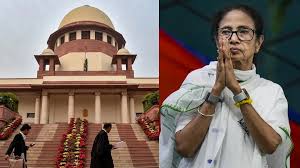
News India Live, Digital Desk: In the ongoing legal battle between the Enforcement Directorate (ED) versus the West Bengal government, the Supreme Court has made very strict and harsh remarks regarding the conduct of Chief Minister Mamata Banerjee. During the hearing held on Wednesday (22 April 2026), Justice Prashant Kumar Mishra and Justice N.V. Anjaria’s bench said that a Chief Minister entering the premises during a raid by an investigating agency and obstructing the investigation “endangering democracy” As it is.
“Extraordinary and unfortunate situation”
The Supreme Court expressed surprise over the presence of Mamata Banerjee during the raids at the office of I-PAC and the house of its director Prateek Jain. The Court commented: “This is a situation in which no one would have imagined that a sitting Chief Minister of the country would personally reach the office of the investigating agency or the site of the raid. This is not merely a State versus Centre dispute, but a case of a person holding a constitutional post using the entire system to obstruct the investigation.”
ED’s allegations: tampering with evidence
The ED argued in the court that in January 2026, when its team was raiding the premises of I-PAC in the coal scam and money laundering case, Chief Minister Mamata Banerjee reached there and not only threatened the officials, but also took away important documents and electronic equipment with herself. ED claims that the Chief Minister spent about 25 minutes there and directly interfered in the work of the investigating agency.
Bengal government’s argument: attack on federal structure
At the same time, senior advocates on behalf of the West Bengal government argued that the ED’s action was motivated by political vendetta. He said that I-PAC is an election strategist of TMC and the central agency’s arrival there just before the elections is an attempt to obtain confidential election data. The Bengal government also argued that the ED is not a ‘Body Corporate’, hence it cannot directly approach the Supreme Court under Article 32.
Strict questions and instructions of the Supreme Court
Rejecting the state government’s arguments, the court asked whether the ED should have merely ‘watched and watched’ when a Chief Minister was obstructing the investigation? The court has given the following instructions in this matter:
Limited Security: The stay on State Police FIRs lodged against ED officers will continue.
Evidence Preservation: The court directed that the CCTV footage and digital data taken during the raid be kept safe.
Next action: Considering the seriousness of this matter, the court is now considering ED’s petition demanding a CBI investigation.
Bengal on the verge of elections, political activity intensifies
This comment of the Supreme Court has come at a time when the voting process for the assembly elections in West Bengal is about to begin (April 23 and 29). The BJP has described the remarks as a “severe rebuke” to Mamata Banerjee, while the TMC has termed it as misuse of investigative agencies by the central government. At present, before the results on May 4, this court comment has created a stir in the politics of the state.