 look news india

China, the world’s second largest economy, is currently facing an unprecedented social and demographic crisis. The interest in getting married and starting a family among the youth in the country is continuously decreasing. Troubled by the falling birth rate and rapidly aging population, the Xi Jinping government is now taking surprising and out-of-the-box steps to tie the knot to the youth.
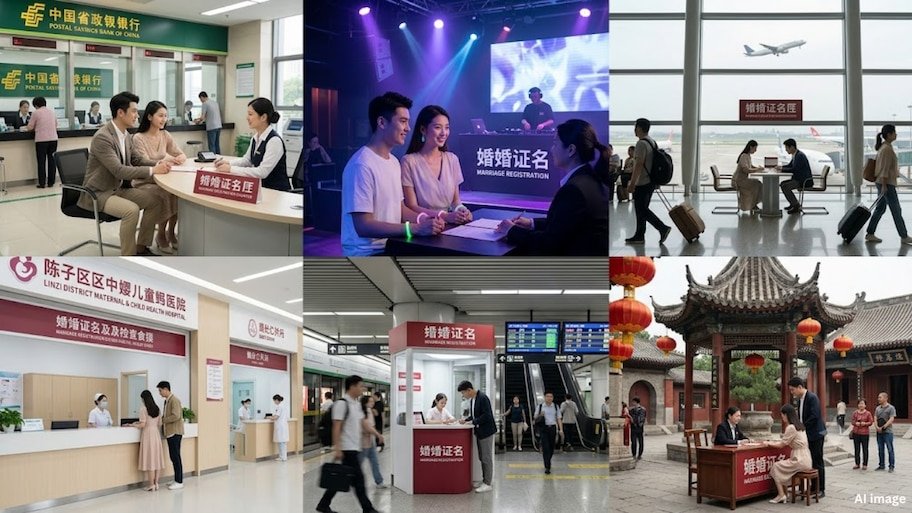
To save the youth from the long and boring queues of traditional government offices (Civil Affairs Bureau), now across the country Banks, nightclubs, metro stations, historical temples and even maternity hospitals Marriage registration counters are being opened inside.
Local administrations in various provinces of China are setting up marriage registration centers in the most crowded and trendy places to attract youth:
-
Marriage counter in bank: A branch of ‘Postal Savings Bank of China’ (PSBC) in northern China’s Tianjin city has become the first bank in the country to conduct marriage registration and certificate ceremonies along with financial operations.
-
Shanghai Nightclub Wedding: In the country’s financial capital Shanghai, local authorities have joined hands with nightclubs where young people can instantly get a legal marriage certificate amid the nightlife and partying.
-
Maternity Hospital and Pre-Wedding Checkup: A marriage registration facility has been launched at the Maternal and Child Health Hospital in Zibo city of Shandong province, so that new couples can get marriage registration, pre-marital medical checkup and family planning advice under one roof.
-
Metro Station and Ancient Temple: A marriage registration center has opened at Jingfuba metro station in Hefei, Anhui province, where thousands of couples have got married. At the same time, the facility to register marriages by wearing traditional Chinese attire has also been provided in the traditional temples and historical parks of Beijing and Nanjing.
This change began in China after major reforms in marriage registration rules. Earlier, it was mandatory for Chinese citizens to go to their ancestral place of residence (Hukou system) to register their marriage.
Under the new rules, now young people can get married anywhere in any city of the country without showing the Hukou booklet. According to official figures, more than 500 independent marriage registration sites and more than 1,300 outdoor venues have been launched in China outside traditional government offices. However, these centers only have the facility of marriage, for divorce one still has to visit the old government offices.
Recent figures from China’s Ministry of Civil Affairs clearly reflect the government’s concern:
-
Heavy decline in first half of 2026: Only 32.75 lakh (3.28 million) couples registered marriages in the first six months (January to June) of 2026, which is 7.5% less than the same period last year.
-
Marriages halved from 2013 peak: In the year 2013, a record 1.34 crore marriages took place in China, after which this graph kept falling continuously.
-
Increase in divorce cases: While marriage rates are falling, divorce cases have increased to more than 13.8 lakh in the first half of 2026.
Mixed reactions are being seen regarding such strange centers on the Chinese social media platform Weibo. Many users took a jibe at this and wrote, “Were people not getting married because they couldn’t find a registry office?”
Sociologists and experts believe that the real reason for the decline in marriages in China is not lack of space, but huge economic and social pressures. Skyrocketing real estate prices, expensive child-rearing, youth unemployment and extreme work stress in the workplace are forcing young people to remain single. Unless the government addresses fundamental issues like housing subsidy, childcare allowance and work-life balance at the workplace, steps like opening marriage counters in nightclubs or banks may prove to be just symbolic.