 look news india

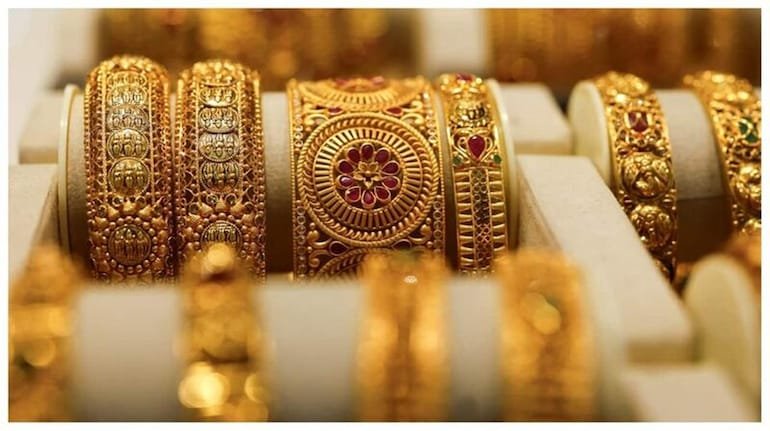
On the holy festival of Shardiya Navratri, when the prices of gold and silver start touching the sky due to huge demand in the jewelery markets, this time a very relieving and shocking news has come out for the buyers from the bullion market. On the fifth day of Navratri, a continuous downward trend in gold prices is being recorded in most of the major bullion markets of North India including the country’s capital Delhi. This sluggishness and selling pressure that has been going on for the last few trading sessions has dulled the shine of the yellow metal to some extent, which has brought cheer to the faces of common consumers and investors planning to buy jewelery in the festive season. Due to the strengthening of the US dollar in the global markets, profit-booking at the international level and unwinding of positions by investors on commodity exchanges, gold prices in the domestic markets have slipped sharply from the upper levels. This fall in prices, despite the peak of festive demand, is like an unexpected gift for those families who were waiting to book jewelery for the upcoming Dhanteras, Diwali and the heavy wedding season that starts soon after.
There was a clear softening of gold rates in this morning’s trading session in Delhi, the country’s largest wholesale and retail jewelery market. In the national capital, 22 carat gold, most commonly used in making jewelery, has slipped to ₹ 1,36,040 per 10 grams. At the same time, 24 carat (99.9% pure) bullion gold, considered the highest on the purity scale, is trading around ₹ 1,48,410 per 10 grams. If compared to the highs of last fortnight, a straight fall of more than Rs 1,000 to Rs 1,500 per 10 grams has been recorded. The price of 18 carat gold has also fallen to the range of ₹ 1,11,300 per 10 grams, which is proving to be quite affordable for buyers of lightweight and modern designed stone-studded jewellery. Leading jewelers of Delhi’s Chandni Chowk, Kucha Mahajani, Karol Bagh and South Extension say that due to this softening of prices, the footfall in the showrooms i.e. the movement of customers has suddenly increased. Instead of waiting for Dhanteras, people are making advance bookings at the current reduced rates, so that they do not have to bear additional financial burden if the prices rise again.
The impact of this fall in gold prices is not limited only to the capital Delhi, but bullion traders in other major metros and tier-2 cities of the country have also revised their rate cards. Today, in the historical bullion markets of Chowk, Aminabad, Hazratganj and Alambagh of Lucknow, the capital of Uttar Pradesh, 22 carat gold remained stable at ₹ 1,36,040 per 10 grams and 24 carat gold remained stable at ₹ 1,48,410 per 10 grams. In Kanpur, the major industrial city of Uttar Pradesh, the price of 22 carat was recorded at ₹ 1,36,000 and the price of 24 carat was recorded at ₹ 1,48,350. In the country’s financial capital Mumbai, 22 carat gold is trading at ₹ 1,35,950 and 24 carat ₹ 1,48,310 per 10 grams. The price of 22 carat jewelery gold in Kolkata, West Bengal is ₹1,36,020 per 10 grams. Due to local demand in Chennai, South India, 22 carat gold is being sold at ₹ 1,36,060 and 24 carat gold at ₹ 1,48,430. At the same time, the price of 22 carat in Jaipur, Rajasthan and Indore, Madhya Pradesh is ₹ 1,36,030 and ₹ 1,35,980 per 10 grams respectively. A slight difference of Rs 50 to 100 is being seen in the rates due to tax, local transport and association rules in different states, but the overall direction is of decline everywhere.
Many strong international and macroeconomic factors are working behind this fall in the price of gold in the domestic market during Navratri. Spot gold prices on the international commodity exchange COMEX have slipped from their record high levels. The biggest reason for this is the strengthening of the US Dollar Index (DXY) beyond 103. Whenever the dollar strengthens in the international market, it becomes expensive to buy gold in non-US currencies, putting pressure on demand globally. Along with this, due to cautious statements coming by the US Federal Reserve regarding the pace of interest rate cuts in the upcoming monetary policies, big hedge funds and foreign institutional investors are booking their profits in gold. Investors had earlier bought gold on a large scale considering it a ‘safe haven’ amid West Asia and geopolitical tensions, but now in the absence of any immediate major conflict on that front, speculators are trimming their long positions and turning to equities and treasury yields. At the domestic level, there is a continuous selling environment on the Multi Commodity Exchange (MCX), the direct impact of which is visible on the retail bullion market.
In Indian culture, the time from Navratri to Diwali and Bhaidooj is considered best for any auspicious purchase, especially investment in gold and silver. In Hindu religion, Goddess Skandamata is worshiped on the fifth day of Navratri and from this day the festive enthusiasm in the markets starts reaching its peak. Experts in the jewelery industry believe that this fall has brought a golden opportunity for the buyers who were postponing purchases due to gold reaching record high levels in the last months. Generally it is seen that on the day of Dhanteras the demand increases so much that jewelers increase the making charges and a premium is charged in the market. In such a situation, it is considered wise to make purchases or book at fixed rates during Navratri. Apart from this, lakhs of marriages are going to take place across the country in the months of November and December. Families planning for their wedding can take full advantage of this fall season and save thousands of rupees on the purchase of heavy jewelery like heavy choker necklaces, bangles and maangtikkas.
In this era of falling gold prices, there is a strong need for customers to be cautious along with enthusiasm. Many times, consumers get lured by cheap rates and buy non-certified or impure gold. According to the strict rules of the Central Government’s Ministry of Consumer Affairs and Bureau of Indian Standards (BIS), there is a complete ban on the sale of gold without a 6-digit alphanumeric HUID (Hallmark Unique Identification) code in the country. Whenever you buy jewelery from a jeweler, check for three mandatory marks: first, the triangular BIS logo, second, the purity grade of the gold (e.g. 22K916 for 22 karat and 18K750 for 18 karat), and third, the unique HUID number of six letters and numbers. Customers can download the ‘BIS Care App’ on their smartphones and enter this six-digit code, which will display the purity of the jewellery, name of the hallmarking center and complete details of the manufacturer on the screen. Along with this, always get a confirmed GST bill from the jeweller, in which the total weight of the gold, the exact price of that day and the making charges are recorded separately, so that if you exchange or sell it in future, you can get the full and 100 percent value of your capital.