 look news india

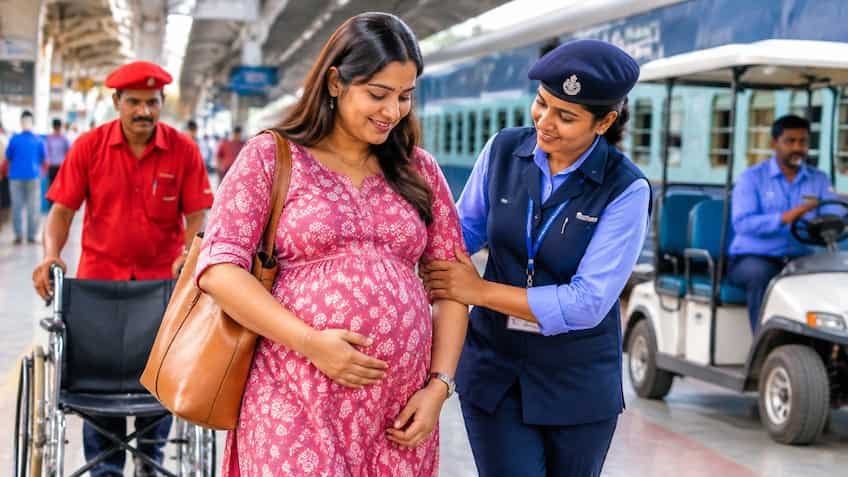
Crores of passengers travel in Indian Railways every day, but when it comes to pregnant women, making the journey safe, easy and comfortable is one of the top priorities of the railway administration. Climbing the upper or middle berth of a train during pregnancy can be extremely physically risky. Keeping this sensitivity in mind, the Railway Board has set many special rules, concessions and emergency protocols for pregnant women passengers from the ticket booking counter to inside the running train. If you or any woman in your family is planning to travel by train during pregnancy, it is extremely important to be fully aware of these official provisions and booking rules.
As per the existing guidelines of the Railway Board, a certain quota of lower berths is reserved for senior citizens, single female passengers aged 45 years and above and pregnant women in coaches of various classes of mail and express trains. Approximately 6 to 7 lower berths per coach in sleeper class, 4 to 5 lower berths in air-conditioned 3-tier (3AC) and 3 to 4 lower berths per 2-tier (2AC) coach are earmarked under this special category. The main objective of this quota is to ensure that physically sensitive passengers can get comfortable seats at ground level without having to climb stairs.
This question often arises in the minds of passengers whether there is a separate online checkbox for pregnant women on the IRCTC website or mobile app. At present, the direct separate quota option for pregnant women in online booking remains limited due to limitations in real-time verification of medical documents in the digital system. In such a situation, booking tickets by visiting the authorized Passenger Reservation System (PRS) counter of Railways is considered to be the most effective way to ensure lower berth:
-
PRS Counter Booking: While filling the form at the reservation counter of the railway station clearly mention ‘Pregnant Passenger/Lower Berth Request’ at the top.
-
Medical Documents: Attach a copy of the Medical Fitness Certificate and Pregnancy Certificate issued by a registered medical practitioner (RMO/MBBS/MD) with the form. The Chief Reservation Supervisor (CRS) has the authority to release lower berths directly from the particular quota pool available.
-
Emergency Quota (EQ) Application: If a lower berth is not available in normal booking and the ticket is in waiting or upper berth, an application for emergency quota on medical grounds can be submitted to the concerned Divisional Railway Manager (DRM) office or Station Director before chart preparation.
If for some reason a pregnant woman is allotted a middle or upper berth even after the chart is prepared, there is no need to panic. Under the Railway Commercial Rules, special powers are given to the on-duty ticket checking staff (TTE) in a moving train:
-
Seat Allocation from Handheld Terminal (HHT): After departure of the train, if any lower berth in the coach becomes vacant due to no-show or cancellation of ticket, the TTE is obliged to first allot that seat to a pregnant woman, sick passenger or an elderly person through his digital tablet (HHT).
-
How to contact TTE: As soon as you board the train, politely lodge a request for lower berth reallocation by showing the medical slip and ticket to the TTE of your coach.
-
Hitchhiker Coordination: Under Railway rules, TTE can also formally request other healthy and young co-passengers traveling in the same compartment or bay to change their seats on humanitarian grounds.
If a pregnant woman’s health suddenly deteriorates in a running train, labor pain begins or any medical consultation is required, the Railways’ Quick Response System gets activated:
-
Helpline number 139: Passengers or their family members can immediately opt for medical emergency by dialing 139 from their phones. The call center sends alerts directly to the train control room and on-board staff.
-
Rail Madad App and Portal: By entering PNR on Rail Madad App, complaint can be lodged instantly under ‘Medical Assistance’ category.
-
Presence of doctor at next station: As soon as the information is received, the control room deploys the doctors and paramedical team of the railway hospital on the platform with medicines and stretchers at the next major stoppage of the train. In case of emergency, first aid is provided at the railway station and if necessary, arrangements are made for safe shifting to the nearest civil hospital.
Climbing the long platforms and stairs at the station before the journey starts can be tiring for pregnant women. For this, special facilities are operated at all the major ‘A-1’ and ‘A’ category stations of the country:
-
Free wheelchair facility: Wheelchair facility can be availed from the main entrance of the station and the office of the Sub-Station Superintendent (Health/Commerce) without any extra charges.
-
Battery Operated Vehicles (BOV / Golf Carts): Battery car service is available at major terminals for senior citizens, disabled and pregnant women, through which female passengers can be taken directly to the gate of their coach.
-
Escalators and Lifts: The provision of lifts and escalators at Foot Over Bridge (FOB) has been mandatorily implemented at almost all redeveloped and junction stations.
Some precautions are extremely necessary for safe travel as per doctors and railway safety standards:
-
Doctor’s Fitness NOC: Before traveling in the last weeks of pregnancy (32nd to 36th week), make sure to get a ‘Fit to Travel’ certificate from your gynecologist and keep its original copy with you.
-
Avoid traveling on waitlisted tickets: Never board a reserved compartment of a train with a Waiting List e-Ticket, because as per the rules, such a ticket automatically gets canceled after charting and not getting a seat can cause huge inconvenience.
-
Food and drinking water: Avoid loose food items from stations or vendors while travelling. Only freshly packed food from the Pantry Car or order branded and hygienic food directly to your seat through IRCTC e-Catering.
-
Casual clothes and medicine kit: Wear loose cotton clothes during travel, do light stretches in between instead of keeping your legs hanging down for long periods and keep all the necessary emergency medicines recommended by the doctor in your handbag.