 look news india

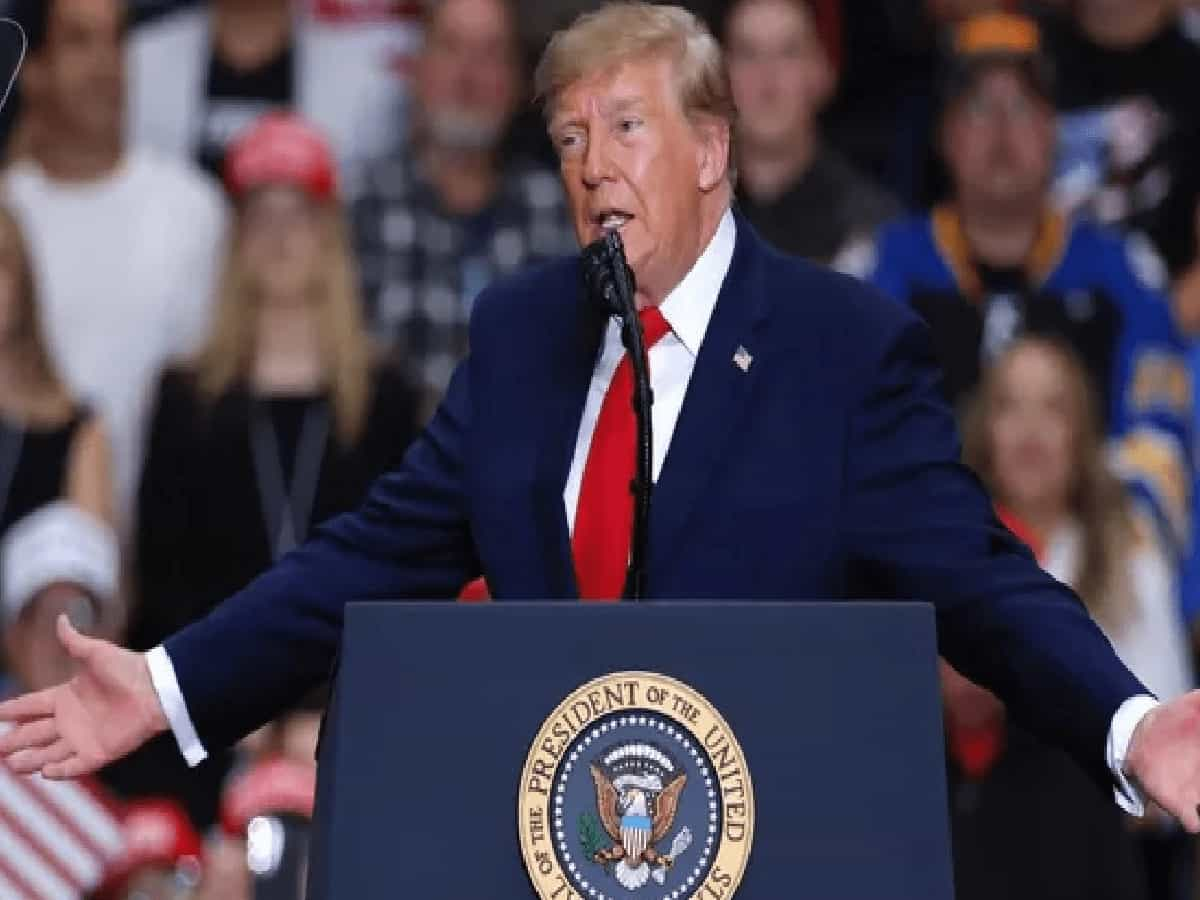
Amidst the ongoing geopolitical turmoil in West Asia, the fear of a new and destructive storm of war has deepened. US President Donald Trump has not ruled out the possibility of another major military attack on Iran. From the White House to the international media, Trump’s latest stance is increasingly in the headlines. Answering the sharp questions of journalists, Trump said in a very aggressive tone that America can take action against Iran at any moment. When he was asked a direct question about how close America has come to launching a military attack on Iran, Trump retorted in his own style and said, “Do you really think that if I am going to launch a major attack, I will tell the media in advance?” He further added bluntly that there is every possibility that this action might be taken tomorrow itself. This brief but deadly gesture by Trump has created a sensation in the corridors of international diplomacy.
However, along with his tough military stance, Donald Trump also left a surprising diplomatic aspect open. He claimed that there could still be a very positive and historic agreement between the US and Iran. According to Trump, the Iranian leadership is indeed willing to compromise, but the biggest question is whether Tehran will be able to stick to its terms and global commitments. Earlier, Trump had indicated on social media that there would be no new attack before the US mid-term elections to be held on November 3, but his latest statement given to journalists has created huge uncertainty about the timeline of military action.
There has been a very sharp and strict reaction from Iran on this aggressive stance of the US President. Iranian President Masoud Pejeshkian, while addressing the nation on state television, directly described America as the biggest obstacle to peace talks. Pezeshkian bluntly said that Iran’s Supreme Leader Ayatollah Ali Khamenei had given clear instructions to top officials to avert a crisis and reach a just settlement. The Iranian side was sitting at the diplomatic table with full seriousness, but at the last moment, Washington violated the established terms and conditions and derailed the entire negotiation process. President Pezeshkian made it clear that due to the double tactics of the American administration, the talks have proved inconclusive.
Meanwhile, the powerful Speaker of the Iranian Parliament Mohammad Baqer Ghalibaf has also warned America in strong words. Ghalibaf said that the White House has completely miscalculated Iran’s strategic strength and public sentiment. Due to miscalculation and a direct conflict with Iran, America itself has got trapped in a strategic quagmire from which it is now becoming impossible for it to get out. Ghalibaf said that it is Washington that has created this dire crisis, hence now the responsibility of recovering from this huge loss also rests entirely on the shoulders of America. At the same time, Iran’s Foreign Minister Abbas Araghchi also showed firmness and said that new threats of military attacks cannot change Iran’s sovereign policies even in the slightest. Araghchi also made it clear that Iran is fully ready for peaceful cooperation and security partnership with its neighboring Arab countries of the Persian Gulf, but will not succumb to any external pressure.
The Strait of Hormuz has become the most sensitive focal point of the increasing military tension between America and Iran. This narrow maritime waterway is considered the backbone of the entire world’s energy security, through which a large part of the global oil trade passes daily. In recent times, such news had spread rapidly in the international media that Iran has sent a new backchannel proposal to America through Pakistan. These reports claimed that if the US Navy lifts its strict maritime blockade from the Gulf region, then Iran is also ready to allow unhindered movement of all types of merchant ships and oil tankers through the Strait of Hormuz.
A statement by the Iranian ambassador appointed to Pakistan had further fueled this discussion, in which he had said that Hormuz can be opened for normal traffic if the sanctions and blockade are lifted. But as soon as this news gained momentum, Iran’s official and semi-official Tasnim news agency refuted this claim quoting top strategic sources. Iranian officials clarified that no such new formal proposal has been made to Pakistan. This contradictory situation has created huge confusion among the global oil market and shipping companies, as even the slightest military movement in the Strait of Hormuz can set crude oil prices on fire all over the world.
Amidst this explosive atmosphere of tension, the situation became more delicate when the Iranian Army presented a major military claim on Sunday. Iran’s Tasnim news agency, citing military sources, reported that Iranian air defense systems have shot down a US Lucas drone intruding into the airspace of the southern coastal strategic port city of Bandar Abbas. The Iranian Army says that this unmanned American spy drone was trying to conduct intelligence surveillance by violating their sovereign border, which was destroyed in the air by firing a missile as soon as it was tracked on the radar.
However, this sensational claim of the Iranian Army has not been confirmed by any independent international agency and no official statement has been issued by the US Department of Defense i.e. Pentagon on this alleged incident. Defense experts believe that if the incident of the American drone being shot down over Bandar Abbas proves to be true, then this spark could directly lead to a full-scale military confrontation. On one hand, American warships and nuclear submarines are ready in the Persian Gulf, while on the other hand, Iran has also put its ballistic missiles and coastal defense systems on ‘high alert’. The eyes of the whole world are now on whether diplomacy will be able to avert this impending world war or whether this warning of Donald Trump will prove to be the clarion call of a new global crisis.