 look news india

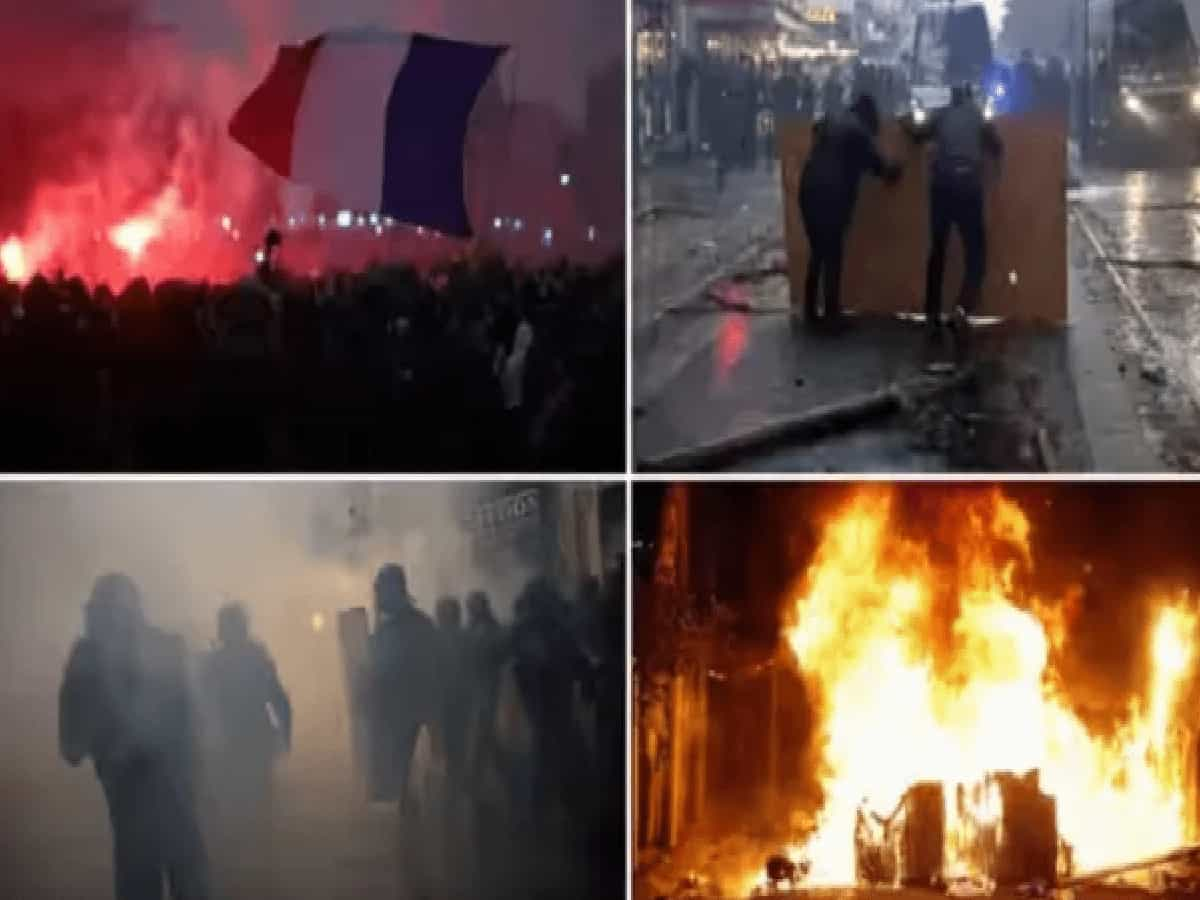
The major countries of Europe are currently burning in the fire of serious economic and social discontent. The patience of common citizens has completely worn out against the increasingly expensive houses to live in, skyrocketing inflation, high cost of basic living and anti-people government policies. From the historic streets of Paris, the capital of France, to Tirana in Albania, industrial cities of Italy, Madrid of Spain and Lisbon, the capital of Portugal, such a wave of dissatisfaction has arisen which has given sleepless nights to the governments of the continent. Protest marches in various cities have turned into violent confrontations, with police using tear gas, rubber bullets and mass arrests to disperse crowds. The agitators seem to include every section of the society, in which at some places the main issue is the housing crisis and pension cuts, while at other places the increasingly expensive higher education, controversial government infrastructure projects and strict security policies are at the center of the protest.
The nature of the movement in France seems to be the most aggressive and widespread. According to official figures from the Home Ministry, about 4.10 lakh citizens participated in the weekend protests, while the famous CGT union, which is leading the movement, has claimed that the actual number of people who took to the streets was more than eight lakh. In the capital Paris alone, about 2.5 lakh people came to raise their voice against the system. The alleged excessive use of force by security forces in the name of maintaining law and order has added fuel to the fire. Police detained about 1,314 protesters across the country, including 65 arrests in the city of Paris alone. The situation became so dire in major cities like Paris, Lyon, Lille and Marseille that the police had to take the help of helicopters and modern drones in the sky to keep an eye on the crowd.
53 police officers were seriously injured during the clashes, while incidents of arson were recorded at 75 different places and looting at 24 shops. Meanwhile, a major lapse was also seen on the information front, where two major French news channels, CNews and FranceInfo, broadcast scenes of the protests in Albania as French, after which they had to publicly apologize. Instead of softening, the attitude of the agitators seems to be becoming sharper. Major labor organizations and groups associated with the historic ‘Yellow Vest’ movement of 2018 have again given an open call for nationwide strikes and mass demonstrations on 31 October and 5 November. The Yellow Vest organization has announced that next Saturday there will be an indefinite strike just outside the Town Hall of Paris and the National Assembly building. He says that dissatisfaction with the government has reached its peak in every workplace, from primary schools to universities and from farms to factories. On the other hand, police unions have also raised their hands and warned the government that they do not have enough security personnel left to maintain emergency deployment continuously for a long time in the entire country.
The situation went out of control in Tirana, the capital of Albania, when Prime Minister Edi Rama announced strict administrative measures to suppress the protests and imposed a heavy fine of 5 lakh lek (about 6188 dollars) on the miscreants. Enraged by this punitive decree, people took to the streets despite torrential rains and started marching straight towards the Prime Minister’s Office via the Education Ministry. The angry mob openly set fire to the chairs arranged at the administrative level for peace talks. A day before this, the police had fired rubber bullets and tear gas shells to control the crowd. Stones and firecrackers were thrown at several government buildings, injuring more than 300 policemen and civilians.
Public anger also erupted on the streets in major Italian cities Milan, Rome, Turin, Naples, Bologna and Florence. Here the furious protesters directly attacked the security forces with glass bottles, stones and firecrackers. Tension reached its peak in the capital Rome when a large group of protesters tried to break through the security cordon of the historical monument Colosseum and enter inside. Nine people were arrested and a total of 371 people, including 110 minors, were detained in a massive operation conducted in eight major cities. Amidst this tense environment, Italy’s Prime Minister Georgia Meloni has expressed gratitude to the administrative officials and security forces and reiterated her commitment to maintain law and order in the country under any circumstances.
In Madrid, the capital of Spain, a joint front of pensioners and youth is standing on the streets. The main demands of the protesters are that the pension amount should be immediately increased in proportion to the rising inflation rate, there should be a comprehensive reform in the minimum pension slab and there should be a complete legal ban on any kind of privatization of the pension system. The protest camp set up at the city’s famous Puerta del Sol square has become the pivot of this movement, where people are continuously protesting against the skyrocketing house rents. In neighboring Portugal’s capital Lisbon, tents were also pitched demanding control of rent rates and tightening of rules for landlords to evict tenants. However, the police took action early on Sunday and forcibly uprooted these camps, leading to a heated scuffle between the police and the public.
Sharp statements have started at the international level on this unprecedented crisis in Europe. US President Donald Trump has blamed the violence that broke out in France and across Europe on the immigration policies there. Addressing a public event in Georgia, America, Trump said that France is burning today because it opened its borders to people who do not respect its culture, tradition, historical buildings and art. Trump said in a harsh tone that when you give shelter to such elements who hate your country, this is their fate. Although French President Emmanuel Macron has been completely rejecting such statements of Trump in the past too, the current situation in Europe has definitely posed a deep political and social crisis in front of the policy-makers.