 look news india

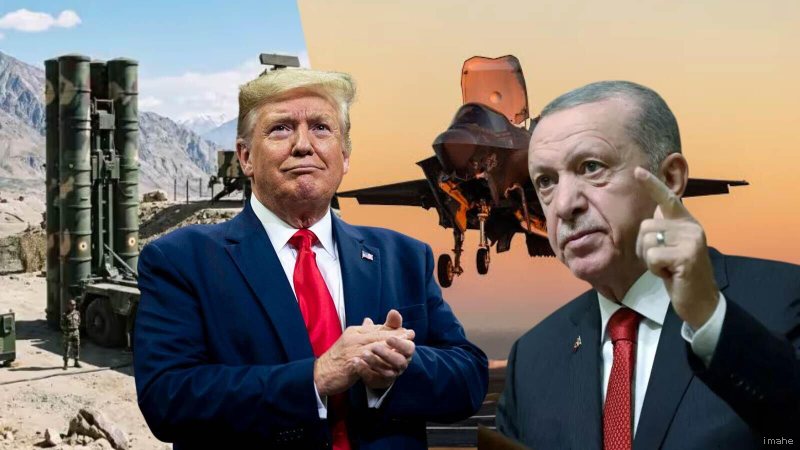
There has once again been a major upheaval in global defense diplomacy and strategic equations. Turkey has accused Washington that America is openly adopting double standards regarding international defense deals and sanctions. This strong reaction from Turkey has come after the US Air Force included its most modern fifth generation F-35 stealth fighter jets in the joint military exercises conducted in India and hinted at offering it to India.
There is deep dissatisfaction among Türkiye’s strategic experts and media circles regarding this decision. Ankara says that in the name of purchasing Russian S-400 Triumph air defense missile system, the way America imposed strict sanctions on its own NATO ally Turkey and excluded it from the F-35 program, why are the same rules not being implemented for India?
The roots of this entire controversy are linked to the military developments that took place between 2017 and 2019. Turkey, a founding and vital member of the US-led military alliance NATO, had signed a deal with Russia to purchase the billion-dollar S-400 missile system to meet its air defense needs.
When Russia began deliveries of the S-400 to Turkey, Washington described it as a serious threat to NATO security and the secret data of the F-35 jets. America claimed that the sensitive radars installed in the S-400 system can steal the data of F-35’s stealth technology (ability to remain invisible) and send it to Moscow.
After this, without showing any leniency, America imposed strict economic and military sanctions against Turkey under the ‘Countering America’s Adversaries Through Sanctions Act’ (CAATSA). Not only this, Turkey was ousted from the Joint Strike Fighter (JSF) F-35 development program overnight. Turkey had invested heavily in this project of about 1.4 to 1.6 billion dollars and its 6 ready F-35 jets were stuck in America’s hangar, which it has not received till date.
Now the question of Turkish defense analysts is that when India has also signed a $5.43 billion S-400 missile deal with Russia and has also deployed four to five squadrons of it in its army, then why is Washington so kind towards India?
India is neither a member of NATO and has purchased the same S-400 missile defense system from Russia. Despite this, America not only refrained from imposing CAATSA sanctions on India, but has even offered its most advanced fighter aircraft F-35 to the Indian Air Force. Recently, the issue of America’s ‘double standards’ has once again heated up in the diplomatic circles of Turkey after seeing the roar of American F-35 fighter planes during Tarang Shakti and other exercises on Indian soil.
Turkish officials say this is a contradiction of US foreign policy—punishing its NATO ally for purchasing the same weapon, while advocating the sale of its most secret and powerful fighter jet to another non-NATO country.
It is very important to understand the geopolitical reasons behind this alleged dual attitude of America. US State Department officials and security experts believe that India’s situation is completely different from Türkiye.
-
China’s challenge and QUAD: The biggest global challenge for America at this time is China’s increasing military influence. India is America’s most reliable and powerful partner to balance China in the Indo-Pacific region. America knows that weakening India’s military power will ultimately work in China’s favor.
-
Historical and legal differences: India signed the S-400 deal with Russia in 2018, which was based on negotiations before the full stringent provisions of the CAATSA law came into force. Whereas Turkey, being a NATO member, went ahead with the deal despite warnings.
-
Strategic Autonomy: India has always adopted a multilateral policy (Strategic Autonomy) instead of depending on any one country for its defense needs.
Even though America is giving positive signals of providing F-35 to India, the stance of the Indian Air Force (IAF) on this is very measured and full of precautions. India is well aware that US weapon systems come with stringent operational conditions and limitations on data access. Recently, the senior leadership of the Indian Air Force has also clarified that unless India gets complete operational control over the aircraft and the freedom to add indigenous technologies, it cannot depend only on the American offer.
India is currently working rapidly on its indigenous fifth generation Advanced Medium Combat Aircraft (AMCA) project and is also relying on tried and tested platforms like France’s Rafale.