 look news india

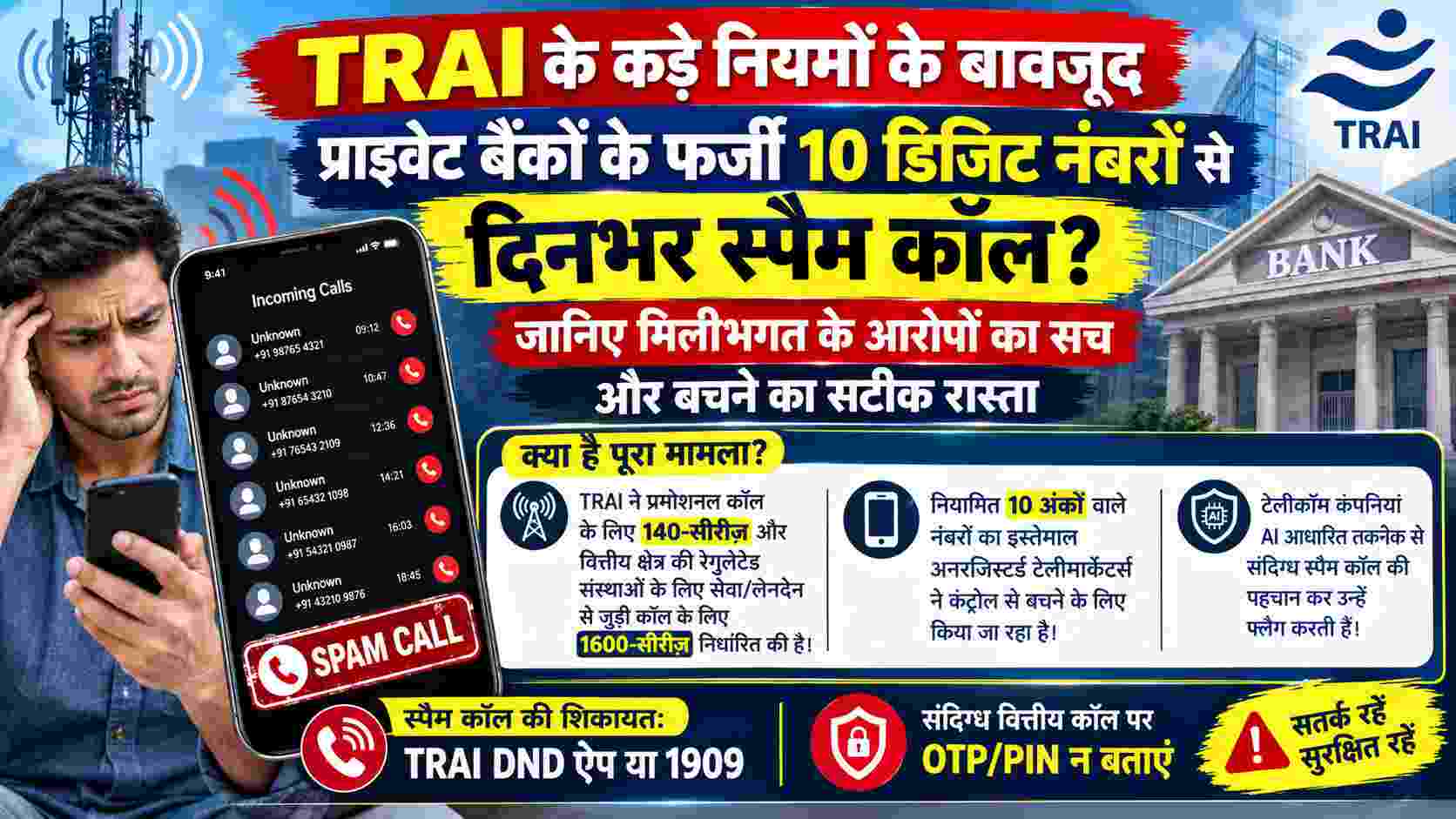
An unknown 10 digit mobile number flashes on the smartphone. A person busy in some important work, meeting or traveling picks up the call thinking that maybe a relative, courier or important office person is calling. But as soon as the call is received, a voice comes from the other side—”Sir, do you want a personal loan?” or “Ma’am, your lifetime free credit card has been approved!” This situation is not of any one corner of the country but has become the daily mental torture of every common Indian mobile user. The most shocking thing is that these calls do not come from some unknown street printing company, but in the name of the country’s big renowned private banks, NBFCs and their associate companies. Consumers are raising questions that when the Telecom Regulatory Authority of India (TRAI) has made stringent rules, how are unregistered telemarketers (UTMs) openly attacking people’s privacy by using normal mobile SIM cards right under its nose? Is this a systemic failure, systemic negligence or the result of some untold collusion between telecom operators and banks?
As per the rules, it is mandatory for any legitimate bank, financial institution or telemarketer to use a particular number series to make promotional or service calls to their customers. Earlier it used to start from 140 series and now 1600 or 160 series has been prescribed for financial institutions. The biggest feature of these numbers is that as soon as the consumer sees the number on the screen, he understands that it is a marketing call from some bank or company. If the subscriber has activated DND (Do Not Disturb), then calls cannot be received from these numbers. To avoid this legal hurdle, private banks and their third-party direct selling agents (DSAs) have found a very clever way. They buy normal 10 digit personal SIM cards in bulk and use them to make calls to hundreds of people every day. Since these numbers look like normal mobile numbers, the automated filters of telecom companies are not able to catch them immediately and the consumer also gets deceived and picks up the phone.
Whenever questions are raised about unwanted calling on any bank, the bank immediately shirks the responsibility that the call has not been made from its official office but by a ‘third-party vendor’ or commission agent. In fact, it is a complex corporate structure designed to avoid accountability. Banks hire external agencies and DSAs at huge commissions to fulfill their loan, credit card and insurance targets. These agencies do not have any official calling system; They make youth sit in small call centers and distribute unregistered personal SIMs. These agents get targets and incentives for every card or loan sold, so they call indiscriminately from morning till night without any care. Banks are well aware that their business is coming through these agents, but to avoid direct legal hassles, they portray themselves as different from them on paper. It is this double standard that the public sees as ‘collusion’ of the system.
A big question is that how do these unregistered telemarketers get access to your phone number, name and even your financial status? Actually, this is the game of unregulated data brokers spread across the country. When you provide a number at the time of billing at a mall, fill an online form on a website, or give a third-party app access to your contact list, that data is not secure. That data is sold for a few rupees and reaches telemarketing agencies. Additionally, sometimes smaller financial platforms and e-commerce sites also share their customer databases with these calling networks. On the basis of this stolen data, the call center employees dial people and sometimes even after refusing, harass them by calling repeatedly from different numbers, due to which this case becomes not only of marketing but of direct mental harassment and violation of privacy.
Amidst the ever increasing public anger, there is always pressure on TRAI and the Department of Telecommunications (DoT) to completely control this. TRAI says that the problem is not of collusion but of the technical and legal gap which these fake agents take advantage of. Telecom companies find it challenging to differentiate between the SIM of an ordinary citizen and the SIM of an unregistered telemarketer, as both use the same network and spectrum. However, in recent times the rules have been more stringent:
-
AI and Machine Learning based filters: Telecom companies have been instructed that if unusually large number of calls are being made from a normal 10 digit number, then the AI system should immediately classify that number as suspected spam and stop its service.
-
Mandatory rules of 160 series: All banks and financial institutions have been ordered to shift all their promotion and verification calls to 160 series only, so that every bank related call coming without this series can be considered as fake.
-
SIM Blacklisting and Penalties: If an unregistered telemarketer is caught, not only is his connection disconnected but there are provisions for blacklisting all other connections of that person or agency for up to two years and imposing heavy financial fines.
If you are also fed up of such unwanted calls on a daily basis, instead of getting angry by simply disconnecting the phone, force the system by using these official and legal avenues:
-
‘Chakshu’ portal of Department of Telecommunications: Use the ‘Chakshu’ facility by visiting the ‘Sanchar Saathi’ portal of the Government of India. Here you can directly lodge a complaint against all those 10 digit numbers from which fake bank loan, lottery or fraud calls are coming. This portal directly checks and blocks such numbers.
-
Use of TRAI DND 3.0 App: Download TRAI’s official DND app on your smartphone. Through this app, you can lodge a complaint with your telecom operator (Jio, Airtel, Vi, BSNL) by selecting that spam number directly from your call log. The operator has to take action on that number within the stipulated time.
-
Complaint through SMS (on 1909): You can go to your phone’s message box and type “COMP TEL NO XXXXXXXXXX, dd/mm/yy, Time” to 1909 (where XXXXXXXXXX is the number from which the call came). This complaint should be sent within three days of receiving the call.
-
Banking Ombudsman and Consumer Forum: If a particular bank is continuously harassing you despite repeated refusals, you can lodge a complaint against ‘Unethical Practices’ with the Nodal Officer of that bank and then directly with the Banking Ombudsman of the Reserve Bank of India (RBI) and the National Consumer Helpline (NCH).
Unless the common citizens become aware and lodge complaints about these unregistered numbers and the regulatory bodies do not directly impose a fine of crores on these banks, this scam will not be stopped completely. Only public activism and strict legal whip can become a permanent solution to this daily mental torture.