 look news india

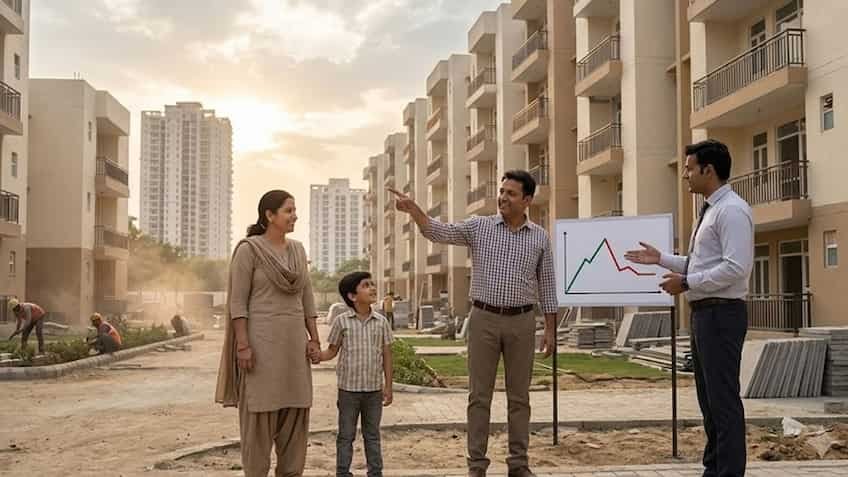
The race for luxury homes that has been going on for the last two years in the Indian real estate sector seems to be coming to a halt now. After the Corona epidemic, big builders concentrated on building super luxury and premium apartments priced between Rs 1.5 crore and more than Rs 5 crore, ignoring middle-class buyers. But now with inventory pressure increasing and sales slowing down in the premium housing segment, real estate developers have been forced to change their strategy. According to the latest market reports from the country’s leading property consultants and industry bodies, builders have once again started prioritizing the demand of India’s largest consumer segment, the middle class. According to the latest data for the current calendar year 2026, in the top 7 to 8 major metros of the country, almost 100 percent i.e. double increase has been recorded on an annual basis in the new launches and supply of affordable and mid-segment houses priced below Rs 40 lakh.
In the last two years, there was a tremendous boom in the ultra-luxury segment on the basis of stock market boom and corporate profits. But now market analysts believe that the premium segment has reached a ‘saturation point’. Due to sky-high prices, rising home loan EMIs and profit-booking by investors, the sales growth rate of flats above Rs 1.5 crore has slipped from 25-30% to single digits. Unsold inventory (unsold flats) of ready and under-construction luxury projects has started piling up in big cities, due to which the working capital of developers started getting stuck. Builders have understood that more than 70 percent of the country’s actual domestic demand (End-User Demand) comes from the middle class and working class, whose total budget is limited to between Rs 30 lakh to Rs 45 lakh. This is why top developers have changed the direction of their projects and have started launching new phases of compact 2BHK and affordable 1BHK units on a large scale.
According to data from real estate research firms, while in the previous quarters the share of affordable housing in total new residential launches had declined to just 15 to 18 percent, now this share has increased to beyond 32 to 35 percent. There are three major factors behind the doubling of supply of houses up to Rs 40 lakh:
-
Government Policies and Withdrawal of Subsidy: With the Central Government giving fresh impetus to the interest subsidy scheme under Pradhan Mantri Awas Yojana (PMAY Urban 2.0) and State Governments relaxing stamp duty and land approval norms on affordable housing, the cost of these projects has become viable for builders.
-
Compact and Smart Layout: Developers have created super-optimized and smart 2BHK designs of 550 to 750 sq. ft. instead of large and bulky flats. This is resulting in more units being created at lower land costs, putting the final selling price squarely in the range of Rs 35 to 40 lakh.
-
Expansion of Peripheral Expressways and Connectivity: The expansion of the Metro and the opening of the Outer Ring Road and Expressways have made affordable land available in the outer suburbs of cities, leading to builders bringing up gated township projects with full modern amenities at low costs.
If seen regionally and geographically, the impact of this change is clearly visible in major cities from North India to Western India:
-
Delhi-NCR: New township projects with budgets ranging from Rs 30 to Rs 40 lakh have been launched rapidly in Greater Noida West (Noida Extension), early sectors of Yamuna Expressway, Rajnagar Extension in Ghaziabad and Sohna Road (Gurugram Extension).
-
Uttar Pradesh and Lucknow: A huge supply of 2BHK apartments and row-housing has been launched by LDA and private promoters on Kisan Path (Outer Ring Road), Sultanpur Road, Mohan Road Yojana and Kanpur Road corridor of Lucknow in the range of Rs 30 to Rs 45 lakh for middle class families.
-
Mumbai MMR and Pune: There has been a huge surge in the sales of compact homes in Mumbai’s Mira-Bhayandar, Kalyan-Dombivli, Navi Mumbai’s Taloja and Panvel, while new supply of budget housing for IT and auto employees has been launched in Pune’s Wagholi, Hinjewadi Phase-3 and Chakan Belt.
This change is proving to be the biggest boon for middle class families. If a family buys a house worth Rs 40 lakh and makes a down payment of 20% i.e. Rs 8 lakh, then it has to take a home loan of Rs 32 lakh. Its monthly EMI for 20 years at an average bank interest rate of 8.5% works out to be around ₹27,700. In metro and semi-metro cities, where the typical monthly rent for a 2BHK has reached Rs 18,000 to Rs 22,000, families are becoming owners of their own homes by just adding Rs 5,000 to Rs 8,000 extra to the rent. Property experts say that the demand for affordable housing is going to be at its peak in the upcoming festive season and New Year, due to which the dream of ‘own house’ of lakhs of middle class families living in rented houses for a long time will come true.