 look news india

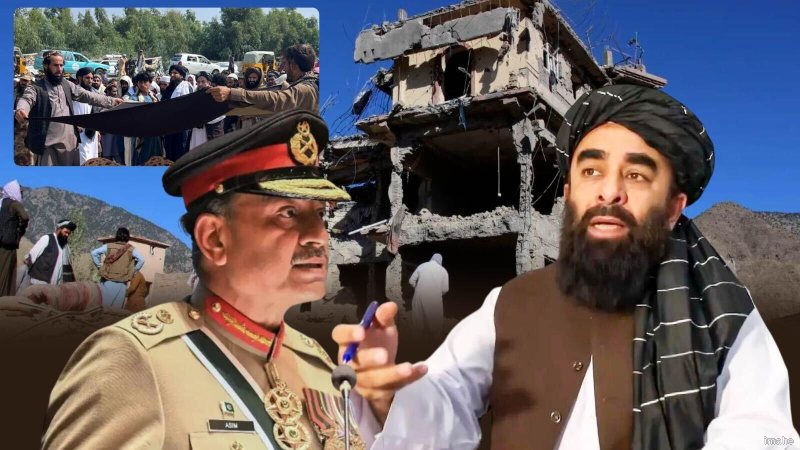
The era of diplomacy and bitterness between neighboring countries is not new, but at present the ongoing tension between Afghanistan and Pakistan has reached a very dangerous point. The ruling Taliban regime in Afghanistan has made very serious and sensational allegations against the Pakistan Army and its top leadership. Official spokespersons and senior officials of Taliban say that Pakistani Army Chief General Asim Munir and the government there are constantly looking for excuses to retreat from the ‘Mecca Pact’ made at the international level i.e. peace agreements and agreements made between Islamic countries. To fulfill its nefarious agenda and divert the attention of the people of the country from its internal political and economic plight, the Pakistani army is deliberately carrying out military attacks on the Afghan border and fueling tension between the two countries.
According to experts, some important religious and diplomatic agreements were agreed upon in the holy city of Mecca in Saudi Arabia to reduce mutual tension between the two countries and to establish peace in the border areas, which is known as Mecca Pact. The main objective of these agreements was to promote regional stability and restore mutual trust between the two neighboring countries. However, Pakistan’s army and intelligence agency ISI never want real peace in the region because a large part of the power there earns its political bread on the basis of anti-India and anti-Afghanistan agenda. The Taliban allege that as pressure increased on Pakistan to fulfill its commitments under the Mecca Agreement, the Pakistani Army shirked its responsibilities by launching unprovoked cross-border firing and airstrikes to completely derail the peace process.
At present, no corner of the world is untouched by the serious economic and political crisis that Pakistan is going through. Inflation within the country is skyrocketing, the Pakistani rupee is continuously weakening and the voices of rebellion are increasing in provinces like Balochistan and Khyber Pakhtunkhwa. To hide its domestic failures, the Pakistani Army has always been looking for an external enemy. The Taliban has exposed the policies of General Asim Munir and said that the Pakistani Army always tries to blame the Afghan Taliban for its failures. Whenever the people of Pakistan come out on the streets for their basic needs, the army creates a war-like situation by increasing the tension on the border so that in the name of nationalism, public attention can be diverted and military rule can be maintained.
For the last few months, violent clashes are being witnessed continuously in the areas around the border of Pakistan and Afghanistan i.e. Durand Line. Many innocent civilians and children have lost their lives in the bombing by Pakistani fighter planes inside the Afghan border, which has filled the minds of Afghan citizens with immense anger and hatred towards Pakistan. The Taliban administration has bluntly warned on international forums that if Afghanistan’s sovereignty and territorial integrity are again attacked, an appropriate and strong response will be given. Such military conflicts are not only putting the peace of South Asia in danger, but the lives of millions of common people living in the border areas have also become hell, who are forced to live amidst the sound of bullets and bombs all the time.
The most worrying thing in this entire incident is that the United Nations and other major global powers seem to be avoiding taking the expected and tough stance on this regional tension. Pakistan, which has become infamous as a sponsor of terrorism, is playing the old trick of gaining world sympathy by portraying itself as a victim, but now after these sharp and frank revelations of Taliban, the real face of Pakistan has been exposed in front of the international community. Geopolitical experts believe that if global organizations do not stop these military activities of Pakistan in time, then this dispute can take the form of a major regional war, due to which the stability of the entire Central Asia and South Asia can be at stake. Pakistan should understand that its internal problems are not going to be solved by forcible attacks and running away from agreements, rather it will lead to its further downfall at the global level.