 look news india

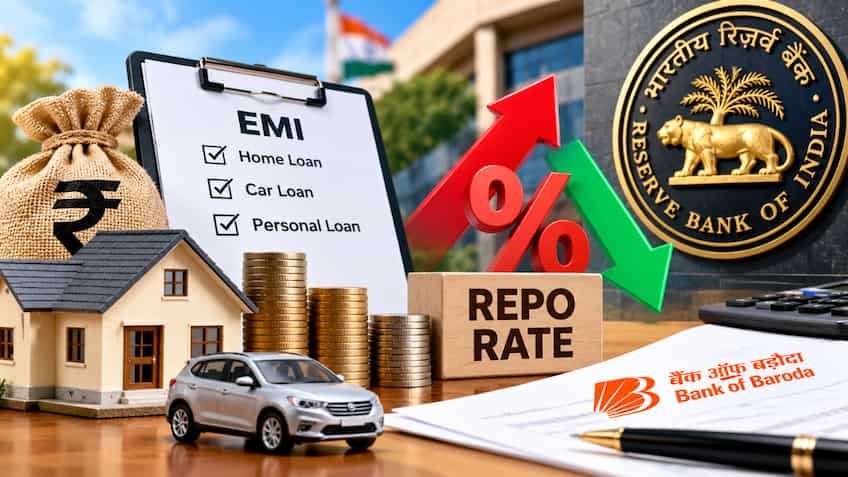
With the start of the bi-monthly review meeting of the Monetary Policy Committee (MPC) of the Reserve Bank of India (RBI), only one question is floating in the minds of crores of home loan, car loan and personal loan holders of the country – is their bank EMI going to increase from next month or will there be a cut in it? Amidst this chaos, the latest analysis report released by the Economic Research Department of the major government bank ‘Bank of Baroda – BoB’ has given very important indications regarding the future of interest rates. According to economists of Bank of Baroda, the series of rate cuts seen in the previous quarters has come to an end for the time being. The report clearly assesses that in view of retail inflation, fluctuations in food prices and uncertainties in global crude oil, there is little possibility of any new rate cut by the central bank in the near future. This simply means that common borrowers should not expect any immediate reduction or relief in EMIs.
It has been underlined in the economic report of Bank of Baroda that the central bank can keep the policy repo rate unchanged at the level of 5.25% in this monetary review of October. However, the report also strongly cautioned that if food inflation and unseasonal rains impact crop production in the coming months, the door is wide open for a possible 25 basis point (0.25%) rate hike in the latter half of the fiscal year. Market analysts believe that in view of the festive season, RBI may avoid taking strict steps to make loans expensive, but if the inflation rate remains above 5%, then it may become a compulsion for the central bank to move the interest rates upwards in future. Therefore, the most favorable scenario for borrowers is that their EMIs remain stable at the current level, while there currently appears to be no basis for a reduction.
If the RBI increases interest rates by 25 basis points (0.25%) in future, the External Benchmark Lending Rate (EBLR/RLLR) of commercial banks will immediately increase by the same amount. Let us understand with a practical example how this will impact 20-year home loans of ₹30 lakh and ₹50 lakh:
-
Home Loan of ₹30 Lakh (Tenure 20 Years): If your current interest rate is 8.50%, your monthly EMI works out to be around ₹26,035. If Bank of Baroda or other banks increase your rate to 8.75% after the repo rate increase by 0.25%, your EMI will increase to approximately ₹26,511. That means there will be an additional interest burden of ₹ 476 every month and approximately ₹ 1,14,240 in full 20 years.
-
Home Loan of ₹50 Lakh (Tenure 20 Years): The EMI for a loan of ₹50 lakh at an interest rate of 8.50% is ₹43,391 per month. After the increase of 0.25% (8.75%), this EMI will increase to ₹44,186 per month. That means there will be a direct increase of ₹ 795 every month, due to which an additional amount of more than ₹ 1.90 lakh will have to be paid as interest in the total loan tenure.
Whenever banks increase the interest rates on floating rate home loans, they usually do not immediately change the monthly EMI amount of the customer. Instead, banks extend the loan tenure by 12 to 24 months, so that there is no immediate blow to the customer’s monthly budget. But this arrangement proves to be even more harmful for the borrower in the long run, because as the tenure of the loan increases, the cycle of compounding interest becomes many times larger. For example, in a 20 year loan, if the rates increase by 0.50% and the EMI is not increased, the total loan tenure may extend from 20 years to 23 to 24 years. Therefore, financial experts advise that whenever banks increase the interest rate, instead of prolonging the tenure, get your EMI amount partially increased so that the loan can be repaid on time.
In the report of Bank of Baroda, borrowers have been specially advised to check their loan category. If your home loan is after October 2019 and is directly linked to the repo rate (RLLR/EBLR), the impact of any RBI decision will be visible on your account within a few days. On the other hand, for old customers whose loans are running on MCLR (Marginal Cost of Funds based Lending Rate) or base rate, the impact is not immediate on them but the new rates are applicable only at the time of their ‘reset clause’ of 6 months or 1 year. If an old customer’s loan is running at a higher MCLR, he can transfer his loan to Repo-Linked Lending Rate (EBLR) by paying a nominal switching fee to maintain transparency.
In this era of stagnation and possible increase in interest rates in future, home loan customers should adopt a disciplined strategy. First, check your current interest rate and reset date in your bank statement and loan letter. Second, if you have any additional funds coming in from bonus, PF or savings, aim to deposit 5 to 10 percent of your principal as prepayment every year. By paying just one additional EMI every year, the 20-year home loan gets retired in just 16 to 17 years, resulting in direct savings of lakhs of rupees in additional interest. Until the official monetary policy stance of the Reserve Bank is fully clarified, it would be prudent to stay away from any new expensive unsecured loans (such as personal loans or credit card loans).