 look news india

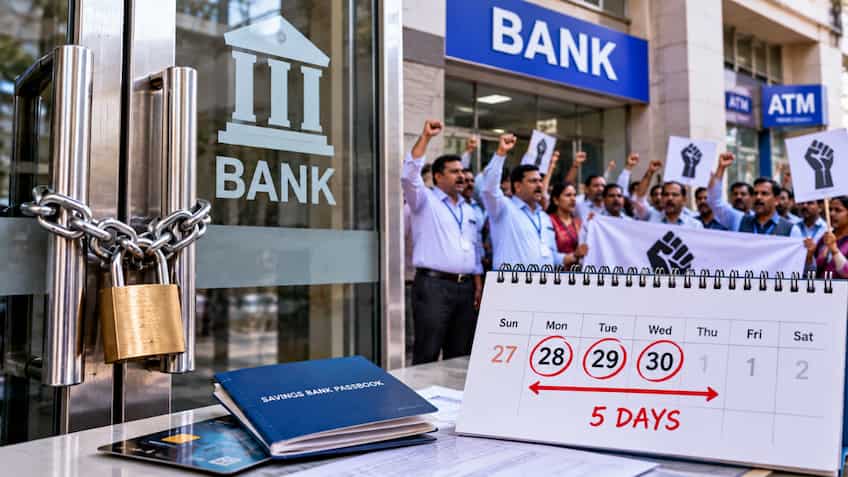
The work in government and regional rural banks (RRBs) across the country has once again reached the verge of massive shutdown. Bank employees and officers are going on a three-day nationwide strike from September 28 to September 30 on the call of the United Forum of Bank Unions (UFBU). Immediately preceding this three-day strike, 26 September is an official bank holiday being the fourth Saturday and 27 September is a weekly holiday on Sunday.
Due to strike of employees from Monday to Wednesday after Saturday and Sunday, direct banking services in the branches will be affected for 5 consecutive days. The most serious thing is that September 30 is the last day of Half-Yearly Closing of the current financial year. On this day, many important works like reconciliation of accounts, provisioning and financial market take place, which can be completely disrupted due to this strike.
Bank employees mainly had two major demands. The first demand is to declare all Saturdays as official holidays and implement ‘5-day work week’ (5 Day Banking). The second demand was regarding the withdrawal of the Performance Linked Incentive (PLI) Scheme, regarding which the employees alleged that only top officials were being given benefits in it. In view of the opposition from the bank unions, the government has currently postponed the PLI scheme (In Abeyance) and has called it a big step on its part.
Despite this, no path for reconciliation could be found between the two parties. The Finance Ministry says that a major demand of the employees has been accepted and 5-day banking is being considered, hence the employees should postpone the strike. However, bank unions argue that 5-day banking was agreed upon with the Indian Banks Association (IBA) months ago and the file is pending with the government. Union leaders clearly say that mere assurances will not work, their agitation will not stop until the government issues an official notification of 5-day working.
Bank unions say that they are not demanding leave without work. In the bilateral agreement with IBA, it was clearly stipulated that if all Saturdays are given holiday, the bank employees will work 40 to 45 minutes extra daily from Monday to Friday, which will not lead to any reduction in the total working hours.
Employees argue that the corporate sector, IT companies, RBI and even the stock market work only 5 days a week. In the last few years, the workload in banks has increased manifold, due to which severe mental and physical stress is being seen among the employees. In such a situation, 5-day working has become mandatory to maintain work-life balance. He also says that today more than 80% of the transactions have been shifted to digital platforms, so the closure of branches on Saturday will not have a major impact on normal life.
On the other hand, the stance of the Central Government and the Finance Ministry is quite cautious in this matter. The government believes that banking is not just a corporate job, but a sector related to the basic public service of the country. In 2015, the second and fourth Saturdays were declared holidays, while arrangements were made to continue business as usual on the first, third and fifth Saturdays so that working people could complete their bank work over the weekend.
The main concern of the government is that a large number of people in rural and semi-urban areas are still physically dependent on branches for cash withdrawals, payments for government schemes and other formalities. If branches were closed on all Saturdays, the pace of rural banking and financial inclusion could be affected. Apart from this, during the closing period on 30th September, the strike is expected to have a direct impact on international banking, foreign exchange market and government tax collection.
If bank branches remain locked from 28th to 30th September, common customers may have to face a lot of trouble. At the branch level, work like check clearance, issuing new check books or passbooks, making DD (demand draft), large scale cash deposits and withdrawals and KYC updation will come to a complete halt. Due to non-clearing of checks, the risk of check bounce for businessmen can also increase.
It is a matter of relief that digital banking services will remain unaffected during the strike. UPI, internet banking, mobile banking app and ATM network will continue to operate as normal. However, closure of branches for 5 consecutive days can definitely lead to cash crunch in busy ATMs of cities. Therefore, many banks including SBI and Union Bank have advised customers to complete their important work before 26th September. If no agreement is reached even after this strike, the unions have also warned of going on an indefinite strike from October 26.