 look news india

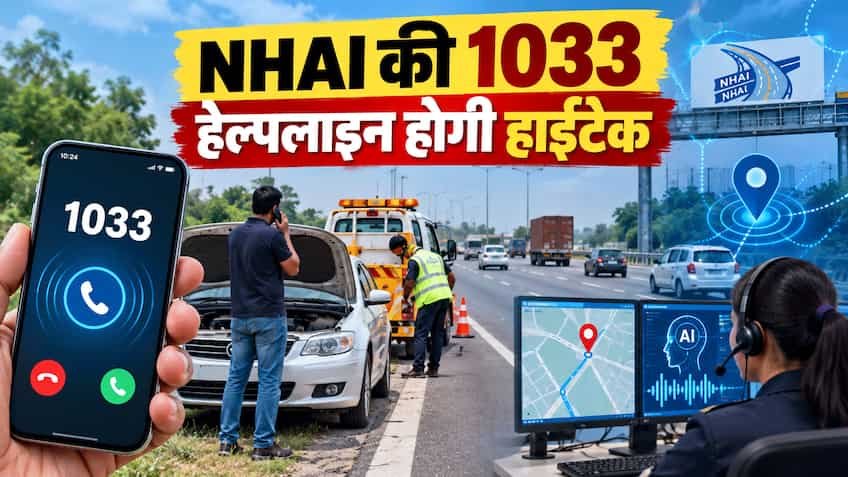
The Ministry of Road Transport and Highways has started a new chapter of safety and quick assistance for crores of passengers, heavy vehicle drivers and daily commuters traveling on the national highways and expressway network of the country. National Highways Authority of India (NHAI) has formally announced to make its prestigious 24×7 emergency helpline ‘1033’ completely modern and hi-tech. Launched in 2018, the 1033 helpline currently covers more than 1.46 lakh kilometers of national highways across the country and receives an average of more than 15,000 emergency and inquiry calls every day. However, in case of any unpleasant road accident, medical emergency, tire burst or sudden stoppage of the vehicle on the highway, the biggest challenge faced by the victims was that they were unable to explain their exact location in panic. Precious time was wasted in searching for the name of some milestone or dhaba nearby. To root out this serious problem, NHAI, through its subsidiary ‘Indian Highways Management Company Limited’ (IHMCL), has now started a comprehensive plan to add cutting-edge Artificial Intelligence (AI), real-time GPS location tracking and state-of-the-art emergency response system to the 1033 helpline.
After the implementation of the new technological framework, any person traveling on the highway will not need to remember how many kilometers ahead or behind which toll plaza he is to seek help. As soon as a passenger dials 1033 from his mobile phone, the system’s integrated caller location tracking technology will capture the caller’s geographical location (Latitude and Longitude) in real-time through the telecom network and GPS. Along with this, ‘Voice AI’ and advanced Indian language speech recognition technology is being incorporated in the next-generation platform to overcome the language barrier in a multilingual country like India. If a person speaks in a nervous voice in any local language or dialect like Hindi, English, Tamil, Telugu, Bengali, Marathi or Bhojpuri, the AI engine of the system will immediately process the words and tone and understand what kind of incident is happening. This will immediately decide whether the caller needs medical assistance (Ambulance), Towing Crane (Hydraulic Crane), Fire Brigade or only patrolling vehicle.
In road safety and trauma care, the first 60 minutes after a serious accident is called the ‘Golden Hour’. Getting timely medical help to the injured during this period decides the difference between life and death. The 1033 system being modernized includes a ‘Computer-Aided Dispatch’ (CAD) module. This simply means that as soon as the caller’s location and problem is recorded, the operator will not have to waste time thinking about the screen; The system itself will track the route of the nearest highway patrolling team, nearest deployed NHAI ambulance and tow-crane. The software will send the exact location of the injured or victim to the tablet or navigation device of the nearest rescue van at a single click. This will reduce the ‘Turnaround Time’ (TAT) between receiving the call and the departure of the assistance van on the highway from minutes to seconds, thereby saving countless lives in time.
Too often the overuse of technology creates a fear that machine responses cannot replace human sensitivity. NHAI has taken special care that the new system will not be completely machine-dependent, but it will be a hybrid model of ‘AI and human expertise’. The architecture of the new call center is being designed in such a way that as soon as the call comes, AI will identify primary data like phone number, location, category of immediate crisis and language and keep it ready on the backend screen. After this the call will be immediately transferred to a trained human operator. The operator will speak to the caller in a very sensitive tone, console the panicked family and assess the on-ground situation with human discretion. Along with this, through this system, information about long jams on the highway, sudden landslides, bad weather, dense fog or repair work on any bridge will also be given to the passengers through real-time SMS or audio alerts so that they can choose alternative routes for further travel.
To get this ambitious project off the ground, NHAI promoted company IHMCL has invited Expression of Interest (EOI) at global and national level. Under this EOI, consortia and tech companies having expertise in software development, digital cloud platforms, 24×7 call center operations and emergency response services have been invited. NHAI has specifically encouraged modern tech giants working in the mobility, ride-hailing (cab aggregators), quick commerce, public safety and logistics sectors to participate in this tender process. The government’s vision is to make highway emergency services as accurate and ultra-fast as a large quick-delivery or modern cab network, with real-time movement of every ambulance and patrol vehicle tracked live on GPS screens.
Uttar Pradesh has become the center of the country’s largest expressway and national highway network. Lakhs of vehicles travel daily on the new 6-lane expressway being built between the capital Lucknow and Kanpur, Lucknow-Ayodhya-Gorakhpur Highway (NH-27), Delhi-Meerut Expressway, Agra-Lucknow Highway and Prayagraj-Varanasi route. This hi-tech 1033 helpline will prove to be a life-saving boon for the travelers of Uttar Pradesh and surrounding states when the vehicle’s axle breaks, petrol runs out or an accident occurs on a deserted highway at night or during dense fog. Apart from this, problems related to FASTag, illegal collection at toll plaza, barrier not opening or wrong toll deduction can also be resolved in a jiffy through this integrated 1033 helpline. As soon as the new system goes completely live, the country’s highways will become world class not only in speed but also on international safety standards.