 look news india

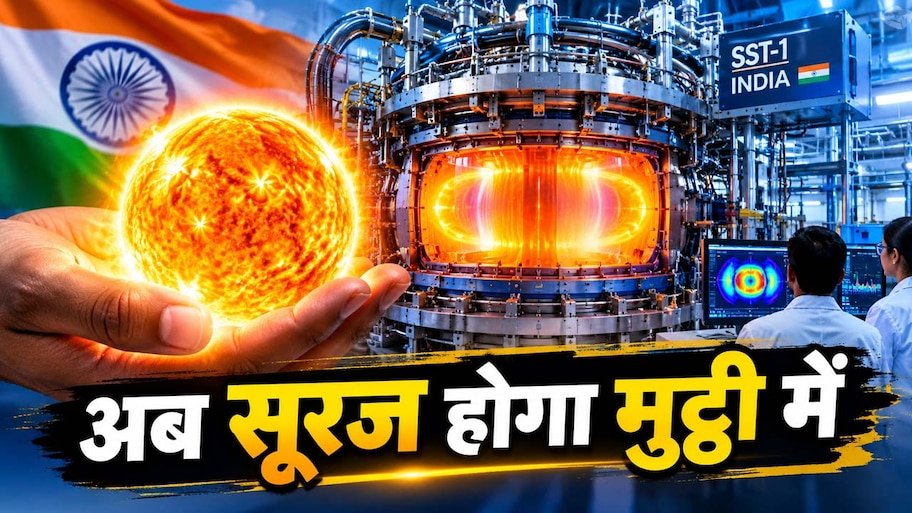
India has embarked on the most complex mission in science to become the world leader in energy and to secure a treasure trove of unlimited, clean energy for future generations. India is now taking decisive work towards creating its own ‘Artificial Sun’ on Earth. Often a question arises in people’s mind that what is the real meaning of creating sun on earth? Actually, this is not a ball of fire, but the scientific technique of ‘Nuclear Fusion’ through which the sun and stars in the universe, millions of kilometers away, have been shining continuously and generating energy for billions of years. At present, conventional nuclear power plants around the world work on the principle of ‘Nuclear Fission’, in which heavy atoms of uranium are broken. There is a huge risk of radioactive waste and fatal accidents like Fukushima or Chernobyl. In contrast, nuclear fusion involves combining lighter atoms of hydrogen (deuterium and tritium) together at extremely high temperatures and pressures, releasing helium gas and immense amounts of energy. India’s Institute for Plasma Research (IPR), located in Gandhinagar, Gujarat, is working day and night to bring this indigenous technology to the ground.
Whenever there is talk of artificial sun, China’s ‘EAST’ (Experimental Advanced Superconducting Tokamak) is often in the headlines, which has made a record of controlling plasma at a temperature of millions of degrees Celsius. But very few people know that India is not behind any country in this scientific race. India has installed its indigenous Tokamak ‘SST-1’ (Steady State Superconducting Tokamak) and upgraded ‘Aditya-U’ reactor at the Gandhinagar based institute. A tokamak is basically a huge donut-shaped magnetic chamber, within which temperatures 10 times higher than the center of the sun—about 100 to 150 million degrees Celsius—are generated. No metal can survive such extreme temperatures, so the plasma is kept floating in the air using powerful superconducting magnets (magnetic fields). Indian scientists are now working on the design of ‘SST-2’ and the future full fusion power plant (Indian DEMO Reactor), with the aim not just to create records but to create a commercial model capable of providing sustainable power supply directly to the grid. On the basis of strong standards of technology and security, India is prepared to give a tough challenge to China in this race in the coming decades.
The biggest proof of India’s global threat is the ‘ITER – International Thermonuclear Experimental Reactor’ project being built in Cadarache, France. It is the largest and most expensive international scientific collaboration project in human history, in which India, the US, Russia, the European Union, China, Japan and South Korea are partners. India is not just a spectator or a common stakeholder in this mega project, rather it has proved its engineering prowess to the whole world by building its most important and huge part. India’s leading engineering company Larsen & Toubro (L&T) and Indian scientists have jointly developed the world’s largest ‘Cryostat’. Cryostat is a kind of giant vacuum refrigerator (thermos), which weighs more than 3800 tonnes and its size is almost as wide and high as Qutub Minar. This cryostat keeps the entire reactor’s 150 million degree Celsius hot plasma isolated from the space-like zero and minus 269 degree Celsius cold superconducting magnets. Without this ‘cooling shield’ and state-of-the-art vessels provided by India, this global dream of making the sun on Earth could never have become a reality.
The science behind this entire technology is extremely miraculous and completely in accordance with the laws of nature. In nature the sun radiates energy and light by fusing millions of tons of hydrogen every second. In scientific language, when deuterium extracted from sea water and tritium prepared from lithium collide with each other heated to more than 100 million degrees Celsius, a small fraction of the mass is transformed into unimaginable energy according to Albert Einstein’s famous equation $E=mc^2$. The most surprising thing is that the fuel required for the fusion process is present on Earth in almost unlimited quantities. From just 1 gram of deuterium-tritium fuel, as much energy can be obtained as is obtained by burning approximately 8 tons of coal or 11 barrels of crude oil. Furthermore, there is never any danger of the chain reaction going out of control in a fusion reactor and exploding. If for some reason the electrical or magnetic control fails, the plasma automatically cools down and shuts down within a few microseconds. It emits neither any poisonous carbon nor radioactive waste that rots for centuries, making it the safest option for energy.
Now the biggest and most direct question is that if this grand experiment is successful, what will be the benefit to the common citizen living in Lucknow, Delhi, Patna, Jaipur, Bengaluru or any small village-town? The simple answer is: End power crisis and expensive electricity bills forever. At present, power companies have to spend huge amounts on purchasing coal, paying rail freight and maintenance of thermal plants, the burden of which ultimately falls on the pockets of domestic consumers in the form of expensive rates of Rs 7 to 10 per unit. When fusion energy is connected to the grid, fuel costs will be almost zero. This will not only provide 24 hours uninterrupted electricity without any power cuts, but per unit electricity rates will fall to nominal or absolutely cheap. Every poor and middle class family in the country will not have to worry about bills for running air conditioners, heaters and home appliances. In the agricultural sector, farmers will not have to wait day and night for electricity to run tube wells for irrigation, which will bring a historic boost to the country’s food security and rural economy.
Every year with the arrival of winter in India, toxic smog and air pollution in North India, especially in the Gangetic plains, becomes a national disaster. A major cause of this pollution is thermal power plants burning to produce electricity, which release millions of tons of carbon dioxide, sulfur and poisonous ash into the air. Nuclear fusion is a zero-emission (zero carbon emission) energy source. Instead of smoke, only harmless water vapor and a little helium gas come out of its chimneys. When India makes its energy system fusion based, all the coal based plants in the country can be closed forever. Apart from this, future electric vehicles (EVs), metro trains and green hydrogen production plants will also be charged with this clean electricity. This means that we will get rid of the toxic fumes of petrol and diesel and the climate of the cities of the country will become completely clean and breathable.
From geopolitical and economic point of view, this experiment has the potential to make India the world’s biggest superpower. India imports more than 85 percent of its crude oil needs from Gulf countries and Russia, on which lakhs of crores of rupees of the country’s hard-earned money go out in the form of foreign exchange every year. Whenever there is war or tension in the Middle East, there is a fear of rising inflation in the country. The success of fusion energy will provide India with ‘Energy Independence’, due to which the country will not have to reach out to any other country for oil or gas. This huge remaining revenue can be used in the country’s infrastructure, health services, higher education and defense modernization. This scientific resolution of India will not only lay the foundation of a self-reliant India in the world of energy, but will also gift a pollution-free, prosperous and safe future to the coming generations.