 look news india

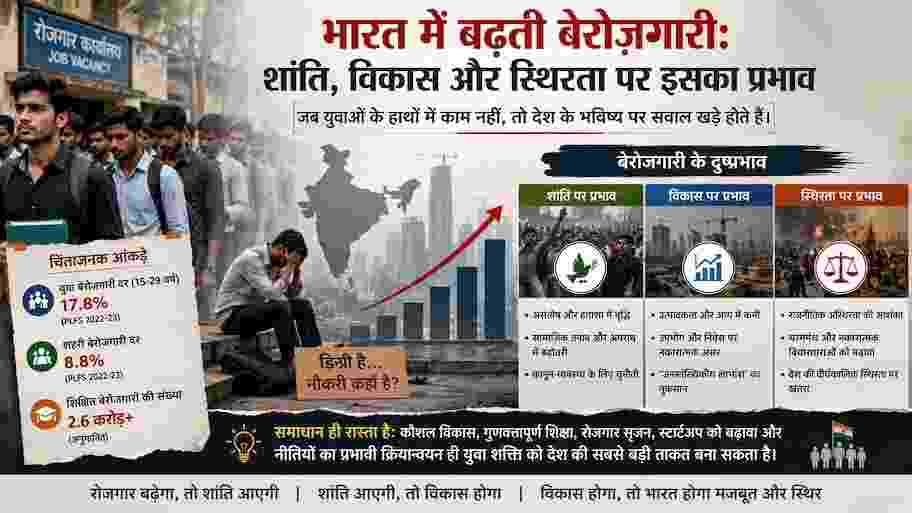
India is one of the fastest growing and shining economies in the world today. The country’s biggest USP on the global stage is its huge youth population, which in the language of economics is called “Demographic Dividend”. It is believed that if these crores of youth get adequate and right employment opportunities, they can make India a superpower economically and socially. But the other side of this golden coin is that continuously increasing unemployment has become one of the most serious and burning challenges facing the country today. This is not just a general economic problem, but it is having a direct and deep impact on the country’s social peace, pace of development and national stability.
First attack on social peace: Increasing dissatisfaction and disappointment among the youth
The first and most lethal effect of unemployment is on the fabric of our society. For any person, employment is not just a means of earning money, but it also gives him respect in the society, confidence and a purpose to live. When lakhs of degree-holding, educated and qualified youths search for jobs for a long time and get disappointed, severe dissatisfaction and frustration sets in within them.
Due to financial constraints, daily distress and pressure increases within families. These circumstances later give rise to social tension, depression, drug addiction and even crimes. Although unemployment does not directly cause any riot or conflict, it definitely creates such a powder in the society, where even a small spark can spread great unrest.
Wastage of talent slows down economic growth, directly impacts industries
Increasing unemployment also slows down the wheels of the country’s economy. The real progress of any nation depends on how well it is using its human resources. When the country’s educated, engineers, doctors, management graduates and skilled youth sit idle, a huge intellectual and labor talent of the country gets completely wasted.
Due to this, the total production capacity of the country decreases, due to lack of money in people’s pockets, purchasing power in the market reduces, due to which the sales and growth of industries are badly affected. When there is a recession in the market, there is a huge decline in the tax revenue received by the government, due to which the pace of development slows down and creating new jobs becomes even more difficult.
Lack of coordination between education and industries: Every year lakhs of unemployed people are coming out of colleges.
The increasing gap between degree and actual job (Skills vs Degree) in India is a matter of biggest concern today. Every year lakhs of students pass out from schools, colleges and universities of the country with degrees, but a large part of them do not get work as per their qualifications.
The main reason for this is that there is no coordination between our old education system and the changing needs of today’s modern industries. Today is the era of Artificial Intelligence (AI), digital economy and automation, where rote theory does not work. In this era, providing youth with skill-based education, vocational training, coding, digital skills and promoting entrepreneurship to start their own startup has no longer become an option but the biggest need.
Migration from villages to cities: expansion of the informal sector and slums
The situation of unemployment in rural India is even more serious and worrying. Most of the families living in rural areas of the country are still dependent on traditional farming, where employment is completely dependent on seasonal unemployment and the weather. Due to severe lack of big industries, manufacturing units and new options in villages, every year lakhs of people are forced to leave their homes and migrate to cities.
Due to this indiscriminate migration, the population pressure on big cities like Delhi, Mumbai, Bengaluru reaches dangerous levels. In cities, the burden on basic amenities (water, electricity, sewerage) increases, slums expand rapidly and there is a compulsion to work in unsafe and difficult conditions at very low wages in the informal sector.
The first condition of national stability is equal opportunity and economic security.
The internal security and stability of any democratic country depends on whether its citizens are getting equal opportunities and a dignified life or not. If the youth of the country start feeling cut off from the mainstream of development, then their trust in the system and government institutions begins to break. Therefore, creating employment on a large scale is not just an economic agenda, but it is the first and essential condition for maintaining the integrity of the country, national unity and social stability.
To deal with this great crisis, the government, private sector and educational institutions will have to come to one table. Crores of jobs can be created simultaneously only by promoting labour-intensive sectors like manufacturing, agro-based industries, tourism, healthcare, green energy and MSMEs. India’s youth power is the biggest capital of the country, and if this unlimited energy gets the right direction, skill and work at the right time, then no one can stop India from becoming the world’s number-1 economic superpower.